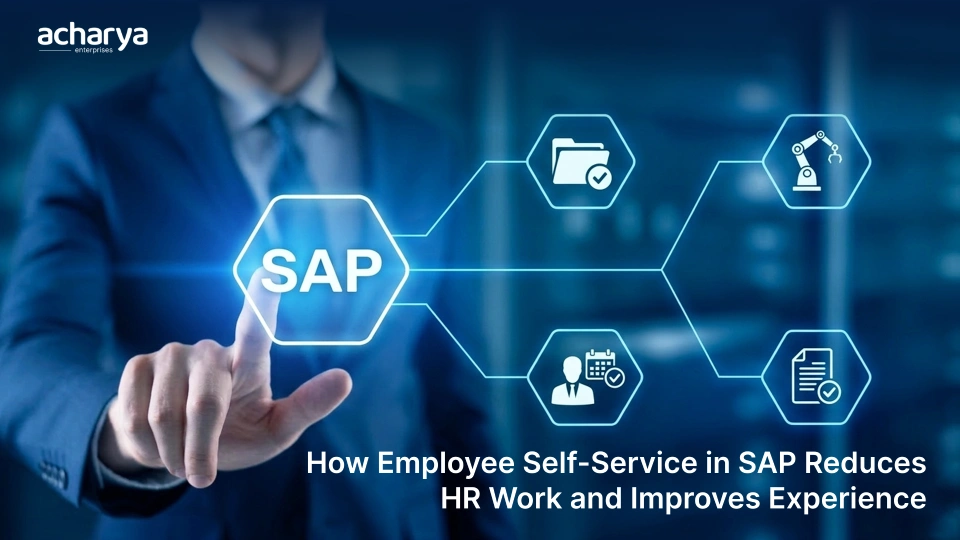
How Employee Self-Service in SAP Reduces HR Work and Improves Experience
What Employee Self-Service in SAP Really Means (And Why It’s More Than a Portal)
Employee self-service in SAP gives employees and managers the ability to complete everyday HR tasks themselves, without waiting for someone in HR to do it for them.
That sounds simple. In practice, it changes how HR operates entirely.
Employee Self-Service (ESS) covers tasks that individual employees handle themselves: updating personal details, requesting leave, downloading payslips, accessing HR letters, and submitting claims.
Manager Self-Service (MSS) covers tasks that people managers handle: approving leave, reviewing team absences, submitting hiring requests, processing promotions, and completing performance actions.
Both are available inside SAP SuccessFactors, SAP HCM, and SAP Fiori apps on web and mobile, accessible from anywhere.
One thing worth clarifying: self-service is not HR pushing its workload onto employees. It is giving employees direct access to things they have every right to handle themselves, faster and without a bottleneck in the middle.

Why HR Teams Get Buried in Requests
Most HR teams spend a large portion of every week handling requests that should not need HR involvement at all.
The pattern is familiar:
- An employee emails HR asking for a salary certificate
- HR finds the right template, fills it in, gets it signed, and sends it back
- Meanwhile three more emails arrive asking the same thing
The hidden cost of this is not just time. It is context switching, missed SLAs, delayed responses for employees who need documents urgently, and HR professionals spending hours on administration instead of work that actually requires human judgment.
SAP SuccessFactors research published for 2026 confirms that organizations increasingly expect self-service and AI-assisted workflows to significantly reduce HR-related tickets and queries, and that HR’s strategic role grows when transactional work is automated.
Self-service solves this by automating the routing, validation, and notifications behind common requests. Policies are built into the workflow. Approvals follow the right path automatically. Employees get answers without waiting.
The Core Employee Self-Service Use Cases That Deliver Immediate Value
These are the workflows that reduce HR workload fastest:
- Personal data updates: contact information, bank account details, emergency contacts, and dependent records updated by the employee directly
- Time off requests: leave balances visible in real time, requests submitted and approved through the system, holiday calendars always current
- Payslips and tax documents: downloaded on demand, any time, from any device, with no more payroll email queries
- HR letters and documents: salary certificates, NOC letters, and employment confirmations generated and delivered without HR manually drafting each one
- Benefits enrollment: guided selections, evidence uploads, deadline reminders, and enrollment confirmation all in one place
- Claims and reimbursements: submission with attachments, automatic routing for approval, and status tracking without chasing
- Onboarding tasks: profile completion, document submission, equipment requests, and readiness checklists before day one
- Policy access: one searchable, current source of truth so employees stop emailing HR to ask basic questions
Manager Self-Service That Cuts Escalations
Managers are often the approval bottleneck in HR processes. When approvals live in inboxes, they get delayed, lost, or forgotten.
Manager self-service through SAP brings every action into one managed workspace:
- Leave and expense approvals with delegation options when managers are unavailable
- Team dashboards showing absences, headcount, and key dates at a glance
- Hiring requests submitted directly through the system with proper approval flows
- Performance check-ins, feedback, and review sign-offs handled without back-and-forth emails
- Compensation inputs and approval workflows with full audit trails
- Organizational changes such as transfers, promotions, and reporting line updates processed with effective dates and automatic data propagation
When managers can complete these actions in a few clicks from their phone, the approval cycle shrinks from days to hours.
How Self-Service Reduces HR Work in Real Terms
The reduction in HR workload from self-service is visible and measurable across several areas.
Fewer repetitive tickets drop first. Leave queries, payslip requests, and document letters disappear almost immediately after launch because employees can handle them independently.
Less manual data entry follows because validations built into the forms prevent incomplete or incorrect submissions from reaching HR.
Email chains disappear when the system sends automated status notifications. Employees can see where their request stands without contacting HR to ask.
Approval cycle times drop because the system follows up automatically. Approvers receive reminders. Overdue items escalate on schedule, not when someone remembers to chase.
Compliance becomes cleaner because every action creates an audit trail. Instead of searching inboxes to reconstruct what happened, HR and auditors can review a complete, timestamped record.
Reporting improves because volume, category, resolution time, and bottlenecks are now visible, not hidden across inboxes and spreadsheets.
How Self-Service Improves Employee Experience
The employee experience impact is just as significant as the operational one.
Employees across UAE organizations in government, healthcare, logistics, and manufacturing often have very different working patterns. Field teams, shift workers, and frontline staff cannot easily contact HR during business hours.
Self-service changes this:
- 24/7 access on web and mobile means requests do not wait for office hours
- Transparency means employees can see the status of every request without following up
- Consistency means the same process works every time, regardless of who in HR is on duty
- Fewer errors in payroll, leave balances, and personal records build confidence in the system over time
- Inclusion means a warehouse employee in Jafza gets the same experience as a corporate employee in DIFC
When HR spends less time processing routine requests, more time becomes available for conversations that actually need a human: performance concerns, career development, and sensitive employee situations.
What Makes SAP Self-Service Actually Work
Poor self-service design drives low adoption and pushes employees back to emailing HR. These principles separate implementations that work from those that struggle.
Start with the highest-volume, lowest-complexity workflows. Leave requests, payslip access, and HR letters are the quickest wins with the broadest impact.
Keep forms simple. Fewer fields, smart defaults, and guided steps reduce friction. If completing the form takes longer than emailing HR, employees will choose the email.
Build policy into the flow. Eligibility rules, required attachments, and approval routing should be automatic, not explained in a manual that nobody reads.
Make approvals effortless. Role-based routing, delegation for absences, and automatic reminders keep approvals moving without manager intervention.
Design for mobile first. UAE workforces are mobile-heavy. Leave requests, approvals, and document downloads need to work cleanly on a phone.
Use plain language. Clear labels, short help text, and simple confirmation messages reduce errors and support queries.
Support a diverse workforce. UAE organizations employ people from dozens of nationalities. Accessible, clear interfaces reduce friction across the board.
Security, Privacy, and Governance
Self-service expands access, which means security must be designed carefully from the start.
Key controls to build in:
- Role-based access: employees see their own data, managers see their direct teams, HR sees what their role requires and nothing more
- Sensitive data handling: bank account numbers, passport copies, medical notes, and salary information must be protected with field-level permissions and secure document storage
- Audit logs: every data change, approval, and document access is recorded with a timestamp and user identity, which is essential for UAE PDPL compliance and internal audits
- Segregation of duties: managers cannot approve their own requests, and HR administrators cannot make data changes without a second approval where required
- Single sign-on: employees access self-service through the same corporate identity they use every day, reducing password risk without adding friction
- Data retention: documents are retained according to policy and deleted when no longer needed, reducing legal and privacy exposure
A Practical Rollout Roadmap
Rolling out self-service in phases reduces risk and builds adoption momentum.
Discovery: Start by analyzing your actual HR request volumes by category. Understanding which requests arrive most often tells you exactly where to begin. Map the end-to-end workflow: who submits, who approves, what the policy is, and what documents are involved.
Design: Build forms, approval flows, and employee communications with real scenarios in mind. Test the form with someone who has never seen it before and time how long it takes to complete.
Configure and test: Build in SAP SuccessFactors with edge cases tested. What happens when the approver is on leave? What happens when an employee submits an ineligible request? Both scenarios need clean handling.
Launch with support: Go live with clear communications explaining what changed and why, designated champions in each business unit, and accessible help for the first few weeks.
Measure and expand: Track adoption, ticket volume by category, and resolution time from week one. Use the data to prioritize what to build next. The key is to sequence future workflows around business value, not technical complexity.

KPIs That Prove the Value to Leadership
HR leadership and finance need to see tangible outcomes. These metrics tell the story:
- Ticket volume reduction by request category, tracked week-on-week and month-on-month
- Average resolution time compared to the pre-self-service baseline
- First-time right submission rate showing how often requests are rejected and resubmitted
- Employee satisfaction scores specifically for HR services
- HR hours reclaimed and redeployed to higher-value work
- Active user count, mobile usage share, and repeat usage rates
- Compliance metrics: audit findings, missing documents, and exceptions by category
These are not vanity metrics. They translate directly into cost reduction, compliance improvement, and measurable HR capacity freed for strategic work.
Common Pitfalls to Avoid
Most self-service rollouts that underdeliver share the same mistakes:
- Launching too many workflows at once and overwhelming users with change
- Building forms as complex as the paper they replaced
- Ignoring mobile experience for frontline and field teams
- Going live with poor master data, since broken leave balances and wrong org structures destroy trust immediately
- Building approval flows that do not match actual reporting relationships
- Communicating the launch as an IT release rather than an employee benefit
Your Self-Service Starter Checklist
If you want to move forward this week, here is where to start:
- List your top 10 HR request categories and pick the first 3 workflows to build
- Define the owner, approval chain, and policy rules for each workflow clearly
- Decide role-based access and document security rules for sensitive data
- Write a short, plain-language communication explaining what is changing and why it benefits employees
- Set your baseline KPIs now so you can demonstrate improvement within 30 to 60 days of go-live
Start With SAP Self-Service Experts in UAE
Acharya Enterprise implements SAP SuccessFactors Employee Self-Service for UAE organizations, from Employee Central foundations through to full self-service workflows, approvals, and mobile access.
Our self-service implementation services include:
- HR request analysis and workflow prioritization
- SAP SuccessFactors Employee Central configuration
- ESS and MSS workflow design and build
- Approval routing, delegation, and notification setup
- UAE compliance and PDPL-aligned data governance
- Mobile access configuration and user testing
- Change management, training, and adoption support
- Post-launch adoption measurement and workflow expansion
Contact Acharya Enterprise for a free HR self-service assessment. We will review your current request volumes and design a phased rollout that delivers fast, visible results.
About Acharya Enterprise
Acharya Enterprise is a UAE-based SAP services provider with consultants across 10+ countries, specializing in SAP SuccessFactors, S/4HANA implementation, SAP security, managed services, and HR cloud transformation.
Related services: SAP SuccessFactors UAE | Employee Central Implementation | SAP ESS MSS | SAP HR Cloud | SAP SuccessFactors Onboarding | SAP HR Workflow Automation | UAE SAP Consulting | SAP Managed Services | SAP HCM UAE | Employee Experience SAP | SAP SuccessFactors Modules