6 Revenue Leaks UAE Construction Companies Miss Without Proper SAP Implementation
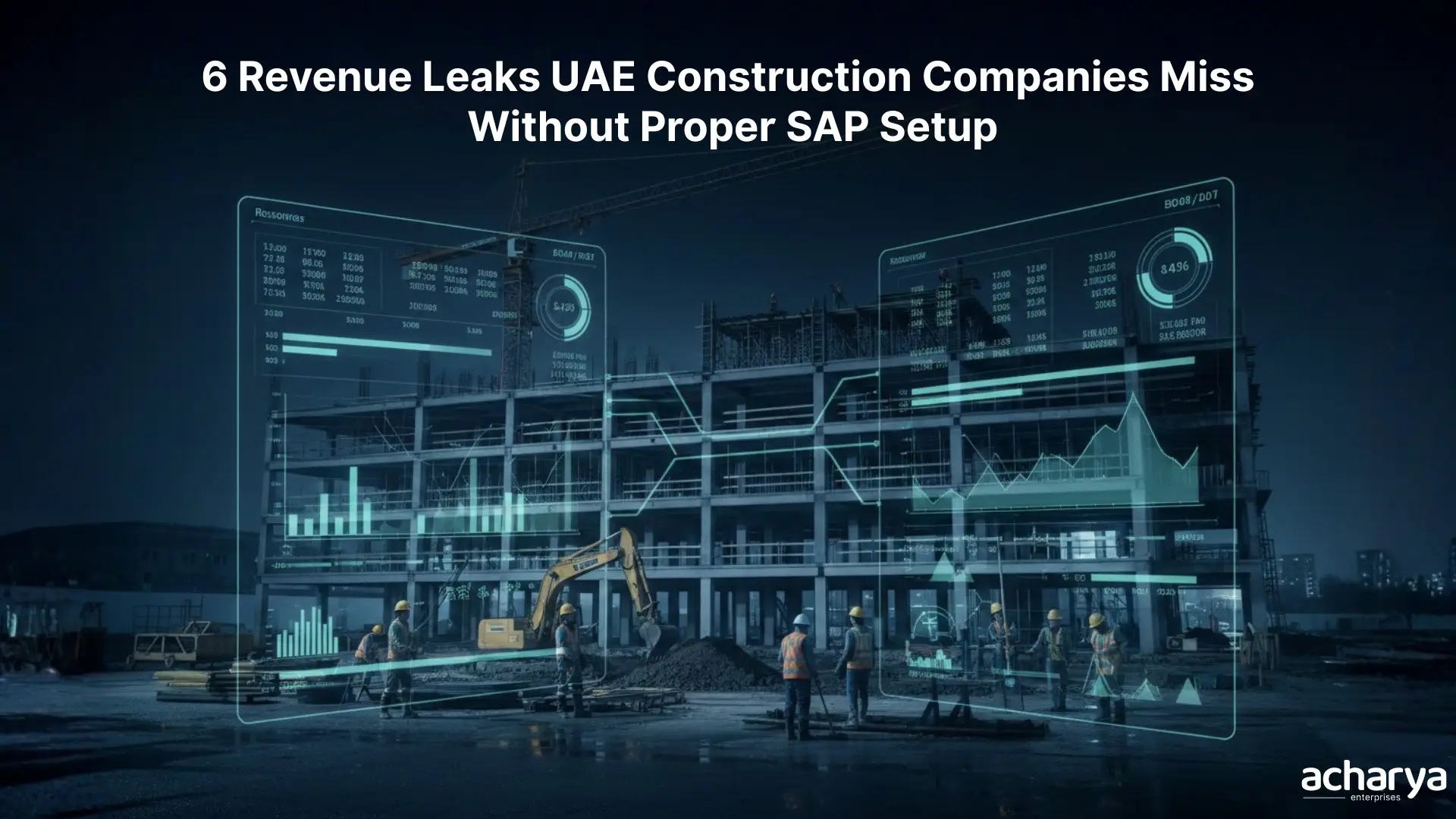
Revenue leaks UAE construction companies face are more common than most firms realize. Even profitable projects can quietly lose money through process gaps and poor visibility.
Construction margins in the UAE average just 3 to 6 percent net, where a single percentage point leak wipes out one third of total profit. A proper SAP Implementation closes these gaps by connecting site data, billing, and contracts into one system that protects every dirham earned.
Revenue leaks UAE construction companies face without SAP Implementation
Six revenue leaks UAE construction companies face are underbilling, lost change orders, contract non compliance, manual data errors, disconnected systems, and delayed approvals.
Resources: SAP for Construction Industry | Revenue Leakage Solutions | Construction Project Management
- Underbilling and missed work tracking
Many contractors complete more work than they actually bill for. Incomplete site reporting and delayed progress tracking leave revenue unclaimed at the end of each cycle. This gap compounds across multiple active projects.
- Missed progress billing entries from field teams
- Inaccurate quantity tracking against completed work
- Unrecorded subcontractor work that goes unbilled
Industry benchmarks show that healthy contractors maintain overbillings exceeding 2 percent of annual revenue, while firms with poor billing controls often fall short by a comparable margin.
Resources: Construction Billing Tools | Progress Tracking Solutions

- Unapproved and lost change orders
Scope changes happen on almost every construction project in the UAE. Without a connected system to track them in real time, change orders often never reach the finance
team for processing. FMI research shows approximately 35 percent of change orders fall on the critical path, meaning delays in approval directly impact project timelines and payments.
- Delayed approvals that push billing into the next cycle
- Missing documentation that prevents claim submission
- Disputes with clients over scope that were never formally recorded
- Contract non compliance and missed clauses
Contracts define billing rates, escalation terms, penalty clauses, and claim windows. When project teams do not follow these terms properly, revenue falls through the cracks. Incorrect billing rates alone can erode margins significantly on large UAE projects where contract values run into hundreds of millions.
- Wrong billing rates applied to line items
- Missed escalation clauses that adjust pricing for inflation
- Ignored penalty or claim provisions that reduce recoverable revenue
The platform helps construction firms automate contract compliance checks so billing teams apply the right rates and capture every entitled clause before deadlines pass.
- Manual data errors across projects
Spreadsheets and manual data entry create costly mistakes that delay invoices and block cash flow. When cost codes are entered incorrectly or quantities are duplicated, the error cascades through billing and financial reporting. Industry data shows the acceptable invoice error rate is 5 percent or less, yet many construction firms operating on manual systems regularly exceed this threshold.
- Wrong cost codes assigned to project activities
- Duplicate entries that inflate costs or understate revenue
- Invoice inaccuracies that trigger client disputes and rework
An SAP data migration from legacy systems often reveals years of billing discrepancies that were hidden inside spreadsheets and disconnected tools.
- Disconnected systems and data silos
Many construction firms in the UAE use separate tools for site management, procurement, and finance that do not talk to each other. This creates gaps between what happens on site and what appears in the billing system. FMI research found that 95 percent of construction data goes unused, largely because information stays trapped inside disconnected platforms.
- No real time cost visibility across projects and sites
- Mismatch between field progress and office billing records
- Lost data between departments that delays financial close
- Delayed approvals and slow billing cycles
Revenue is often earned on site but not collected on time due to internal approval bottlenecks. Timesheets sit unsigned, invoices queue up waiting for review, and payment cycles stretch from weeks into months. Industry research shows 69 percent of construction companies still rely on paper checks, a practice that directly slows down payment processing and cash collection.
- Delayed timesheet approvals from project managers
- Slow invoice processing between site and finance teams
- Long payment cycles caused by manual review workflows
Integrated systems automate the approval chain so invoices move from site to client without manual handoffs that add days or weeks to every billing cycle.
Key Takeaways
- Construction margins in the UAE average just 3 to 6 percent net, making even small leaks critical
- Underbilling alone can cost firms up to 2 percent of annual revenue
- About 35 percent of change orders fall on the critical path and delay payments when not tracked
- About 95 percent of construction data goes unused due to disconnected systems
- Connected platforms can detect revenue shortfalls in real time and recover margins before projects close