UAE Market Volatility Demands Composable SAP Thinking
UAE companies face constant change. New regulations appear monthly. Markets shift rapidly. Traditional SAP systems can’t keep up.
Composable SAP offers a solution. It transforms rigid S/4HANA into flexible, modular systems that adapt without complete reimplementation.
The challenge is real. In 2025 alone, UAE introduced new AML laws, corporate tax changes, VAT amendments, ESG reporting requirements, and data protection rules. Each change demands SAP system updates.
Companies with monolithic SAP designs struggle. Every regulatory change requires extensive customization. Business expansions need months of ERP work. New market opportunities get delayed by inflexible systems.
The pace of regulatory, economic, and market change
UAE regulatory environment evolves faster than most markets:
- Federal Decree-Law No. 10 of 2025 overhauled AML regulations (effective October 2025)
- New VAT amendments take effect January 1, 2026
- Corporate tax framework continues implementation (9% on profits over AED 375,000)
- ESG reporting becomes mandatory for large companies (revenue over AED 1 billion)
- Data protection law (PDPL) requires full compliance by January 2027
- Single-use plastic ban expands January 2026
Economic factors add complexity:
- Free zone expansions creating new business structures
- Dubai and Abu Dhabi competing with evolving incentives
- Regional headquarters relocations
- Cross-border trade agreement changes
- Digital currency and fintech regulation updates
Why traditional monolithic SAP designs slow response
Traditional SAP implementations built everything into one massive system:
- Custom code embedded deep in SAP core
- Tightly coupled integrations breaking with any change
- Business processes locked into rigid workflows
- Customizations affecting upgrade paths
- Changes requiring months of testing across entire landscape
When new UAE regulations arrive, companies with monolithic SAP face:
- 6-12 month implementation cycles for compliance changes
- Risk of breaking existing processes when making updates
- Heavy dependence on scarce SAP technical resources
- Expensive change projects for simple requirement updates
- Delayed business initiatives waiting for ERP modifications
What Composable SAP Really Means in S/4HANA World
Composable SAP isn’t a product. It’s an architectural strategy for building flexible S/4HANA systems.

Breaking down the concept of composability in ERP
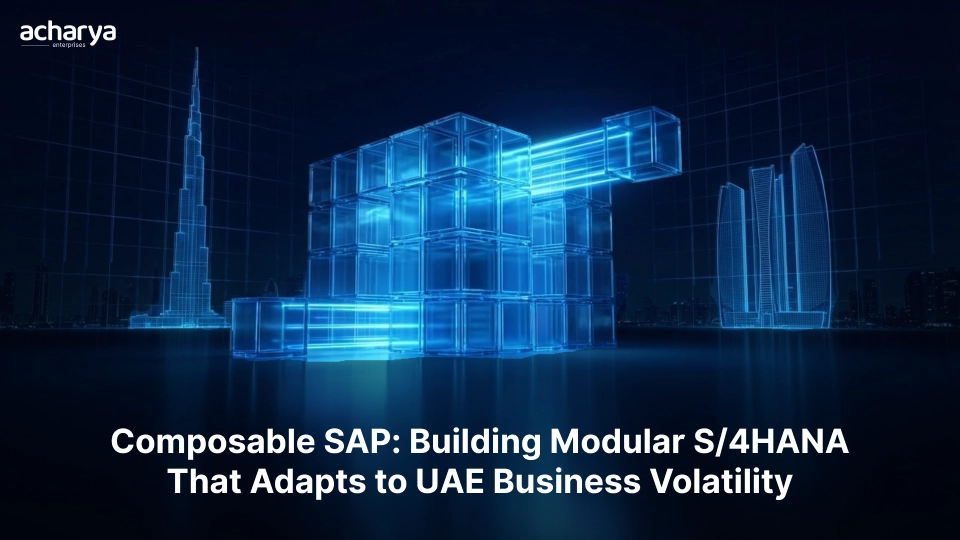
Composable SAP means designing S/4HANA as modular building blocks:
- Core SAP S/4HANA: Transactional backbone for essential business processes
- SAP BTP: Platform for extensions and custom capabilities
- APIs and events: Connectors allowing modules to work together
- Packaged Business Capabilities (PBCs): Independent modules serving specific functions
Think of it like LEGO blocks versus a single molded structure. Composable SAP lets you add, remove, or replace pieces without rebuilding everything.
How modular architecture differs from heavy customization
Traditional customization approach:
- Modify SAP standard code directly
- Build custom logic inside SAP core
- Create dependencies between customizations
- Risk system stability with each change
- Complicate every SAP upgrade
Composable SAP approach:
- Keep SAP core clean and standard
- Build extensions outside core on SAP BTP
- Use APIs for communication between components
- Change individual modules without affecting core
- Upgrade SAP core without breaking extensions
Why composable design aligns with SAP clean core principles
SAP clean core means keeping S/4HANA as close to standard as possible. Composable architecture achieves this by:
- Avoiding modifications to SAP standard objects
- Using only released SAP APIs for extensions
- Building custom capabilities on SAP BTP instead of in core
- Maintaining upgrade compatibility
- Enabling quarterly SAP release adoption
Gartner predicts that by 2024, 80% of CIOs will list modular redesign through composability as a top reason for accelerated business performance.
Business Volatility in UAE: The Case for Modularity
UAE market dynamics create specific pressures that composable SAP addresses.
Frequent regulatory changes and compliance updates
Recent examples show the pace:
AML/CTF updates (2024-2025):
- Federal Decree-Law No. 7 of 2024 amended previous AML law
- Federal Decree-Law No. 10 of 2025 completely replaced it again
- Enhanced penalties: AED 50,000 – AED 2,000,000 (doubled for repeat violations)
- New requirements for virtual asset providers
- Expanded FIU enforcement powers
Tax regulation evolution:
- Corporate tax introduced (effective June 2023)
- VAT framework continues refinement
- Federal Tax Authority receives expanded audit powers (January 2026)
- Lookback periods extend to 15 years for suspected evasion
Modular SAP handles these changes better:
- Compliance modules update independently
- Regulatory reporting sits outside core as separate capability
- New requirements don’t trigger full SAP change projects
- Updates deploy faster with isolated testing
Market expansion, contraction, and diversification pressures
UAE companies constantly adjust business models:
- Opening operations in new free zones (JAFZA, DMCC, ADGM, DIFC)
- Expanding to neighboring GCC markets
- Divesting non-core business units
- Acquiring competitors or complementary businesses
- Pivoting to new industries or customer segments
Composable SAP supports these changes:
- Add new legal entities without core system changes
- Spin off business units with their modules intact
- Integrate acquisitions by connecting modules rather than merging systems
- Test new business models with temporary modules
How volatility exposes weaknesses in rigid ERP landscapes
Monolithic SAP becomes a liability when:
- New ESG reporting requirements need quarterly data that doesn’t exist in current system
- Free zone expansion requires different VAT treatment but core can’t easily adapt
- Market opportunity demands quick product launch but ERP changes take 6 months
- Regulatory deadline approaches but SAP customization backlog is 8 months long
- Acquisition integration delayed because systems can’t connect
Core vs Edge: Redefining S/4HANA’s Role
Composable SAP requires clear thinking about what belongs where.
What belongs in the S/4HANA digital core
Keep these in core SAP S/4HANA:
Transactional processes:
- Financial accounting and controlling
- Order-to-cash processes
- Procure-to-pay workflows
- Inventory management
- Production planning and execution
Master data:
- Chart of accounts
- Customer and vendor records
- Material master
- Cost centers and profit centers
Core regulatory compliance:
- VAT calculation and reporting
- Basic financial statement generation
- Audit trail requirements
What should live outside core as modular capabilities
Build these on SAP BTP or as separate modules:
Differentiating processes:
- Industry-specific workflows unique to your business
- Custom pricing engines
- Specialized approval workflows
- Proprietary calculation logic
Regulatory-specific add-ons:
- UAE ESG reporting consolidation
- Economic substance regulation compliance tracking
- DHA/HAAD healthcare-specific requirements
- DFSA financial services reporting
Innovation and experimentation:
- AI-powered demand forecasting
- Customer portals and mobile apps
- IoT device integrations
- Advanced analytics and dashboards
Reducing risk by limiting changes to core system
Core SAP S/4HANA becomes more stable when:
- Fewer customizations mean fewer points of failure
- Upgrades don’t break custom code because there is minimal custom code
- Standard SAP processes benefit from SAP’s testing across thousands of customers
- Changes happen in isolated modules with contained blast radius
- Rollback easier when problems limited to single module
Building Blocks of Composable SAP Architecture
Composable SAP relies on specific SAP technologies working together.
SAP S/4HANA as the transactional backbone
S/4HANA provides:
- Real-time transaction processing on HANA database
- Integrated finance, supply chain, manufacturing processes
- Single source of truth for master and transactional data
- Standard SAP Fiori user interface
- Core business logic that’s proven and reliable
Keep S/4HANA focused on what it does best: running core business operations.
SAP BTP as the extensibility and integration layer
SAP Business Technology Platform enables composability through:
Development capabilities:
- SAP Build for low-code/no-code application development
- ABAP Cloud for upgrade-safe custom development
- Cloud Application Programming Model (CAP) for modern apps
Integration services:
- SAP Integration Suite connecting S/4HANA to other systems
- API Management for secure API exposure
- Advanced Event Mesh for real-time event-driven integration
Data and analytics:
- SAP Datasphere for data integration across sources
- SAP Analytics Cloud for reporting and planning
- AI/ML services for intelligent automation
APIs, events, and services as connectors
Modules communicate through well-defined interfaces:
- RESTful APIs: Synchronous communication for data queries and updates
- OData services: Standard SAP approach for exposing business data
- Events: Asynchronous notifications when business actions occur
- Business Application Interface (BAdI): Extension points within S/4HANA
SAP provides thousands of pre-built APIs through SAP Business Accelerator Hub.
Designing Modular Finance, Supply Chain, and HR Processes
Apply composable thinking to specific SAP functional areas.
Composable finance for faster reporting and compliance
Financial processes benefit from modular design:
Core S/4HANA Finance:
- General ledger and subledgers
- Accounts payable and receivable
- Asset accounting
- Basic financial statements
Modular extensions:
- UAE ESG reporting module pulling data from S/4HANA
- Management reporting consolidation on SAP Analytics Cloud
- Transfer pricing calculations as separate service
- Regulatory reporting for multiple free zone entities
- Advanced cash flow forecasting using AI
When UAE introduces new financial reporting requirements, update the extension module without touching core finance.
Flexible supply chain extensions for demand and disruption
Supply chain must adapt to market volatility:
Core S/4HANA Supply Chain:
- Materials management
- Purchasing and procurement
- Inventory management
- Basic production planning
Modular capabilities:
- AI demand forecasting consuming S/4HANA sales data
- Supplier portal for UAE and GCC vendors
- IoT integration for warehouse automation
- Advanced transportation management
- Supply chain visibility platform connecting partners
Add or replace capabilities as supply chain strategy evolves.
Decoupling HR processes to support workforce changes
Human resources processes need flexibility for UAE labor market:
Core HR in S/4HANA or SuccessFactors:
- Employee master data
- Payroll processing
- Time management
- Basic organizational structure
Modular HR extensions:
- UAE labor law compliance tracking
- End-of-service benefits calculation (UAE-specific)
- Visa and work permit management
- Employee self-service portal
- Skills marketplace matching internal talent to projects
Managing Change Without Disruption
Composable SAP’s biggest advantage: change becomes routine instead of risky.
Adding, replacing, or retiring capabilities without reimplementation
Modular architecture enables:
Adding new capabilities:
- Deploy new module connecting to S/4HANA via APIs
- Test independently before releasing to users
- Roll out gradually to different user groups
- Core SAP unchanged, so no regression testing needed
Replacing existing modules:
- Build new module with better functionality
- Run both old and new in parallel during transition
- Switch users to new module when ready
- Decommission old module cleanly
Retiring unnecessary capabilities:
- Identify modules no longer providing value
- Disconnect module from core system
- Archive data if needed
- Reduce costs by eliminating unused functionality
Testing and deploying changes independently
Traditional SAP change management requires:
- Testing every change across entire SAP landscape
- Coordinating changes in development, quality, production systems
- Full regression testing for even small changes
- Infrequent releases bundling many changes
Composable SAP enables:
- Test individual modules in isolation
- Deploy modules independently without coordinating core SAP changes
- Continuous deployment of module updates
- Smaller, more frequent releases reducing risk
Reducing downtime and business risk during change
Modular changes minimize disruption:
- Core SAP stays running while modules update
- Failed module deployment doesn’t crash entire system
- Quick rollback of problematic module without affecting core
- Blue-green deployment switching traffic to new module version
- Zero-downtime updates for many types of changes
Governance Models for Composable SAP Landscapes
Flexibility without governance creates chaos. Composable SAP needs clear rules.

Preventing uncontrolled sprawl of extensions and apps
Risk: Every business unit builds its own extensions without coordination.
Governance approach:
- Enterprise architecture review board approves new modules
- Standard evaluation criteria for module proposals
- Build versus buy decision framework
- Prevent duplicate modules solving same problem
- Sunset plan required for every new module
Defining ownership for core and edge components
Clear ownership prevents neglect:
Core S/4HANA ownership:
- SAP Basis team manages platform
- Functional leads (Finance, Supply Chain) own processes
- Change management controlled centrally
Module ownership:
- Business unit sponsors fund and own specific modules
- Technical ownership assigned to development team
- Ongoing budget allocated for maintenance and evolution
- Performance metrics defined and monitored
Ensuring security, performance, and compliance across modules
Modular architecture needs consistent standards:
Security governance:
- All modules must authenticate through SAP identity management
- Authorization model consistent with S/4HANA roles
- Data encryption requirements for all integrations
- Security scanning mandatory for all custom code
Performance standards:
- Response time SLAs for user-facing modules
- API rate limiting to protect core SAP performance
- Load testing required before production deployment
- Monitoring and alerting for all modules
Compliance requirements:
- Audit trail preservation across all modules
- Data residency rules (UAE data in UAE)
- Retention policies aligned with UAE regulations
- Regular compliance audits of entire landscape
Cost and Performance Implications of Composable Design
Composable SAP changes the economics of ERP ownership.
Avoiding long-term technical debt and rework
Traditional customization creates debt:
- Custom code becomes harder to maintain over time
- Original developers leave, knowledge disappears
- Each SAP upgrade requires expensive remediation
- Eventually forced to reimplement to escape technical debt
Composable approach reduces debt:
- Modules built on standard SAP BTP patterns age better
- Clean interfaces isolate modules from core changes
- Individual modules can be replaced without full reimplementation
- Technical debt contained to specific modules, not entire system
Optimizing spend by scaling only what’s needed
Modular architecture enables granular scaling:
- Core S/4HANA sized for transactional load
- Compute-intensive modules scale independently
- Development environments don’t need production-size BTP
- Seasonal modules scale up for peak, down for off-season
- Pay for what you use rather than overprovisioning entire system
Balancing modular flexibility with enterprise-grade performance
Concerns about composable performance:
- Won’t API calls slow down processes?
- Isn’t modular architecture less efficient?
- Will multiple systems create latency?
Reality with proper design:
- Modern APIs perform at microsecond latency
- Asynchronous event processing doesn’t block transactions
- Caching strategies reduce redundant API calls
- SAP HANA in-memory speed compensates for integration overhead
- Well-designed modules often perform better than monolithic customizations
Common Mistakes When Adopting Composable SAP
Learn from others who’ve attempted composable transformations.
Treating composability as technology-only initiative
Biggest mistake: thinking composable SAP is just about technology.
Composable requires changing:
- Thinking: From “what can we customize” to “what should stay standard”
- Processes: From monolithic workflows to modular capabilities
- Organization: From centralized IT to federated ownership
- Skills: From ABAP developers to multi-cloud platform engineers
- Governance: From project-based to continuous evolution
Recreating monolithic complexity outside the core
Some companies move customization from S/4HANA to BTP but maintain same problems:
- Build massive custom applications on BTP that are just as rigid
- Create tight coupling between modules defeating modularity
- Implement complex logic that’s hard to change
- Lose benefits of composability by building monoliths elsewhere
True composability requires discipline: keep modules small, focused, and loosely coupled.
Ignoring integration and data consistency challenges
Modular systems create integration complexity:
- Data synchronization across modules
- Maintaining referential integrity across systems
- Handling failures in distributed transactions
- Reconciling conflicting data from multiple sources
Success requires:
- Clear data ownership: single source of truth for each data type
- Event-driven architecture for data propagation
- Data governance framework spanning all modules
- Monitoring and alerting for data consistency issues
How Composable SAP Supports Long-Term Resilience
Composable architecture isn’t just for current needs. It’s about future-proofing.
Adapting faster to regulatory and market changes
When UAE introduces new regulations (and it will):
- Build compliance module on SAP BTP
- Connect to S/4HANA via standard APIs
- Deploy in weeks instead of months
- Update module as regulations evolve
- Replace with SAP standard when it becomes available
When market opportunities emerge:
- Rapid prototyping of new business models
- Quick addition of capabilities to support new markets
- Fast integration of acquired companies
- Easy retirement of failed experiments
Supporting innovation without destabilizing core operations
Innovation happens outside core SAP:
- Experiment with AI on SAP BTP without touching production S/4HANA
- Test IoT integrations in sandbox modules
- Build customer-facing apps without risking ERP stability
- Pilot new processes before committing to core changes
Failures don’t bring down entire system. Successes graduate to production.
Enabling continuous evolution instead of periodic transformation
Traditional approach: Major reimplementations every 10 years.
Composable approach: Continuous improvement every quarter.
- Modules evolve independently at different speeds
- Adopt SAP innovations as they’re released
- Replace aging modules gradually
- No more “big bang” transformation projects
- System stays modern through continuous evolution
Getting Started: Practical Path to Composable S/4HANA
Transition to composable SAP doesn’t happen overnight. Follow a structured approach.
Assessing current SAP landscape and pain points
Start with honest evaluation:
Technical assessment:
- Inventory all custom code in S/4HANA
- Identify tightly coupled customizations
- Document integration points and dependencies
- Assess technical debt in current landscape
Business assessment:
- Which processes change most frequently?
- Where does rigid SAP block business initiatives?
- What regulatory changes are you struggling to implement?
- Which customizations provide real competitive advantage?
Identifying processes best suited for modularization
Best candidates for early modularization:
High-change processes:
- Regulatory reporting that changes frequently
- Pricing logic that varies by market
- Approval workflows that differ by business unit
Innovation opportunities:
- Customer portals and self-service
- Advanced analytics not available in standard SAP
- Mobile apps for field operations
Integration challenges:
- Connections to third-party systems
- Legacy system integrations
- IoT device connections
Avoid modularizing stable core processes that SAP handles well.
Building a phased roadmap that evolves with the business
First 3-6 months (Foundation):
- Establish SAP BTP environment
- Define composable architecture standards
- Train team on SAP BTP capabilities
- Pilot one non-critical module
Next 6-12 months (Momentum):
- Modularize 2-3 high-value processes
- Implement governance framework
- Begin clean core assessment of S/4HANA
- Build internal BTP development capability
12-24 months (Transformation):
- Systematic modularization of custom code
- Extraction of customizations from S/4HANA to BTP
- Integration of acquired systems through composable approach
- Continuous evolution becomes normal operating model
Embrace Composable SAP for UAE Market Demands
UAE companies cannot afford rigid SAP systems. Market volatility demands flexibility.
Composable SAP provides:
- Faster response to regulatory changes
- Easier adaptation to market shifts
- Lower risk when implementing changes
- Better alignment with clean core principles
- Foundation for continuous innovation
The alternative is falling behind competitors who can adapt faster.
Partner With UAE SAP Experts for Composable Architecture
Acharya Enterprise helps UAE organizations design and implement composable SAP architectures that balance flexibility with stability.
Our approach combines deep SAP technical expertise with understanding of UAE regulatory environment and business requirements.
Our Composable SAP services:
- Composable architecture assessment and roadmap
- SAP BTP implementation and enablement
- Custom module development on SAP BTP
- API design and integration services
- Clean core assessment and remediation
- Governance framework development
- S/4HANA modularization strategy
- Continuous evolution support
Get a free composable architecture assessment. We’ll analyze your current SAP landscape and show you how modular design can improve agility while reducing long-term costs.
About Acharya Enterprise
Acharya Enterprise is a leading SAP services provider in the UAE, specializing in S/4HANA implementation, SAP BTP development, and composable architecture. With SAP consultants across 10+ countries and deep expertise in UAE compliance requirements, we help organizations build flexible SAP landscapes that thrive in volatile markets.
Related services: S/4HANA Implementation | SAP BTP Development | Composable Architecture | API Integration | Clean Core Assessment | SAP Modernization | Managed Services