2nd Why UAE Sustainability Reporting 2026 Is Now a Board-Level Priority
The days of voluntary ESG disclosure in the UAE are ending. UAE sustainability reporting 2026 marks a turning point where environmental, social, and governance data becomes as critical as financial reporting.
On May 30, 2025, the UAE enacted Federal Decree-Law No. 11 of 2024. This law changes everything for businesses operating in the Emirates. Every company, from SMEs to large enterprises, now faces mandatory climate reporting requirements with a full compliance deadline of May 30, 2026.
For the first time in the MENA region, sustainability reporting carries the same legal weight as financial statements. Boards can no longer treat ESG as a marketing initiative. It’s now a regulatory requirement with serious penalties for non-compliance.
Companies face fines ranging from AED 50,000 to AED 2 million for violations. Repeat offenses within two years see penalties doubled. Business suspension, loss of operating licenses, and inclusion on regulatory adverse lists are all possible sanctions.
This isn’t just about avoiding penalties. The UAE’s regulatory shift creates a clear dividing line between companies prepared for sustainable business practices and those caught unprepared.
What’s Changing with UAE Sustainability Reporting 2026
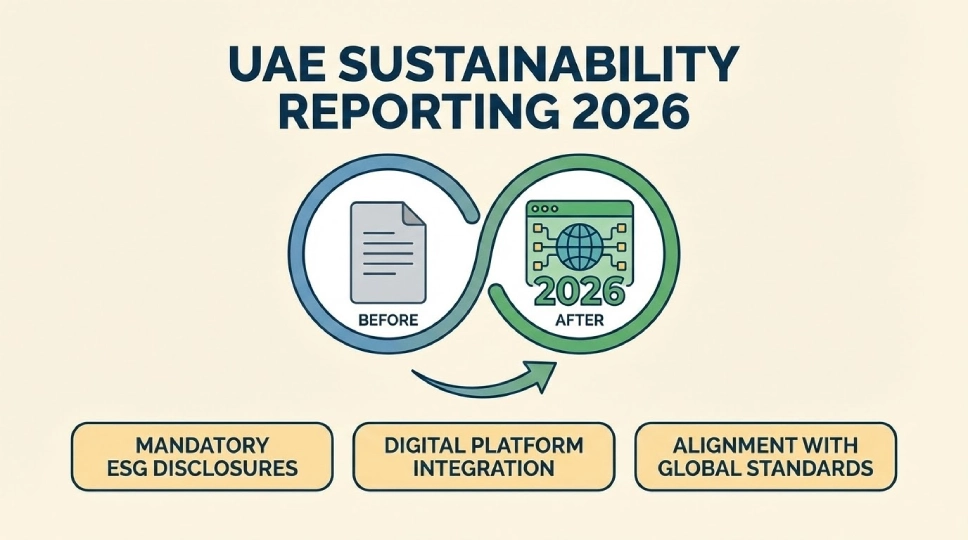
Federal Decree-Law No. 11 of 2024 establishes four core obligations for every UAE entity:
- Measure and report Scope 1 emissions (direct emissions from owned or controlled sources)
- Measure and report Scope 2 emissions (indirect emissions from purchased energy)
- Register with the National Register for Carbon Credits (NRCC)
- Submit verified reduction strategies through MOCCAE’s national platform
Large emitters releasing 0.5 million tCO2e or more annually faced accelerated registration deadlines starting June 28, 2025. All other businesses must achieve full compliance by May 30, 2026.
Listed companies on Dubai Financial Market (DFM) and Abu Dhabi Securities Exchange (ADX) face additional requirements. The Securities and Commodities Authority (SCA) mandates annual sustainability reports within 90 days of each financial year-end.
How UAE regulations align with global ESG frameworks
The UAE Sustainable Finance Working Group (SFWG) established in 2019 has been preparing this transition. Their disclosure principles align with internationally recognized frameworks:
- Global Reporting Initiative (GRI) standards
- Sustainability Accounting Standards Board (SASB) metrics
- Task Force on Climate-related Financial Disclosures (TCFD)
- World Economic Forum (WEF) stakeholder capitalism metrics
Companies operating globally benefit from this alignment. A single sustainability reporting system can serve both UAE regulatory requirements and international investor expectations.
What non-compliance means for UAE companies
Beyond direct financial penalties, non-compliance creates cascading business risks:
- Difficulty accessing sustainable finance and green loans
- Loss of contracts with ESG-conscious customers
- Reduced competitiveness in government tenders (sustainability is increasingly weighted)
- Reputational damage affecting brand value and market position
- Supply chain exclusion as global partners demand ESG transparency
Why ESG Reporting Fails Without the Right Systems
Most UAE companies currently manage sustainability data through spreadsheets and manual processes. This approach worked when ESG reporting was voluntary and occasional.
Under mandatory UAE sustainability reporting 2026 requirements, manual methods create serious risks.
Manual data collection risks
Spreadsheet-driven reporting introduces multiple failure points:
- Human error in data entry and calculations
- Version control issues across multiple contributors
- Lack of audit trail showing who changed what and when
- Inability to verify data accuracy back to source transactions
- Time-consuming consolidation across business units and locations
A Dubai manufacturing company discovered this problem during their first compliance attempt. They spent six weeks collecting emissions data manually, only to find inconsistencies that required starting over.
Disconnected data across systems
Sustainability data doesn’t exist in isolation. Environmental metrics tie directly to:
- Energy consumption tracked in facilities management systems
- Transportation and logistics data in supply chain platforms
- Production volumes and waste from manufacturing systems
- Employee commuting and travel from HR systems
- Procurement decisions affecting supplier emissions
When these systems don’t talk to each other, companies can’t create accurate, complete sustainability reports. Data gaps and inconsistencies make audit verification impossible.
Last-minute reporting creates accuracy issues
Many companies approach ESG reporting as a year-end exercise. They scramble to collect data, fill gaps, and produce reports just before deadlines.
This approach guarantees problems. Historical data reconstruction is unreliable. Estimates replace actual measurements. Verification becomes difficult when source documentation is missing or incomplete.
Auditors and regulators increasingly demand continuous data collection with real-time visibility. Last-minute reporting simply won’t meet UAE sustainability reporting 2026 standards.
Understanding ESG Data Beyond Finance
ESG data spans far wider than traditional financial reporting. Environmental, social, and governance metrics touch every part of your business.
What ESG data actually includes
Environmental data:
- Energy consumption by source and location
- Greenhouse gas emissions (Scope 1, 2, and 3)
- Water usage and wastewater management
- Waste generation and recycling rates
- Raw material consumption and efficiency
Social data:
- Workforce diversity and inclusion metrics
- Employee health and safety incidents
- Training and development hours
- Labor practices and working conditions
- Community engagement and social impact
Governance data:
- Board composition and independence
- Ethics and compliance violations
- Anti-corruption policies and controls
- Data privacy and cybersecurity measures
- Stakeholder engagement processes
Why ESG spans procurement, manufacturing, HR, and logistics
Consider a typical UAE trading company. Their carbon footprint includes:
- Direct emissions from company vehicles and facilities (captured in fleet management)
- Energy use in warehouses and offices (tracked in facilities systems)
- Supplier emissions from purchased goods (sits in procurement data)
- Transportation emissions from logistics partners (exists in shipping records)
- Employee commuting patterns (HR can estimate based on location data)
No single system holds all this information. Accurate sustainability reporting requires connecting operational data across the entire business.
The challenge of validating sustainability data at scale
Financial data has built-in validation. Debits must equal credits. Bank reconciliations provide external verification. Decades of accounting standards define exactly how to measure and report financial performance.
Sustainability data lacks these established validation mechanisms. How do you verify that a supplier’s reported emissions are accurate? How do you ensure consistency when measuring water usage across 20 different facilities?
Auditors increasingly apply financial-grade scrutiny to ESG data. Companies need systems that provide the same level of control, traceability, and verification for sustainability metrics.
How SAP S/4HANA Supports ESG and Sustainability Reporting
SAP S/4HANA provides the digital backbone for integrated sustainability reporting. Rather than treating ESG as a separate reporting exercise, S/4HANA embeds sustainability data capture into core business processes.
Why ESG needs to be in core business systems
Sustainability data quality depends on where and when you capture it. The best time to record environmental impact is at the moment of the business transaction:
- Energy consumption when production actually happens
- Transportation emissions when goods are shipped
- Waste generation when materials are processed
- Supplier sustainability metrics when purchase orders are created
SAP S/4HANA captures this data automatically as part of normal business operations. No separate data entry required. No manual reconciliation needed.
Single source of truth for ESG data
S/4HANA provides one unified platform connecting:
- Financial transactions with their environmental impact
- Production operations with emissions and waste data
- Supply chain activities with supplier sustainability metrics
- HR processes with social and diversity indicators
- Governance controls with compliance and risk data
When auditors ask “Where did this number come from?”, you can trace it back to the original transaction in the system. Complete audit trail. Full transparency. Real-time accuracy.
Connecting operational data to sustainability metrics
SAP S/4HANA includes built-in sustainability capabilities:
- Environment, Health & Safety (EHS) Management for tracking environmental performance
- Product Compliance for managing sustainability across product lifecycles
- Integration with SAP Sustainability Control Tower for consolidated ESG reporting
- Embedded analytics showing sustainability KPIs alongside financial metrics
These tools work together to transform raw operational data into meaningful sustainability insights.
Environmental Reporting Use Cases in SAP S/4HANA
Let’s look at practical examples of how UAE companies use S/4HANA for environmental compliance.
Tracking energy consumption, emissions, and resource usage
A Dubai-based manufacturing company uses S/4HANA to automatically calculate carbon footprint at the product level. Every production run captures:
- Electricity consumed (from meter integrations)
- Fuel used in manufacturing equipment
- Materials consumed with their embedded carbon
- Waste generated by production process
The system calculates total emissions using emission factors from recognized databases. Results feed directly into UAE sustainability reporting 2026 submissions.
Capturing supplier and logistics sustainability data
Supply chain emissions (Scope 3) are often the largest part of a company’s carbon footprint. SAP S/4HANA enables supplier sustainability tracking:
- Supplier sustainability questionnaires integrated into onboarding
- Emissions factors assigned to purchased materials
- Transportation mode and distance captured automatically from logistics
- Supplier performance dashboards showing sustainability metrics
An Abu Dhabi trading company reduced their Scope 3 emissions by 15% by using S/4HANA data to identify and switch to lower-carbon suppliers.
Improving carbon footprint calculation accuracy
Manual carbon calculations use estimates and assumptions. SAP S/4HANA uses actual transaction data:
- Real energy consumption from connected meters
- Actual transportation distances from logistics records
- Verified supplier emissions from purchase documents
- Precise production volumes from manufacturing execution
Accuracy improves from ±30% with manual methods to ±5% or better with system-driven calculations.
Social and Governance Reporting with SAP
Environmental reporting gets most attention, but social and governance data matter equally for UAE sustainability reporting 2026 compliance.
Workforce diversity, health, and safety integration
SAP SuccessFactors (integrated with S/4HANA) provides comprehensive social reporting:
- Workforce diversity metrics by gender, nationality, age, and position
- Pay equity analysis identifying compensation gaps
- Training hours and professional development by employee category
- Health and safety incidents with complete case management
- Employee satisfaction and engagement scores
This data flows automatically into sustainability reports. No separate HR data collection required.
Tracking compliance, ethics, and governance indicators
SAP S/4HANA governance capabilities include:
- Segregation of duties controls preventing conflicts of interest
- Audit trails showing who did what and when
- Whistleblower case management
- Policy acknowledgment and training compliance tracking
- Board composition and independence metrics
GRC (Governance, Risk, and Compliance) modules provide the backbone for governance reporting required under ESG frameworks.
Strengthening transparency across group and entity levels
Large UAE companies often operate multiple legal entities and business units. S/4HANA provides:
- Consolidated sustainability reporting across all entities
- Drill-down capability to individual location or department performance
- Consistent metrics and methodologies enterprise-wide
- Centralized governance with local operational flexibility
Turning ESG Compliance Into Competitive Advantage
Forward-thinking UAE companies view sustainability reporting not as a burden but as an opportunity.
Why sustainability reporting is more than compliance
Compliance gets you to the starting line. Competitive advantage comes from what you do with sustainability data:
- Identify operational inefficiencies (energy waste, material losses)
- Make data-driven decisions on supplier selection
- Develop sustainable products that command premium pricing
- Attract customers who prioritize ESG performance
- Reduce insurance costs through better risk management
How transparent ESG data improves investor confidence
Global investors manage over $87 trillion using SASB-aligned ESG metrics. In the UAE, 91% of issuers expect to reallocate capital toward environmental and social outcomes.
Companies with verified, transparent ESG data access:
- Lower cost of capital from sustainability-linked financing
- Stronger investor interest and higher valuations
- Better terms from banks offering green loans
- Access to ESG-focused investment funds
SAP S/4HANA provides the audit-ready data that investors demand.
Using sustainability insights for operational efficiency
A Sharjah logistics company used S/4HANA sustainability analytics to discover that route optimization could cut fuel consumption by 12%. The change reduced costs and emissions simultaneously.
Similar opportunities exist across industries:
- Manufacturing: Reduce energy costs by optimizing production schedules
- Retail: Minimize waste through better inventory management
- Construction: Lower material waste with accurate quantity forecasting
- Healthcare: Reduce medical waste through better supply chain planning
Integrating Sustainability Reporting with Finance and Risk
The most powerful aspect of SAP S/4HANA is connecting sustainability metrics with financial performance.
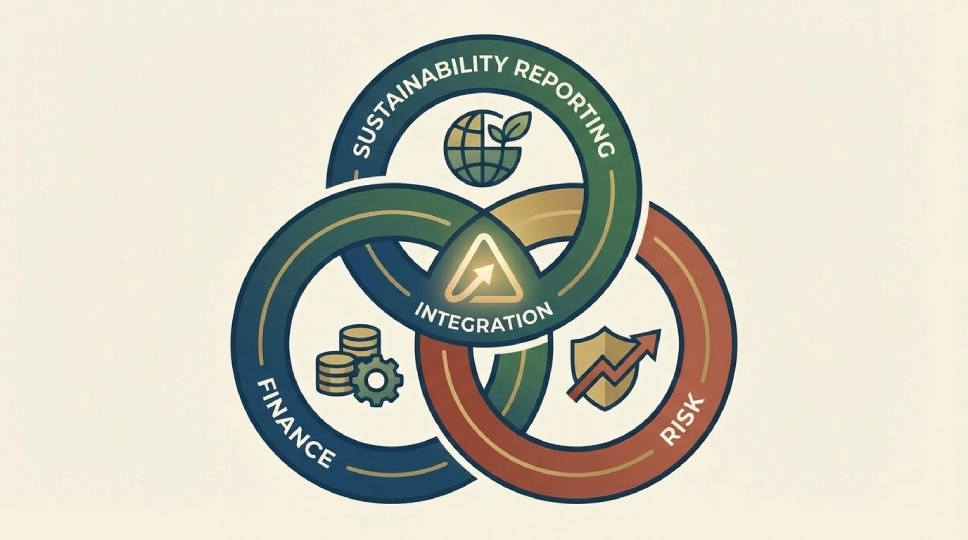
Linking ESG metrics with financial performance
SAP Profitability and Performance Management (PaPM) enables companies to analyze profitability and sustainability together:
- Product profitability with carbon intensity
- Customer profitability with sustainability impact
- Business unit performance with environmental metrics
- Investment decisions factoring ESG risks and opportunities
Research shows companies with high ESG performance achieve operating margins 4.7 times higher than low ESG performers.
Supporting audit-ready sustainability disclosures
External auditors increasingly verify sustainability reports with the same rigor as financial audits. SAP S/4HANA supports this by providing:
- Complete audit trails from source transaction to reported metric
- Automated controls preventing unauthorized data changes
- Version control showing report evolution over time
- Documentation of calculation methodologies and emission factors
- Evidence packages supporting every reported claim
Aligning ESG reporting with enterprise risk management
Climate risk is business risk. SAP S/4HANA connects sustainability data to enterprise risk frameworks:
- Physical risks (flooding, extreme weather) tied to facility locations
- Transition risks (carbon pricing, regulation changes) affecting business models
- Supply chain risks from supplier sustainability failures
- Reputational risks from ESG performance gaps
Data Governance and Control for ESG Reporting
Poor data governance is the fastest way to fail a sustainability audit or face greenwashing accusations.
Ensuring consistency across sustainability data sources
SAP S/4HANA enforces data consistency through:
- Master data management ensuring one version of truth
- Standardized calculation methodologies across all entities
- Controlled emission factor libraries preventing arbitrary changes
- Validation rules catching data entry errors at source
Defining ownership and accountability for ESG data
Every sustainability data point needs a clear owner. S/4HANA supports this through:
- Role-based permissions controlling who can enter or change data
- Workflow approvals for critical sustainability entries
- Data quality scorecards showing completeness and accuracy by owner
- Automated alerts when data quality falls below standards
Preventing greenwashing through controlled data governance
Greenwashing happens when companies make unsubstantiated sustainability claims. Strong data governance prevents this by:
- Requiring evidence for every reported metric
- Blocking manual overrides without documented justification
- Maintaining complete history of all data changes
- Enabling external auditors to verify source data independently
Preparing for UAE Sustainability Audits and Assurance
As UAE sustainability reporting 2026 requirements take effect, third-party assurance becomes standard practice.
What auditors expect from ESG reports
External auditors verify sustainability reports using similar approaches to financial audits:
- Sample testing of underlying transactions
- Recalculation of key metrics using source data
- Verification of controls preventing errors or fraud
- Assessment of estimation methodologies and assumptions
- Evaluation of disclosure completeness and accuracy
How SAP S/4HANA supports traceability and evidence
Every number in a sustainability report must be traceable to source. S/4HANA provides:
- Document links connecting reported metrics to original transactions
- Drill-down capability from consolidated reports to individual entries
- Automated evidence packages for auditor sampling
- Real-time data access for auditors within controlled environments
Reducing audit effort through system-driven reporting
Manual reporting requires extensive auditor work to verify accuracy. System-driven reporting reduces this burden:
- Automated calculations eliminate manual arithmetic errors
- Standardized processes ensure consistent treatment
- Built-in controls reduce need for extensive testing
- Complete audit trails eliminate reconstruction work
Companies using SAP S/4HANA report 40-50% reduction in sustainability audit time and cost.
Common ESG Reporting Mistakes UAE Companies Make Today
Understanding common pitfalls helps avoid them as UAE sustainability reporting 2026 deadlines approach.
Treating sustainability as separate from operations
Biggest mistake: Creating a separate “ESG team” disconnected from operations, finance, and IT. Sustainability data comes from business operations. Treating it separately guarantees data quality problems and inefficiency.
Relying on manual consolidation near deadlines
Second mistake: Starting data collection two months before the report is due. Manual consolidation under time pressure produces errors, gaps, and unreliable results.
Underestimating IT and finance integration needs
Third mistake: Assuming sustainability reporting is purely an environmental or CSR function. Successful programs require:
- IT systems integration expertise
- Finance team involvement for audit-ready controls
- Operations input for accurate data capture
- Executive sponsorship for cross-functional coordination
Building an ESG-Ready SAP S/4HANA Roadmap
Companies don’t need to implement everything at once. A phased approach delivers value while managing change.
Identifying high-impact sustainability data first
Start with mandatory UAE sustainability reporting 2026 requirements:
- Scope 1 and 2 emissions (required by Federal Decree-Law No. 11)
- Energy consumption by source
- Waste generation and disposal
- Water usage (especially relevant for UAE context)
Once these foundations are solid, expand to Scope 3 emissions and social metrics.
Phasing ESG capabilities into existing SAP landscapes
Recommended implementation phases:
1st Phase (3-4 months):
- Activate SAP EHS Management for environmental data
- Configure emission factors and calculation methodologies
- Connect energy meters and facility management systems
- Establish baseline measurements
2nd Phase (4-6 months):
- Integrate supplier sustainability data in procurement
- Configure logistics carbon tracking
- Connect HR data for social metrics
- Implement SAP Sustainability Control Tower
3rd Phase (6-12 months):
- Expand to Scope 3 emissions across value chain
- Implement product-level carbon footprint
- Integrate sustainability with financial reporting
- Deploy advanced analytics and scenario planning
Aligning sustainability goals with business strategy
Effective sustainability programs connect to business objectives:
- Cost reduction through energy efficiency
- Revenue growth from sustainable product lines
- Risk mitigation through supply chain resilience
- Market differentiation through ESG leadership
The Bigger Picture: Sustainability as Long-Term Business Strategy
UAE sustainability reporting 2026 compliance is the starting point, not the destination.
Moving from compliance-driven to value-driven sustainability
Compliance ensures you meet minimum requirements. Value creation requires going further:
- Using sustainability data to redesign products and services
- Developing new business models around circular economy
- Creating partnerships based on shared sustainability goals
- Investing in innovation that delivers both profit and planet benefits
Using data transparency to support innovation and growth
Transparent sustainability data enables:
- Product innovation informed by environmental impact analysis
- Market expansion into sustainability-conscious customer segments
- Partnership opportunities with like-minded organizations
- Employee attraction and retention (especially younger talent)
Positioning sustainability as a differentiator in the UAE market
The UAE is positioning itself as a regional sustainability hub. Companies leading on ESG benefit from:
- Preferential treatment in government procurement
- Access to sustainability-focused investment funds
- Recognition and awards enhancing reputation
- First-mover advantage as regulations tighten
Take Action on UAE Sustainability Reporting 2026 Now
The May 30, 2026 deadline is closer than it appears. Implementation of proper ESG systems typically takes 8-12 months.
Companies starting now have time to implement properly. Those waiting until late 2025 will face rushed implementations, higher costs, and quality compromises.
Next steps for UAE companies:
- Assess current state: Understand your baseline emissions and sustainability data gaps
- Define requirements: Map UAE regulatory requirements to your business operations
- Plan implementation: Create a phased roadmap for SAP S/4HANA sustainability capabilities
- Build the team: Assemble cross-functional resources (operations, finance, IT, sustainability)
- Execute: Begin implementation with focus on May 2026 deadline
Partner With UAE SAP Experts for ESG Success
Acharya Enterprise helps UAE organizations implement SAP S/4HANA sustainability solutions. Our team has deep experience with both SAP systems and UAE regulatory requirements.
We don’t just configure software. We help you build sustainable business practices that deliver compliance and competitive advantage.
Our UAE Sustainability Reporting 2026 services include:
- ESG readiness assessment and gap analysis
- SAP S/4HANA sustainability module implementation
- Sustainability Control Tower deployment and configuration
- Integration with existing SAP and non-SAP systems
- Data governance and quality frameworks
- Training for sustainability reporting teams
- Ongoing support and optimization
Get a free UAE sustainability reporting readiness assessment. We’ll evaluate your current capabilities and provide a clear roadmap to May 2026 compliance.
Contact Acharya Enterprise today to transform ESG compliance into competitive advantage.
About Acharya Enterprise
Acharya Enterprise is a leading SAP services provider in the UAE, specializing in S/4HANA implementation, sustainability solutions, and ESG compliance. With SAP consultants across 10+ countries and deep expertise in UAE regulations, we help organizations meet UAE sustainability reporting 2026 requirements while building long-term business value.
Related services: SAP S/4HANA Implementation | Sustainability Control Tower | ESG Compliance | Carbon Accounting | Environmental Management | SAP Managed Services