Outsourced SAP Support vs In House Team: What Works Better for UAE Companies?
Outsourced SAP support UAE has become a serious consideration for CIOs and IT leaders as SAP landscapes grow more complex and business expectations increase. The decision between building an in house SAP team or relying on an outsourced support partner directly affects cost control, risk management, operational stability, and the ability to scale.
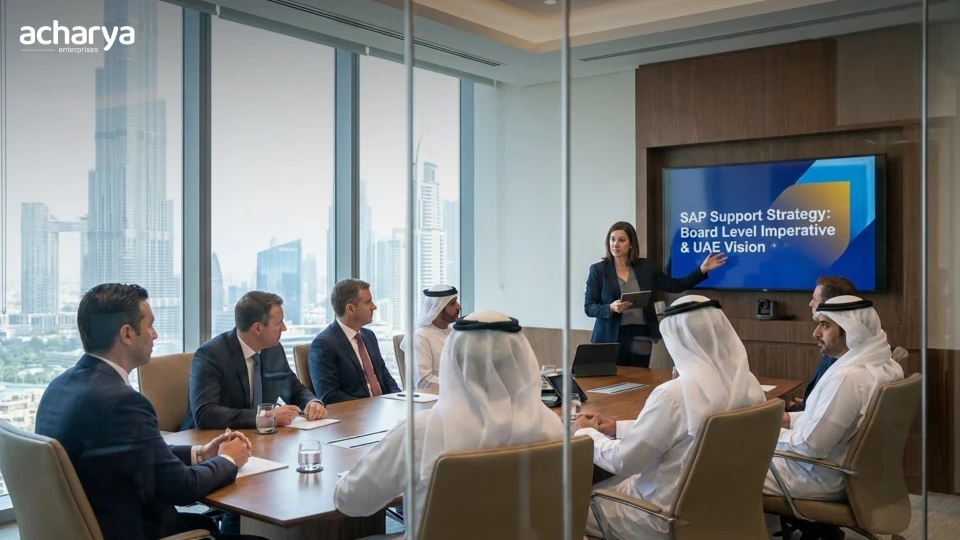
Why SAP support strategy is becoming a board level discussion in the UAE
SAP systems now sit at the center of finance, supply chain, HR, and reporting for most UAE enterprises.
Any disruption, delay, or inefficiency in SAP support has a direct impact on revenue, compliance, and customer experience.
Understanding SAP support models
Before comparing options, organizations must clearly understand how different SAP support models operate.
The differences go far beyond staffing and cost.
What an in house SAP support team typically looks like
An in house SAP team usually consists of functional consultants, technical resources, and a support lead.
The team handles day to day incidents, enhancements, and coordination with business users.
How outsourced SAP support works in practice
Outsourced support involves a third party managing SAP incidents, changes, and monitoring.
Support is delivered through defined service levels, escalation paths, and governance frameworks.
Cost structure and budget predictability
Cost is often the first comparison point, but it should not be the only one.
Understanding the full cost picture prevents long term surprises.
Fixed and variable costs of building an internal SAP team
In house teams involve fixed salary costs regardless of workload.
Additional expenses include recruitment, training, certifications, and attrition replacement.
How outsourced support pricing models are structured
Outsourced SAP support is typically priced as a monthly or annual service.
Pricing may be based on system size, modules covered, or ticket volumes.
Hidden costs UAE companies often miss in both approaches
Hidden costs affect both models if not planned properly.
- After hours or emergency support
- Knowledge loss during staff turnover
- Additional tools for monitoring and reporting
Access to skills and expertise
SAP expertise requirements continue to expand with new modules and technologies.
Access to the right skills at the right time is a key differentiator.
Challenges of hiring and retaining SAP talent in the UAE
Experienced SAP professionals are in high demand across the UAE.
Retention becomes difficult as talent frequently moves between projects and employers.
How outsourced teams provide multi module and industry expertise
Outsourced providers maintain teams across multiple SAP modules.
This allows access to specialized expertise without hiring full time resources.
Handling complex issues and peak demand scenarios
Peak periods such as audits, upgrades, or rollouts require additional capacity.
Outsourced teams can scale resources more easily than internal teams.
Operational control and responsiveness
Control and responsiveness directly affect business confidence in SAP.
The two models approach these areas differently.
Day to day control with an in house SAP team
Internal teams offer direct access and close alignment with business users.
Issues can be discussed informally and resolved quickly when capacity allows.
Service level agreements and escalation in outsourced support
Outsourced support relies on clearly defined SLAs.
Escalation paths ensure accountability, but require disciplined governance.
Balancing speed, quality, and accountability
Speed without quality increases risk.
Both models require clear prioritization and ownership to maintain balance.
Scalability and flexibility
Business conditions in the UAE can change quickly.
Support models must adapt without disrupting operations.
Scaling SAP support during business growth or transformation
Growth initiatives often increase SAP workload.
Outsourced models allow faster scaling without long recruitment cycles.
Adapting support capacity during mergers, rollouts, and upgrades
Major initiatives create temporary spikes in support demand.
Flexible resourcing reduces pressure on internal teams.
Why flexibility matters for UAE organizations with seasonal demand
Some industries experience seasonal peaks.
Flexible support avoids paying for unused capacity during slower periods.
Security, compliance, and risk management
Security and compliance cannot be compromised in SAP environments.
Both models must meet UAE regulatory expectations.
Managing system access and data security with internal teams
Internal teams provide direct oversight of system access.
However, weak role governance can still create risks.
Governance and controls in outsourced SAP support
Outsourced providers operate under defined access controls.
Strong contracts and audits are essential to maintain security.
Meeting audit and compliance requirements in regulated sectors
Regulated industries require documented controls.
Support models must align with audit expectations.
Support quality and business alignment
Technical resolution alone is not enough.
Support must align with business priorities.
Understanding business processes versus just technical fixes
Effective SAP support requires business context.
Issues should be resolved with process impact in mind.
Knowledge continuity and documentation challenges
Staff turnover affects both models.
Documentation and knowledge transfer reduce dependency risks.
Ensuring SAP support aligns with business priorities
Clear prioritization frameworks are required.
Support teams must understand what matters most to the business.
Impact on IT leadership and internal teams
The support model influences how IT leaders spend their time.
This affects long term IT maturity.

How support model choice affects IT focus and workload
In house models often pull IT leaders into daily firefighting.
Outsourced models can reduce operational distractions.
Freeing internal teams to focus on innovation and projects
When support is outsourced, internal teams can focus on transformation.
This accelerates innovation and value creation.
Long term talent and capability considerations
Organizations must decide which capabilities to retain internally.
This decision shapes future IT strategy.
Common decision pitfalls UAE companies make
Many organizations make support decisions under pressure.
This leads to avoidable mistakes.
Choosing based on cost alone without service clarity
Low cost models may lack responsiveness or expertise.
Service quality must be clearly defined.
Underestimating governance needs in outsourced models
Outsourcing does not eliminate management responsibility.
Strong governance is still required.
Over investing in internal teams without utilization planning
Idle capacity increases cost without value.
Utilization planning is often overlooked.
Hybrid support models explained
Many UAE companies adopt a hybrid approach.
This combines the strengths of both models.
Combining in house ownership with outsourced execution
Internal teams retain ownership and business knowledge.
Outsourced teams handle routine and specialized support.
When a hybrid approach delivers the best results
Hybrid models work well for complex SAP landscapes.
They balance control with scalability.
Structuring roles and responsibilities clearly
Clear boundaries prevent duplication and conflict.
Responsibility matrices are essential.
How to decide what works best
The right choice depends on business context.
There is no universal answer.
Key questions CIOs and IT leaders should ask
Leaders should assess complexity, risk tolerance, and growth plans.
These answers guide the support strategy.
Matching support strategy to business size and complexity
Smaller organizations may benefit from outsourcing.
Larger enterprises may require hybrid or in house models.
Building a support model that evolves with the organization
The chosen model should adapt as the business changes.
Flexibility protects long term value.