RISE with SAP vs SAP S/4HANA On Premise: Which Is Better for UAE Companies?
RISE with SAP vs S/4HANA is one of the most important deployment decisions UAE companies are facing as they move away from SAP ECC before 2027. The choice impacts cost structure, compliance, control, and how quickly the business can adapt to future growth and regulatory change.
Why UAE companies are rethinking their SAP deployment models
UAE organizations are reassessing how SAP should be deployed as digital transformation, compliance pressure, and infrastructure costs increase.
Cloud maturity, government digitization initiatives, and the 2027 SAP ECC deadline are accelerating this shift.

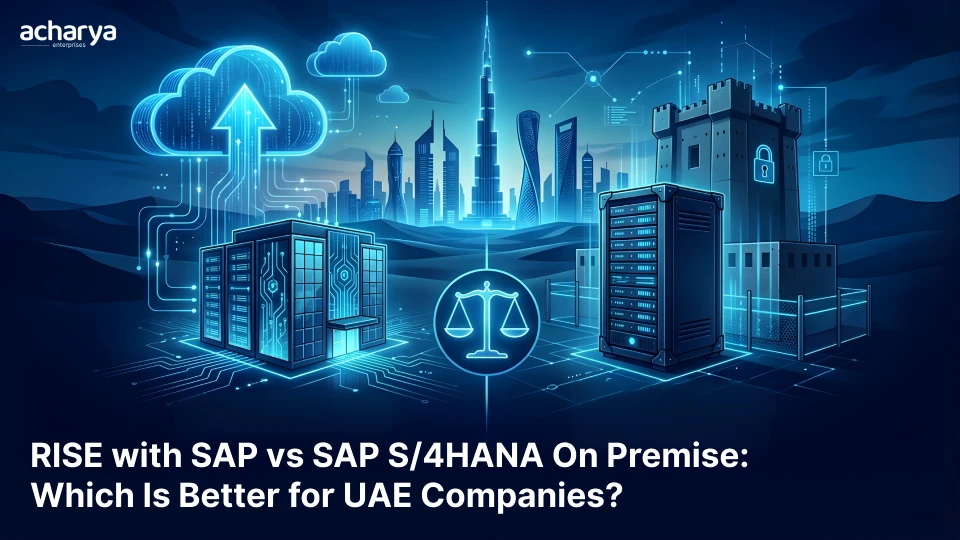
Understanding the two paths: RISE with SAP and S/4HANA on premise
RISE with SAP and on premise S/4HANA represent two fundamentally different operating models, not just hosting choices.
Understanding what each option truly includes is essential before comparing costs or features.
What RISE with SAP actually includes beyond cloud hosting
RISE with SAP is a bundled subscription offering that combines software, infrastructure, and managed services.
- SAP S/4HANA Cloud subscription
- Infrastructure hosted on approved hyperscalers
- Technical operations managed by SAP
- Standardized service level agreements
What SAP S/4HANA on premise really means for IT control and ownership
On premise S/4HANA places full responsibility for infrastructure, operations, and system management with the organization.
This model offers maximum control but also requires stronger internal capabilities.
Deployment architecture explained in simple terms
The architectural difference between the two models affects security boundaries, performance tuning, and operational responsibility.
These differences are especially relevant for UAE companies with complex environments.
How RISE with SAP is structured across hyperscalers and SAP layers
RISE with SAP runs on hyperscalers approved by SAP, with SAP managing the application layer.
- Hyperscaler manages physical infrastructure
- SAP manages the technical SAP stack
- Customer focuses on business processes and data
How on premise S/4HANA infrastructure is designed and managed
On premise deployments are designed around customer owned or dedicated data center infrastructure.
IT teams control system sizing, network design, security tools, and performance optimization.
Cost structure and total cost of ownership
Cost comparison between RISE with SAP vs S/4HANA requires looking beyond headline pricing.
Long term ownership costs often differ significantly from initial estimates.
How subscription pricing works under RISE with SAP
RISE with SAP uses a subscription based pricing model.
- Predictable recurring costs
- Infrastructure and basic operations included
- Lower upfront capital expenditure
What capital and operational costs look like for on premise SAP
On premise S/4HANA requires upfront investment in hardware, licenses, and infrastructure setup.
Ongoing costs include maintenance, upgrades, staffing, and data center operations.
Hidden costs UAE companies often overlook in both models
Hidden costs can significantly impact long term TCO.
- Custom development and integrations
- Security tooling and monitoring
- Disaster recovery setup and testing
Control, customization, and flexibility
Control and flexibility are often the deciding factors for larger UAE enterprises.
The two models offer very different levels of system freedom.
How much system control you get with RISE with SAP
RISE with SAP standardizes many technical decisions to simplify operations.
This reduces administrative burden but limits low level system access.
Customization limits and extensibility considerations
Custom code and deep system changes are more restricted under RISE.
Extensibility is encouraged through side by side development rather than core modifications.
Why some UAE enterprises still prefer full on premise control
Enterprises with complex integrations or regulatory oversight often prefer on premise control.
This allows tighter alignment with internal security and audit frameworks.
Data residency, security, and UAE compliance
Compliance and data residency are critical decision factors for UAE based organizations.
Both models can meet requirements, but responsibilities differ.
How RISE with SAP addresses data hosting and compliance in the UAE
RISE with SAP supports UAE compliance through approved data center regions.
SAP defines shared responsibility boundaries for compliance controls.
Security responsibilities shared between SAP and the customer
Under RISE, SAP manages platform security while customers manage user access and business controls.
Clear governance is required to avoid security gaps.
On premise compliance advantages for regulated industries
On premise deployments allow full customization of security architecture.
This suits government, defense, and heavily regulated sectors.
Performance, scalability, and reliability
Performance and scalability affect user experience and business continuity.
Workload patterns should guide the deployment decision.
How cloud scalability works under RISE with SAP
RISE with SAP enables elastic scaling during peak periods.
This benefits businesses with variable workloads.
Performance tuning options for on premise deployments
On premise allows fine grained performance tuning.
Dedicated resources ensure predictable system behavior.
Handling peak business cycles and mission critical workloads
Both models can support peak cycles, but planning differs.
On premise requires capacity planning, while RISE relies on cloud elasticity.
IT operations and internal resource impact
The deployment model directly impacts internal IT roles and responsibilities.
UAE companies must consider long term talent availability.
What happens to your internal IT team with RISE with SAP
RISE shifts focus from system maintenance to business support.
IT teams spend less time on infrastructure management.
Operational responsibilities in an on premise model
On premise requires dedicated teams for operations, upgrades, and security.
This increases control but also staffing complexity.
Long term skill and talent considerations in the UAE market
SAP infrastructure skills remain in high demand across the UAE.
Talent availability may influence deployment decisions.
Upgrade cycles and innovation access
Upgrade management differs significantly between the two models.
This affects how quickly organizations can adopt new SAP features.

How RISE with SAP simplifies upgrades and patches
SAP manages technical upgrades under RISE.
This reduces testing and coordination effort for customers.
Managing upgrades and testing in on premise environments
On premise upgrades require careful planning and testing.
This allows more control over timing and impact.
Speed of innovation and access to new SAP capabilities
RISE customers often gain earlier access to innovations.
On premise customers may adopt features at their own pace.
Business continuity and disaster recovery
Business continuity planning is essential for UAE operations.
Each model approaches resilience differently.
How disaster recovery is handled in RISE with SAP
RISE includes standardized disaster recovery configurations.
Recovery objectives are defined within the subscription.
Designing high availability and DR for on premise SAP
On premise DR requires separate infrastructure and testing.
This allows tailored recovery strategies.
Risk mitigation strategies for UAE based operations
Risk assessments should align with regulatory and operational needs.
Both models require clear continuity governance.
Which model fits which type of UAE company
No single model fits every organization.
Company size, industry, and growth plans should guide the choice.
Why RISE with SAP suits fast growing and mid size organizations
RISE reduces operational complexity and upfront investment.
This suits companies focused on speed and scalability.
When on premise S/4HANA makes more strategic sense
Large enterprises with complex landscapes often benefit from on premise control.
This supports customization and compliance needs.
Industry specific considerations across manufacturing, government, and services
Manufacturing may prioritize performance control.
Government often prioritizes data sovereignty.
Common decision mistakes UAE companies make
Many organizations underestimate the strategic impact of deployment choices.
Avoiding common mistakes improves long term outcomes.
Why choosing based on cost alone leads to long term issues
Lowest cost options may increase risk or limit flexibility.
TCO should be evaluated over multiple years.
Misunderstanding cloud responsibility and control trade offs
Cloud does not eliminate responsibility.
Governance remains essential.
Overlooking future business expansion and compliance needs
Deployment choices should support future growth.
Compliance requirements often evolve.
How to decide: a practical evaluation framework
A structured evaluation reduces uncertainty.
Decisions should balance business, technical, and regulatory factors.
Key questions IT and business leaders should ask internally
Organizations should assess risk tolerance, control needs, and growth plans.
Clear answers guide the final decision.
Aligning deployment choice with business goals and risk tolerance
The right model supports both strategy and compliance.
Alignment prevents rework later.
Building a roadmap that supports growth beyond 2027
The chosen deployment should remain viable beyond ECC retirement.
A long term roadmap protects the SAP investment.