SAP S/4HANA Cloud Implementation: 5 Steps That Work for UAE Companies
Why SAP S/4HANA Cloud Implementation Is a Different Kind of Project
SAP S/4HANA Cloud implementation is not an upgrade. It’s a fundamentally different way of running your ERP — and UAE companies that treat it like a traditional on-premise project end up stuck, over budget, and frustrated.
The cloud model changes the rules. You get pre-configured best-practice processes out of the box. Customization is deliberately limited. Updates happen on SAP’s schedule, not yours. That means the way you plan, design, and deliver the project must change too.
Research shows that organizations adopting S/4HANA see an average five-year ROI of 547% with a payback period of 11 months. But those results come from programs that embraced the standard approach — not ones that tried to rebuild their legacy system in a new environment.
What UAE leaders actually want from this move: faster decisions, tighter compliance, cleaner audit trails, and a system that doesn’t require constant IT firefighting.
The programs that stall share the same problems: unclear scope, poor data quality, and teams that keep pushing for legacy customizations instead of adopting the standard.
Here’s how to avoid that.
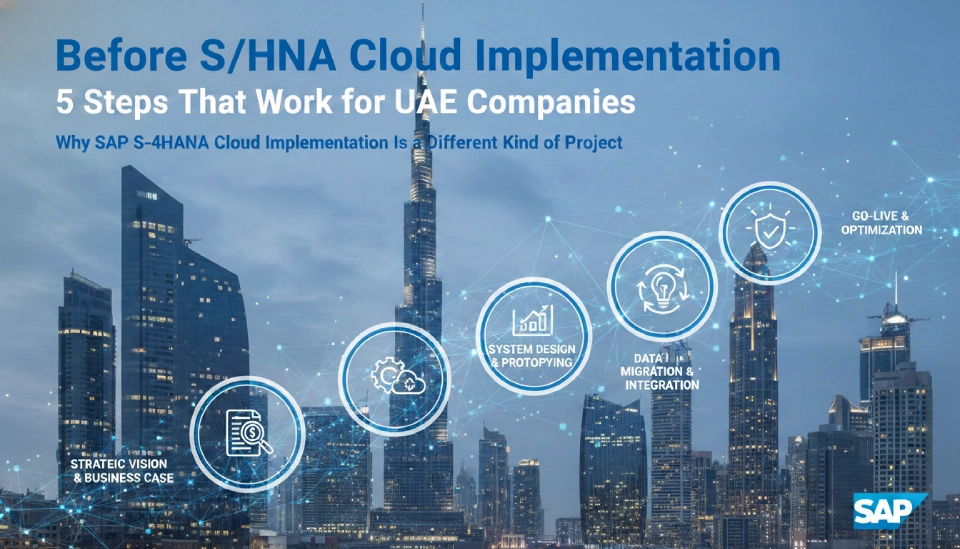
Step One: Lock Business Outcomes and Scope Before You Choose a Timeline
The most common reason UAE S/4HANA cloud programs run late is scope that wasn’t properly defined before the project started.
Start with outcomes, not features
Define the top three to five business improvements you expect to see:
- Faster financial close — how many days faster, and who owns the target?
- Better inventory accuracy — what’s the current error rate and what’s the goal?
- Improved procurement control — which approvals are currently bypassed?
These outcomes drive scope decisions. Without them, every request becomes urgent and the project never ends.
Make scope measurable and bounded
Agree in writing on:
- What processes are in scope for this phase
- What is explicitly out of scope and moved to phase two
- Who owns each process design decision and who can approve changes
Build a UAE-specific benefits story
UAE finance and leadership teams need more than generic ROI claims. Connect the project to:
- VAT compliance confidence and FTA audit readiness
- Multi-entity visibility across your Dubai, Abu Dhabi, and free zone operations
- Stronger procurement controls that reduce leakage
- Reporting that supports both internal management and external audit
Create a demo script based on your real scenarios — not generic SAP slides. Decision-makers trust what they recognize.
Step Two: Build a UAE-Ready Foundation for Compliance and Security
Skipping this step is one of the most expensive mistakes UAE programs make. Compliance and security cannot be retrofitted after go-live.
Data privacy and residency
UAE PDPL requires full compliance from January 2027. Before go-live, validate:
- Where your SAP Cloud data is hosted and whether it meets local data residency requirements
- How personal data for employees, customers, and suppliers is controlled
- Who has access to sensitive records and under what conditions
VAT and invoicing readiness
Design VAT compliance into the system from day one:
- Invoice formats and document trails that satisfy FTA requirements
- Tax reporting structures that support accurate quarterly filing
- Approval controls that prevent incorrect tax treatment
Security by design
- Role-based access with segregation of duties from the first configuration sprint
- Privileged access management for administrators
- Audit logging enabled across finance, procurement, and HR from go-live
- Incident response procedures documented before the system goes live
Connectivity planning
UAE businesses often have operations across multiple emirates, free zones, and remote warehouse locations. Map connectivity requirements early — branch offices, warehouse scanners, delivery apps, and field teams all need reliable access.
Step Three: Run Fit-to-Standard Workshops That End With Decisions
Fit-to-standard workshops are the engine of a cloud ERP program. They translate your current business processes into SAP’s pre-built standard processes — and identify where gaps genuinely exist.
The rule is simple: configuration first, extension only when absolutely necessary.
How to run workshops that work
Most workshop programs fail because they become debate sessions rather than decision sessions. Avoid this by:
- Assigning a named process owner who has authority to make decisions in the room
- Using SAP’s standard process flows as the starting point, not your legacy process documentation
- Documenting every gap as either “configure,” “extend on BTP,” or “change the business process”
- Getting written sign-off at the end of each workshop before moving to the next
Build the clean core rulebook
Agree on what you will not customize. Every customization in a cloud ERP makes upgrades harder and support more expensive. The rulebook should specify:
- No custom logic inside the S/4HANA core
- Extensions built on SAP BTP only
- Any deviation from standard requires architecture review and documented justification
Confirm integration needs
UAE companies typically need to connect S/4HANA to:
- Local bank payment formats for payment runs and reconciliation
- UAE FTA portal for VAT filing
- Logistics and warehouse management systems
- POS systems, e-commerce platforms, or customer portals
- Payroll and HR systems
Map every integration in the workshop phase. Integrations discovered late are the leading cause of go-live delays.
Step Four: Treat Data as a Product — Clean It, Govern It, Migrate Only What You Need
Data quality is the number one cause of SAP implementation failures according to implementation specialists. Yet most UAE programs still leave data work until the last two months.
Master data cleanup — before migration starts
Every duplicate, inactive, or inconsistent record you carry into S/4HANA becomes a support ticket after go-live. Clean:
- Customers and vendors: remove duplicates, update payment terms and bank details
- Materials and items: rationalize codes, units of measure, and descriptions
- Chart of accounts: align to your new reporting structure before any data loads
Define governance ownership
Decide who owns each data domain after go-live. Master data without an owner degrades within months. Finance owns the chart of accounts. Procurement owns vendor master. Operations owns material master.
Migration scope: what moves, what archives, what stays behind
- Open AR/AP, open orders, active contracts, and current stock move into S/4HANA
- Closed historical transactions go into an archive — accessible but not in the active system
- Opening balances carry forward; individual historical line items typically do not
Reconciliation and cutover design
Prove your opening balances, open item lists, and stock values are correct before any go-live decision is made. Run at least two full cutover rehearsals. Identify the highest-risk business periods — quarter-end, peak season, high-volume inventory cycles — and avoid scheduling go-live near them.
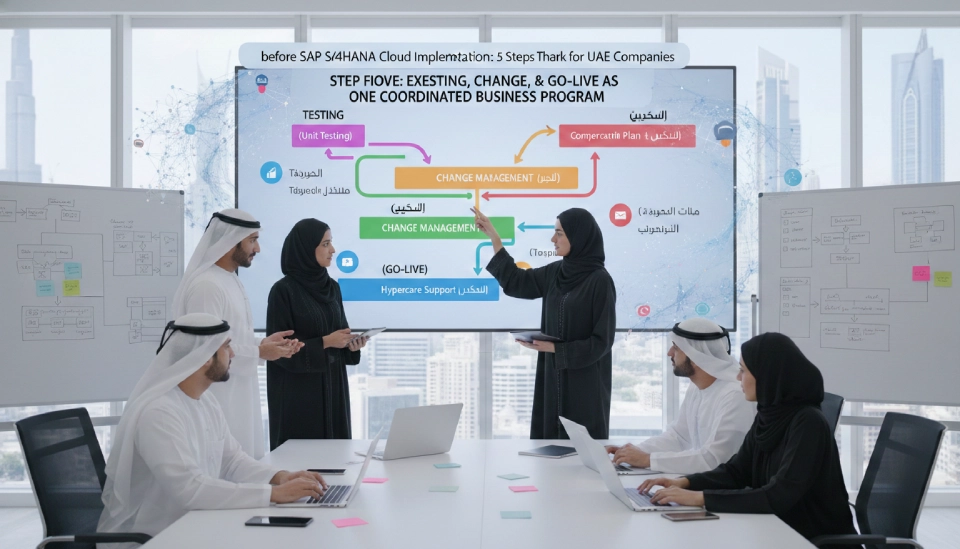
Step Five: Execute Testing, Change, and Go-Live as One Coordinated Business Program
The last stretch is where programs either land cleanly or scramble. The difference is treating go-live as a business event, not an IT event.
Testing that protects operations
Test by business risk, not by module:
- Can your finance team complete a month-end close in S/4HANA on time?
- Does the full order-to-cash cycle — order, delivery, invoice, payment — work end-to-end?
- Do bank integrations run correctly for payment runs and statement reconciliation?
- Are integration tests passing for every external system connected to SAP?
Performance testing matters in cloud environments too. Validate that the system handles your peak transaction volumes without slowing down.
User adoption that actually sticks
Generic system training fails. Role-based training works:
- Finance users train on closing, reporting, and reconciliation workflows
- Procurement users train on PO creation, approval, and goods receipt
- Warehouse and operations users train on the specific daily tasks in their role
- Super users are trained first and become the first line of support for their teams
Hypercare done right
Set up a war room for the first two weeks after go-live:
- Dedicated triage team with defined escalation paths
- Daily review of open issues ranked by business impact
- Clear rule on what triggers a go-back decision vs a fix-forward approach
Track stabilization KPIs weekly: transaction success rates, support ticket volume, close cycle time, and inventory variance.
UAE-Specific Factors That Make or Break the Program
Multi-entity structures UAE holding groups with multiple legal entities need a template approach — one entity goes first, proves the model, then rollout follows. Shared services structures need specific design for intercompany processes and group consolidation.
Banking and payment integrations Manual bank reconciliation is one of the biggest time drains in UAE finance teams. Design bank connectivity properly and automate payment runs from go-live.
Peak season planning Retail, logistics, and trading businesses in the UAE have defined peak seasons — Ramadan, major retail events, year-end. Avoid go-live in these windows. The operational pressure makes stabilization much harder.
Compliance culture Approval workflows only work if teams follow them. Design approval steps that are fast enough to use and visible enough to track. Workflows that are too cumbersome get bypassed.
Common Pitfalls to Avoid
- Trying to recreate legacy customizations in the cloud system instead of adopting standard processes
- Business SMEs unavailable for workshops because they’re pulled back to operations
- Integration scope discovered late because nobody mapped external dependencies in the planning phase
- Rushing data migration and discovering balance discrepancies during the cutover rehearsal
- Not defining phase two clearly, which causes everything to become “must have” in phase one
Go/No-Go Checklist Before You Go Live
Before committing to a go-live date, confirm:
- Configuration is locked with documented decisions and all approved gaps recorded
- Data has been migrated and reconciled with signed-off results from finance and operations
- All integrations are stable with monitoring and defined support ownership
- Every critical function has trained users and super user coverage
- Cutover has been rehearsed, hypercare is staffed, and escalation paths have been tested with real scenarios
Partner With UAE SAP S/4HANA Cloud Experts
Acharya Enterprise helps UAE organizations implement SAP S/4HANA Cloud with structured delivery, UAE-specific compliance design, and experienced teams who understand the regional business environment.
Our SAP S/4HANA Cloud implementation services cover:
- Business outcome definition and scope management
- UAE compliance, VAT, and PDPL readiness design
- Fit-to-standard workshops and process blueprinting
- Master data governance and migration management
- Integration design and build for UAE banking, logistics, and government systems
- Testing, cutover, and hypercare management
- Post-go-live managed services and continuous improvement
Contact Acharya Enterprise for a free implementation readiness assessment. We’ll review your current landscape and give you a realistic view of scope, timeline, and what it takes to go live with confidence.
About Acharya Enterprise
Acharya Enterprise is a UAE-based SAP services provider with consultants across 10+ countries, specializing in S/4HANA implementation, migration, SAP BTP, security and controls, and managed services for UAE enterprises and agency partners.
Related services: SAP S/4HANA Cloud Implementation | SAP S/4HANA UAE | RISE with SAP | GROW with SAP | Fit-to-Standard Workshop | SAP Data Migration | UAE VAT SAP | SAP Integration Suite | Change Management SAP | SAP Managed Services UAE