SAP S/4HANA Data Migration: How to Move Less and Still Gain More
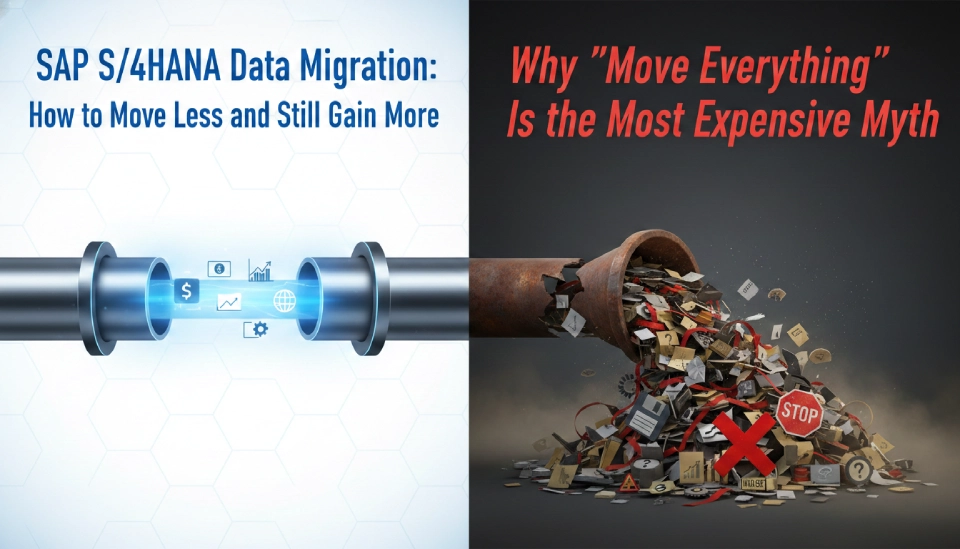
Why “Move Everything” Is the Most Expensive Myth in SAP S/4HANA Data Migration
SAP S/4HANA data migration does not have to mean hauling years of historical clutter into your new system. But that’s what most companies assume — and that assumption makes migrations slower, riskier, and more expensive than they need to be.
The default thinking goes like this: old system has ten years of data, so new system gets ten years of data. Everything moves. Everyone feels safe.
In practice, moving everything creates serious problems:
- Testing takes longer because every historical record is a potential failure point
- Cutover windows stretch because data volumes are massive
- Performance suffers as teams reconcile records nobody has touched in years
- Data quality issues from the old system follow you into the new one
- HANA’s in-memory speed cannot fix data that is dirty, duplicated, or irrelevant
According to both Gartner and the SAP User Group, data migration is one of the major causes of risk in S/4HANA programs — primarily because companies address data scope and quality too late.
The smarter goal is different: business continuity, audit confidence, and fast reporting — with only the data your business actually needs.
Your Migration Options: You Don’t Have to Bring All History
Three established approaches exist for moving to S/4HANA. Each handles data differently.
Brownfield (system conversion) Your existing ECC system is technically converted to S/4HANA. By default this brings all data, but selective strategies can reduce scope — a time-slice approach, for example, takes only historical data after a defined cut-off date rather than everything.
Greenfield (new implementation) A fresh S/4HANA system is built and only relevant, clean data is migrated from the old system. Historical data stays in ECC or moves to an archive. This is the cleanest approach for businesses with messy legacy systems.
Selective Data Transition (hybrid) Often called the “Goldilocks option,” this approach combines the best of both. The technical configuration and code base come across from ECC, but business data is selectively migrated — only the master data and transactions your business needs to operate. Older history stays accessible through a separate archive or read-only legacy system.
Selective Data Transition can reduce migration time and effort by half compared to a full brownfield conversion, according to implementation specialists who use this approach regularly.
Multi-entity and carve-out moves Large UAE groups can migrate one company code at a time, reducing single-event risk. Carve-out situations — selling a business unit or separating entities — can migrate only the data belonging to the new structure.
Define What Data You Actually Need
This is the conversation most projects skip — and then regret.
Before any technical work begins, business owners, finance leads, and operations heads should agree on four categories:
Operational must-haves (these move into S/4HANA)
- Open AR and AP items: unpaid invoices, outstanding payments
- Open purchase and sales orders not yet fully delivered
- Active contracts, service agreements, and maintenance items
- Current master data: active customers, vendors, materials, and cost centers
Legal and audit must-haves (these must be accessible, not necessarily in the core)
- Documents required under UAE retention obligations — typically 5 to 10 years for financial records
- Audit evidence for completed transactions
- Regulatory filings and tax documentation
Analytics wants vs operational needs
Finance teams often want years of trend data. That data does not need to live inside S/4HANA to be available for reporting. It can live in an archive or a separate analytics layer and still be used for year-on-year comparisons.
“Nice to have” data that creates “nice to troubleshoot” problems
Closed purchase orders from five years ago. Fully settled invoices with no audit relevance. Inactive customer records. These add migration cost, testing time, and database size without adding business value.
What Typically Moves and What Typically Doesn’t
Master data — moves, but cleaned first Customers, vendors, materials, and chart of accounts must come across. The critical point: only active, clean records. Duplicate vendors, inactive materials, and outdated customer codes should be resolved before migration, not carried forward.
Open transactional data — moves Any transaction not yet completed goes into S/4HANA. Open purchase orders, open sales orders, outstanding invoices, in-progress deliveries, and open production orders all need to be in the new system from day one.
Balances and summaries — often a better option than line items Instead of migrating every historical journal entry line by line, finance teams can carry forward opening balances and summarized account totals. This is dramatically faster, easier to reconcile, and still gives a correct starting position.
Closed historical transactions — typically archived, not migrated Fully settled invoices, completed delivery documents, closed purchase orders, and cleared payments do not need to live in S/4HANA. They belong in an archive where they remain searchable and retrievable for audit purposes.
Attachments and documents Decide what moves, what links externally, and what archives. Not everything needs to be inside S/4HANA — but everything legally required must be retrievable within minutes.
Three Strategies That Make “Less Data” Work in Practice
Data archiving before migration Archive closed data in ECC before the migration starts. This reduces the source system volume and makes the migration itself faster. SAP Information Lifecycle Management (ILM) is the standard tool for this. Some industries require 7 or more years of data to be retained but not necessarily inside the active ERP.
External archive with retained access Historical data moves into an archive solution where users can search and retrieve documents without logging into a live ECC system. Finance and audit teams can still pull invoices, purchase orders, and payment records — they just do it through the archive rather than through the ERP.
Read-only legacy system for a defined period Some UAE companies keep the old ECC system running in read-only mode for 6 to 12 months after go-live. Users access history there while all new transactions happen in S/4HANA. This approach requires a clear retirement plan and an end date — otherwise the old system runs forever and you pay for both.
How to Keep History Accessible Without It Living in S/4HANA
The biggest worry teams have about leaving data behind is: “What if someone needs it?”
That’s a legitimate concern. The answer is designing retrieval, not resisting archiving.
Users need a clear promise: historical documents are findable in under two minutes. Deliver that through:
- An archive tool with a simple search interface by document number, vendor, date, or amount
- Trained users who know which system to check for which type of record
- Audit retrieval workflows that produce compliant evidence packs without scrambling
Year-on-year reporting continuity is handled by keeping summarized financial data available in your analytics layer — either in SAP Analytics Cloud on BTP or in a retained reporting environment fed from both systems.
Keeping Selective Migration Safe: What Must Be Controlled
Moving less data is only smart if the data that moves is verified correct. Controls that prevent go-live surprises:
- Data quality validation rules applied before anything loads into S/4HANA
- Reconciliation scripts proving opening balances, open AR/AP totals, and stock values match the source
- Cutover rehearsals — SAP recommends running at least two full dress rehearsals before go-live weekend
- Integration readiness validation — bank connections, logistics platforms, and third-party systems must work correctly when history is split across two environments
- Role-based security on archived historical data — sensitive financial and HR records need access controls even in archive
Change management matters here too. Teams need to know exactly where to find documents that used to be in one system and now live in two different places.
Common Mistakes That Make Selective Migration Fail
These are the patterns that consistently cause problems:
- Not aligning finance, audit, and operations upfront on what “accessible history” actually means — everyone has a different answer until you force the conversation
- Migrating dirty master data and recreating old problems in the new system — inactive vendors, duplicate materials, and outdated cost centers should be retired before cutover
- Underestimating attachments and document trails — approval documents, goods receipt notes, and email chains linked to transactions are frequently forgotten until audit asks for them
- Forgetting edge cases: returns with open credit notes, long-open purchase orders spanning the go-live date, and partial deliveries require specific handling
- Treating reporting as an afterthought and losing year-on-year comparability
- Keeping the legacy system without a retirement plan and paying for two ERP environments indefinitely
A Practical Roadmap for Migrating With Less Data
Discovery and classification Categorize all data: what moves into S/4HANA, what archives, and what retires. Get business sign-off before IT extracts anything.
Archiving and cleanup in legacy Archive closed transactions and clean master data in ECC before starting migration work. This reduces volume and removes problems at the source.
Target design for access and reporting Define how users access history post-go-live. Build the archive or read-only approach. Confirm that reporting continuity is designed, not assumed.
Build and dry runs Run mock data loads, reconciliations, and cutover rehearsals. Identify issues before they become go-live emergencies. Test integration stability when history is split across systems.
Go-live and stabilization Triage issues by business impact. Support users through the transition period. Track which data retrieval questions come up repeatedly and fix the process around them.
Legacy retirement Set a firm end-date for the old system. Define governance for the transition period. Decommission on schedule and don’t let “we might need it” extend the timeline forever.
Are You Ready to Migrate With Less Data? Quick Checklist
Before committing to a selective migration approach, confirm these are in place:
- Clear legal retention requirements and audit expectations agreed with your legal and finance team
- A defined “minimum viable data” set for operations and finance signed off by business owners
- A designed archive or read-only access approach with trained users who know how to use it
- Proven reconciliation scripts and sign-off criteria that confirm opening balances are correct
- A cutover plan that avoids peak financial close periods, quarter-end, or major operational cycles
Partner With UAE SAP Data Migration Experts
Acharya Enterprise helps UAE organizations design and execute SAP S/4HANA data migration programs that move the right data — not all of it. Our team handles data classification, archiving strategy, selective migration design, reconciliation, and cutover management.
Our data migration services include:
- Data landscape discovery and classification workshops
- Legacy archiving and data reduction planning
- Selective Data Transition program design and delivery
- Master data cleansing and harmonization
- Reconciliation and cutover management
- Archive solution design and user training
- Post-go-live legacy retirement planning
Contact Acharya Enterprise for a free data migration assessment. We’ll review your current data landscape and give you a clear view of what needs to move, what should archive, and what should be retired — before your program budget is committed.
About Acharya Enterprise
Acharya Enterprise is a UAE-based SAP services provider with consultants across 10+ countries. We specialize in S/4HANA migration, data migration strategy, SAP implementation, security and controls, and managed services for UAE enterprises and agency partners.
Related services: SAP S/4HANA Migration | SAP Data Migration UAE | Greenfield Implementation | Brownfield Conversion | Selective Data Transition | SAP Data Archiving | Master Data Management | SAP Cutover Management | UAE SAP Consulting | SAP Managed Services