SAP S/4HANA Roadmap for Multi Entity Groups in UAE: Phases, Risks and Governance
SAP S/4HANA roadmap UAE planning becomes significantly more complex when organizations operate multiple legal entities, shared services, and cross border structures. For UAE based groups, a successful roadmap must balance group wide standardization, local compliance, risk control, and long term scalability.
Why SAP S/4HANA programs are more complex for multi entity groups in the UAE
Multi entity SAP programs introduce complexity that single entity implementations do not face.
UAE groups must manage regulatory differences, intercompany processes, and shared services without disrupting daily operations.

Understanding multi entity SAP landscapes in the UAE
Multi entity landscapes combine centralized systems with local operational requirements.
Understanding this structure is essential before designing any roadmap.
What defines a multi entity group in the UAE context
Multi entity groups typically operate under a holding structure with multiple legal entities.
These entities may differ by industry, geography, and regulatory obligations.
Shared services, local entities, and cross border operations explained
Many UAE groups run shared finance, procurement, or HR services.
At the same time, local entities must comply with country specific tax, reporting, and audit rules.
Why legacy SAP structures struggle at group scale
Legacy ECC systems often evolved through local customizations.
At group scale, this results in inconsistent processes, fragmented data, and limited visibility.
Strategic objectives before building the roadmap
A strong SAP S/4HANA roadmap UAE must start with clear strategic objectives.
Technology decisions should follow business priorities, not the other way around.
Aligning the S/4HANA program with group level business goals
Group leadership must define what success looks like across the organization.
This may include financial transparency, faster closes, or operational efficiency.
Balancing standardization with local entity flexibility
Not all processes should be identical across entities.
The roadmap must define where standardization is mandatory and where flexibility is allowed.
Defining success metrics across finance, operations, and IT
Clear metrics help measure progress and value realization.
These should be agreed upon before design begins.
Designing the SAP S/4HANA roadmap
Roadmap design determines how complexity is managed over time.
For multi entity groups, sequencing and structure are critical.
Core system design for group wide visibility and control
The core system must support consolidated reporting and intercompany processing.
This enables leadership to view performance across the entire group.
Deciding between single global instance and phased entity rollout
A single global instance simplifies reporting but increases initial risk.
Phased rollouts reduce risk but require strong integration and governance.
Sequencing entities based on risk, readiness, and business impact
Entities should be grouped into rollout waves.
Factors include data quality, process maturity, and operational criticality.
Phased implementation approach
A phased approach reduces disruption and allows lessons learned to be applied.
This is especially important for UAE groups with mission critical operations.
Pilot phase and template validation for one or two entities
The pilot phase validates core design assumptions.
It helps identify gaps before broader rollout.
Wave based rollouts across remaining group companies
After the pilot, entities are migrated in controlled waves.
This allows better resource planning and risk management.
Managing dependencies between finance, supply chain, and reporting
Functional dependencies must be clearly mapped.
Finance, logistics, and reporting changes must be coordinated.
Data governance and master data strategy
Data governance is one of the most critical success factors.
Without it, group wide reporting and automation fail.
Creating a single source of truth across all entities
Group wide master data standards enable consistent reporting.
This reduces reconciliation effort and errors.
Harmonizing chart of accounts, vendors, and customers
A harmonized chart of accounts is essential for consolidation.
Vendor and customer data must follow shared standards.
Managing local data requirements without breaking group standards
Local regulatory data must be supported without customization overload.
This requires clear data ownership and governance rules.
Risk management across the program
Multi entity S/4HANA programs introduce risks at multiple levels.
Proactive risk management is essential.
Common risks in multi entity S/4HANA transformations
Typical risks include scope creep, data inconsistency, and change fatigue.
These risks increase with the number of entities involved.
Managing business disruption during parallel entity rollouts
Parallel rollouts can strain shared services and support teams.
Careful scheduling and contingency planning reduce disruption.
Controlling scope creep and customization overload
Strong design authority is needed to prevent excessive customization.
Exceptions must follow formal approval processes.
Governance model for large SAP programs
Governance determines how decisions are made and enforced.
Weak governance leads to delays and inconsistent outcomes.
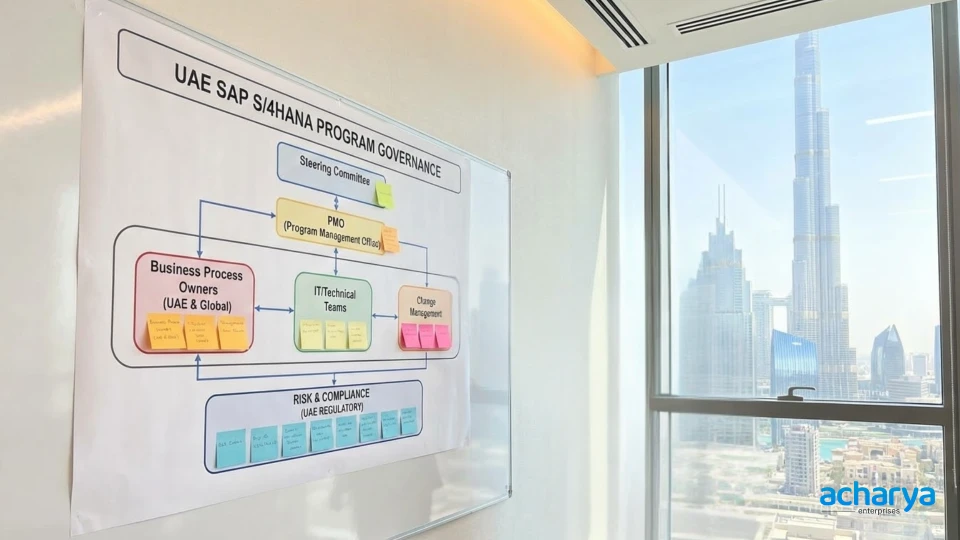
Establishing clear decision rights at group and entity levels
Decision rights must be defined early.
This avoids conflicts between group and local priorities.
Role of steering committees, PMO, and functional leads
Steering committees provide strategic direction.
PMOs coordinate delivery and manage risks.
Managing partner accountability and delivery transparency
Partners must be accountable for timelines, quality, and outcomes.
Transparent reporting builds trust and control.
Change management and user adoption at scale
User adoption determines whether the roadmap delivers value.
At scale, change management becomes a program of its own.
Handling cultural and process differences across entities
Different entities may have different working cultures.
Change strategies must respect these differences.
Training strategies for shared services and local teams
Training must be role based and phased.
Shared services and local users require different approaches.
Driving adoption without slowing daily operations
Training and cutovers should avoid peak business periods.
This protects productivity and morale.
Security, controls, and compliance
Security design becomes more complex in multi entity environments.
Controls must work across legal boundaries.
Managing access controls across multiple legal entities
Role design must prevent excessive access.
Entity based restrictions are critical.
Segregation of duties in group finance environments
SoD conflicts increase with shared services.
Automated monitoring reduces audit risk.
Ensuring audit readiness throughout the transformation
Audit readiness should be maintained during all phases.
Controls must be tested continuously.
Post go live optimization and continuous governance
The roadmap does not end at go live.
Long term success depends on continuous improvement.
Stabilization period and hypercare for all entities
Hypercare supports users during the transition.
Issues must be resolved quickly to build confidence.
Measuring value realization at group and entity levels
Value metrics should be reviewed regularly.
This ensures the program delivers expected benefits.
Building a long term governance model beyond implementation
Governance must continue after implementation.
This protects standardization and supports future growth.