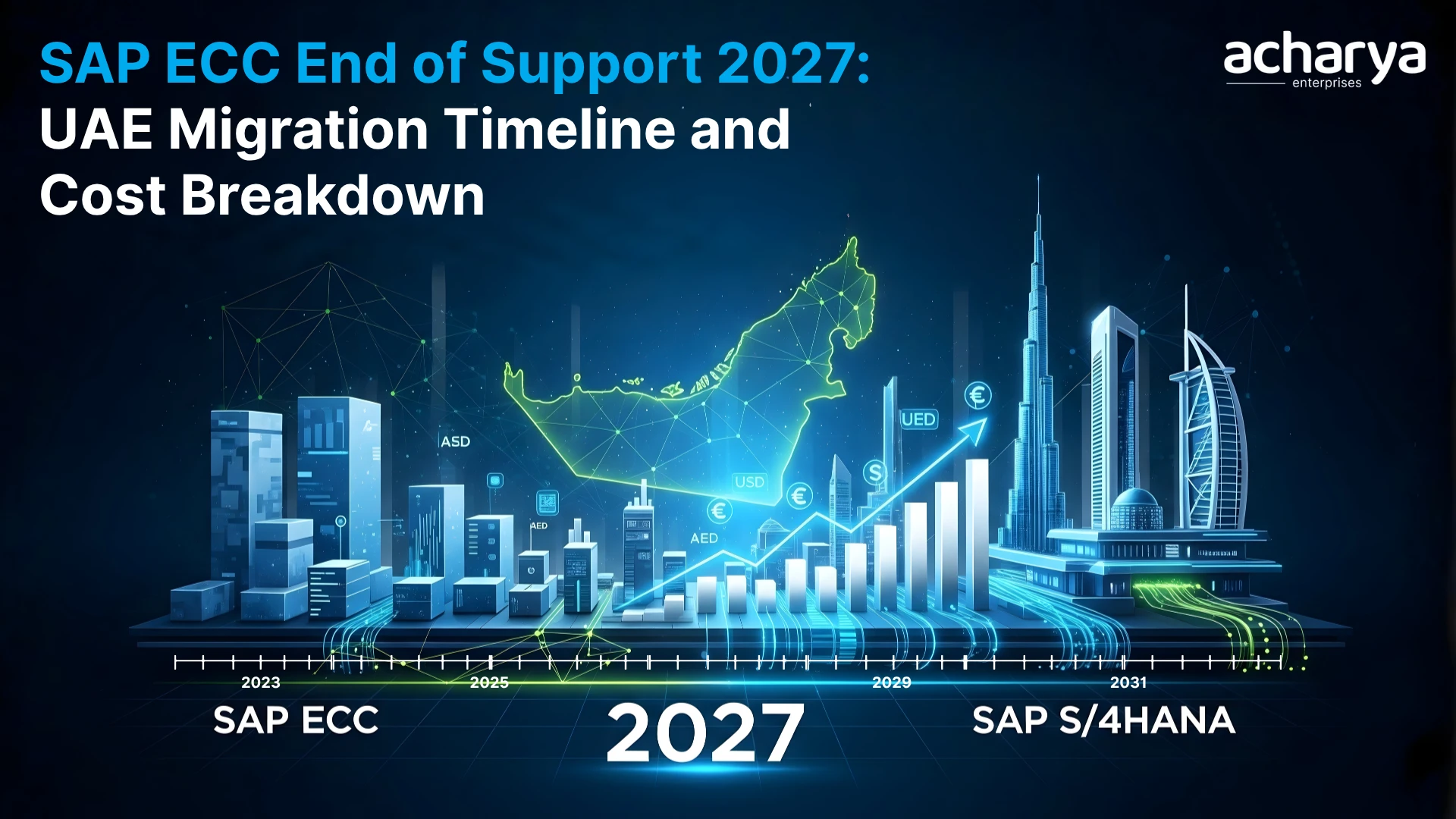
Your SAP ECC Has a Hard Deadline. Here’s What You Need to Know
SAP ECC stops getting support on December 31, 2027. That’s the deadline. If you’re still running ECC after that date, you’re on your own. No patches, no updates, no support from SAP. Most UAE organizations need 18 to 48 months for SAP migration 2027, which means your start date might already be overdue.
This guide breaks down everything you need to know: how much time you have, how much it costs, and when you must actually start. If your organization still runs ECC, these numbers matter to your budget and timeline right now.
When Does Your SAP ECC Support Actually End in 2027?
SAP ECC support ends on December 31, 2027. After that date, SAP provides nothing: no security updates, no bug fixes, no technical support.
What happens after 2027:
- No security patches for new vulnerabilities
- No assistance with system failures or errors
- No help with compliance or regulatory changes
- System continues running, but you’re completely alone
Why this deadline is real:
This isn’t optional or flexible. It’s the same deadline globally. Every organization running ECC must transition off the system by end of 2027 or accept significant risk.
UAE organizations face additional pressure:
Government digital transformation initiatives expect modern systems. Industry regulators (DHA for healthcare, DFSA for financial services) increasingly require modern platforms for compliance. Running unsupported ECC makes compliance harder and more expensive.
The business reality:
Staying on ECC after 2027 means paying 2-3x normal support costs for extended support agreements. You’ll pay more, get less, and still need to migrate eventually. Every month you wait costs money.
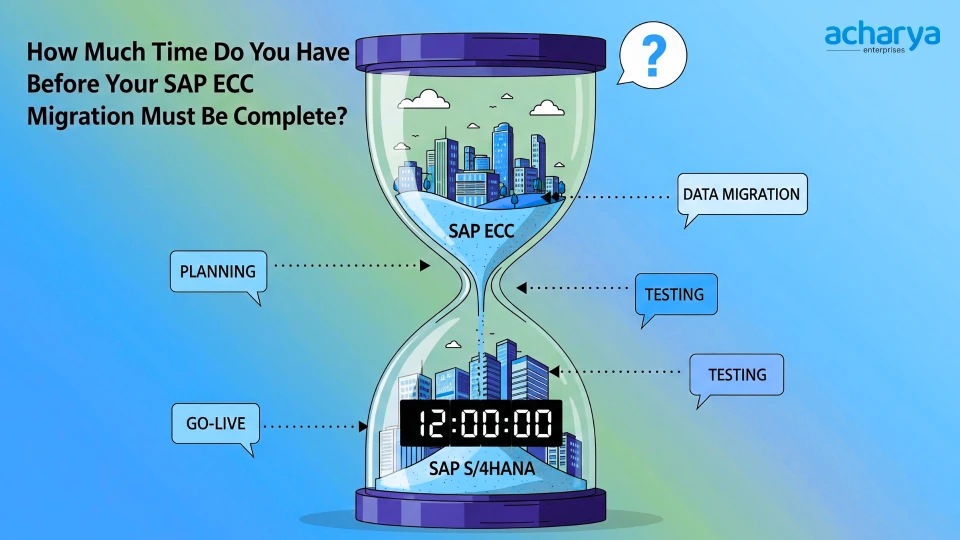
How Much Time Do You Have Before Your SAP ECC Migration Must Be Complete?
Your deadline is December 31, 2027, but your migration start date is much sooner. Most organizations need 24 to 48 months for migration. Do the math: 2027 deadline minus your migration duration equals your start date.
Timeline reality check:
If migration takes 24 months: you need to start by late 2025 (it’s already late 2025, so you’re already tight) If migration takes 36 months: you need to start by mid-2024 (you’re already behind) If migration takes 48 months: you needed to start in 2023 (definitely overdue)
Why these timelines matter:
Organizations that plan ahead finish comfortably and control costs. Organizations that wait get rushed, pay 30-50% more, and take on higher risk. Rushed migrations have more problems during go-live.
The cost of waiting:
Starting in 2026 instead of 2025 doesn’t save 12 months of cost. It creates compressed timelines that cost more, not less. You pay overtime for consultants, sacrifice quality for speed, and experience more post-go-live issues.
Your action right now:
If you haven’t started your SAP migration 2027 assessment, you’re running out of comfortable planning window. Even 24-month migrations require 2-3 months of planning before actual implementation begins.
How Long Does S/4HANA Migration Actually Take?
Migration timeline depends on system complexity, not organizational size. A small company with simple systems migrates in 18 months. A complex organization with 20 years of customization needs 36-48 months.
Timeline breakdown by complexity:
Small, simple organizations:
- 18 to 24 months
- Minimal custom code
- Few interfaces to other systems
- Straightforward business processes
Mid-size organizations:
- 24 to 36 months
- Some custom developments
- Multiple system integrations
- Some complex processes
Large, complex organizations:
- 36 to 48 months (or longer)
- Extensive custom code requiring redesign
- Many system interfaces
- Complex, evolved business processes
- Multiple locations or business units
What determines YOUR timeline:
The complexity assessment happens early in migration planning. You examine your ECC system, count custom code, map interfaces, and document business requirements. This assessment determines realistic timeline and cost for your specific situation.
Critical factor: Migration approach
Brownfield (upgrading current system) typically takes 10-20% longer than greenfield (starting fresh). Hybrid approaches land in the middle. Your chosen approach affects timeline.
Why timeline accuracy matters:
Underestimating timeline means rushed execution, compressed testing, and higher go-live risk. Overestimating timeline burns budget and delays benefits realization. Accurate timeline assessment prevents both problems.
What’s the Real Cost of S/4HANA Migration for UAE Organizations?
S/4HANA migration costs range from AED 5 million to AED 50+ million depending on complexity and organization size. Most mid-size UAE organizations budget AED 10 to 25 million.
Cost breakdown for typical mid-size organization:
Software licensing: AED 1-3 million
- S/4HANA software licenses
- Database and infrastructure software
- Ongoing annual support
Professional services: AED 3-8 million
- Consulting and design
- Implementation and development
- Testing and quality assurance
- Project management
Internal resources: AED 2-5 million
- Your team’s time (opportunity cost)
- Internal testing and validation
- Business process redesign work
- Change management effort
Infrastructure and tools: AED 1-3 million
- Hardware upgrades or cloud infrastructure
- Testing tools and environments
- Networking and integration tools
- System setup and configuration
Training and change management: AED 1-2 million
- User training programs
- Documentation
- Change management consulting
- Post-go-live support
What these costs include:
Your budget covers everything from assessment through 3-6 months post-go-live support. It includes licensing costs, professional services from implementation partners, your internal team effort, infrastructure investments, and hypercare support during stabilization.
UAE-specific cost factors:
Local SAP expertise typically costs 15-25% more in UAE market compared to offshore resources. However, local teams reduce timezone delays and travel costs, often making the total cost comparable. Government and healthcare organizations often budget 20% more due to compliance complexity.
Does Brownfield or Greenfield S/4HANA Migration Cost More?
Neither approach costs consistently less. Costs differ in where the money goes. Brownfield costs more for professional services. Greenfield costs less for implementation but more for change management and training.
Brownfield approach (keeping current setup, upgrading):
Cost profile: AED 12-18 million
- Higher professional services (remediate custom code)
- Lower software and infrastructure costs
- Moderate change management
- Faster timeline (24-36 months typical)
Best for: Stable organizations satisfied with current processes
Greenfield approach (new system, clean design):
Cost profile: AED 10-20 million
- Lower professional services (build clean, not remediate)
- Moderate software costs
- Higher change management (bigger organizational change)
- Moderate timeline (18-30 months typical)
Best for: Organizations wanting to modernize business processes
Hybrid approach (mix both):
Cost profile: AED 11-18 million
- Balanced services costs
- Balanced change management
- Modernizes some areas, preserves others
- Moderate timeline (24-36 months)
Best for: Most organizations (balances cost and transformation)
The real cost question:
Don’t ask “which approach costs less?” Ask “which approach delivers the best return on investment for my organization?” Greenfield costs less to implement but requires bigger organizational change. Brownfield costs more to implement but requires less change management.
An organization that can handle significant change might find greenfield delivers better long-term ROI. An organization with limited change capacity might find brownfield lower total cost because change management costs stay lower.
Your choice depends on:
- How satisfied you are with current business processes
- Your organization’s appetite for change
- Your available budget and timeline
- Your competitive pressures and modernization needs
What Hidden Costs Do Organizations Miss in SAP Migration Budgets?
Organizations often leave AED 1-5 million of costs out of initial budgets. These hidden costs add 20-30% to project budgets if not identified upfront.
Common hidden costs that surprise organizations:
Data cleansing: AED 300k-800k
- Legacy systems have duplicate records, incomplete data, obsolete information
- Cleaning data before migration takes 2-3 months and dedicated effort
- Cost to identify and fix problems in source systems
Custom code remediation: AED 500k-2 million
- Years of custom code modifications must be redesigned for S/4HANA
- Some customizations become unnecessary in modern system
- Some require complete rebuilding in new architecture
Infrastructure upgrades: AED 400k-1.5 million
- S/4HANA requires more computing power than legacy ECC
- Cloud migration costs, database infrastructure, network upgrades
- Often underestimated by IT teams during initial planning
Extended team disruption: AED 300k-1 million
- Your team members spend time on migration (opportunity cost)
- Projects are delayed while resources focus on migration
- Productivity loss during implementation and cutover
Post-go-live support (hypercare): AED 200k-600k
- 4-12 weeks of intensive support after go-live
- Extra staffing to handle user questions and issues
- Often treated as optional, then becomes necessary emergency spending
Business process redesign effort: AED 400k-1.2 million
- Organizations using this opportunity to improve processes
- Consulting for process redesign and change management
- Training and documentation for new processes
Why these costs get missed:
Initial budgets focus on obvious costs: software, services, hardware. Hidden costs emerge during detailed planning or after project starts. Organizations that identify these upfront avoid budget overruns and approval delays.
Budgeting recommendation:
Add 20-30% contingency to your estimated costs to cover hidden factors. This prevents surprises later and shows realistic planning to leadership.
When Should You Actually Start Your S/4HANA Migration?
Your start date equals 2027 deadline minus migration duration minus 3-6 month safety buffer.
The calculation:
1 Example: 36-month migration
- 2027 deadline: December 31, 2027
- Migration duration: 36 months
- Safety buffer: 6 months
- Start date: June 2024 (already overdue)
2 Example: 24-month migration
- 2027 deadline: December 31, 2027
- Migration duration: 24 months
- Safety buffer: 6 months
- Start date: December 2025 (very tight now)
3 Example: 18-month migration
- 2027 deadline: December 31, 2027
- Migration duration: 18 months
- Safety buffer: 3-6 months
- Start date: June-September 2026 (possible but tight)
Why the safety buffer matters:
Migrations rarely follow perfect schedules. Testing takes longer than expected. Go-live delays happen. Discovering unexpected system complexity requires additional planning. Your 3-6 month buffer prevents deadline panic when delays inevitably occur.
The reality for most organizations:
It’s late 2025. If your migration takes 24-36 months (typical for most), you’re already late or cutting it very close. Starting in January 2026 is possible for 18-month migrations, but leaves almost no buffer for delays.
What “starting” means:
Starting your SAP migration 2027 doesn’t mean implementation begins immediately. It means beginning assessment, planning, resource allocation, and vendor selection. These planning activities take 2-3 months before implementation actually starts.
Your decision:
If you haven’t started planning your migration, begin this month. Assessment and planning take time. Implementation follows planning. Every month of delay compresses your timeline and increases risk and cost.
Can You Keep Running SAP ECC After 2027 Without Migrating?
Technically yes, but it’s expensive and risky. You can stay on ECC after 2027, but only with SAP Extended Support agreements that cost 2-3x your normal support costs.
Extended Support details:
Cost: AED 2-5 million per year (typical for mid-size organization) Duration: Extends 3-5 additional years beyond 2027 Coverage: Limited support for critical issues, no new functionality
What Extended Support doesn’t cover:
- Security patches for new vulnerabilities
- Compliance updates for regulatory changes
- Performance optimization for modern requirements
- Integration with new technologies or systems
- Support for newer database versions
The business case against staying on ECC:
You still migrate eventually. You’re not avoiding migration, you’re delaying it and paying more. If you extend support 3 years, you migrate in 2030 at much higher cost and with outdated systems.
Why compliance pressure forces migration:
Government digital transformation mandates expect modern systems. Healthcare organizations need DHA-compliant systems. Financial organizations need DFSA-compliant infrastructure. Running 10-year-old ECC systems makes compliance increasingly difficult and expensive.
The cost comparison:
Migrating now (2025-2027): AED 15 million one-time cost Extending support 3 years (2027-2030): AED 6-15 million support cost, then AED 20 million migration cost in 2030 Difference: You pay more total and delay modernization benefits by years
The reality:
Every organization eventually migrates. The question isn’t whether to migrate, but when. Migrating on schedule costs less and delivers benefits sooner. Delaying migration only increases total cost.
How Do You Build a SAP Migration Budget and Timeline for 2027?
Start with complexity assessment, calculate total cost with contingency, break into annual budgets, and present to leadership with clear ROI and risk explanation.
Step 1: Complexity assessment (1-2 months)
Answer these questions:
- How much custom code exists in your ECC system?
- How many custom interfaces connect to other systems?
- What’s your data quality? How much cleansing is needed?
- How satisfied are you with current business processes?
This assessment determines: realistic timeline, scope of professional services needed, required infrastructure changes
Step 2: Calculate total cost based on approach
Choose your migration approach: Brownfield, Greenfield, or Hybrid Factor in your complexity: Simple (AED 5-10M), Medium (AED 10-20M), Complex (AED 20-50M) Verify with professional services partner who understands your situation
Step 3: Add 20% contingency for hidden costs
If your estimate is AED 15 million, add AED 3 million contingency This covers data cleansing surprises, infrastructure upgrades, extended effort Shows leadership you’ve thought realistically about unknowns
Step 4: Build annual budgets showing go-live before 2027
Year 1: Assessment, planning, licensing setup (AED 2-4M) Year 2: Implementation, testing, training (AED 5-10M) Year 3: Go-live, hypercare, stabilization (AED 2-5M) Year 4 (if needed): Optimization, extended initiatives (AED 1-2M)
Total multi-year budget shows when investment occurs and when benefits arrive.
Step 5: Present to leadership with risk explanation
Show what happens if you don’t migrate:
- 2027: ECC goes unsupported, compliance risk increases
- 2028-2030: Pay 2-3x support costs for Extended Support
- 2030+: Forced migration at higher cost with less planning time
Show migration benefits:
- Lower annual operating costs (15-25% reduction typical)
- Better compliance and security
- Access to modern technology capabilities
- Competitive advantage through faster decision-making
Making the business case:
SAP migration 2027 isn’t an IT project. It’s a business transformation that delivers financial and operational benefits. Present it that way to leadership.
Real benefits include:
- AED 1-3 million annual cost reduction through operational efficiency
- Faster reporting and decision-making (improves competitiveness)
- Better compliance (reduces regulatory risk)
- Technology readiness (enables future innovations)
Migration cost is an investment that pays back through operational improvements.
Timeline summary for UAE organizations:
Most UAE organizations should start planning immediately (if not already started). Assessment and planning take 2-3 months. Implementation takes 18-48 months depending on complexity. Go-live must occur before end of 2027.
You have limited planning window. Acting now gives you control over timeline and budget. Waiting makes both worse.
Your 2027 Deadline Decision
The 2027 deadline is real and inflexible. Every UAE organization running SAP ECC must plan their migration. The decision isn’t whether to migrate, but when and how.
Organizations that start now:
- Control their timeline
- Spread costs across multiple budget years
- Execute migrations with fewer surprises
- Realize benefits sooner
Organizations that wait:
- Face compressed timelines
- Pay 30-50% more for rushed execution
- Experience higher go-live risk
- Delay benefit realization
Your realistic migration timeline (18-48 months) determines your start date. Your budget (AED 5-50 million) requires planning and leadership approval. These decisions can’t be made last minute.
If your organization still runs SAP ECC and hasn’t started migration planning, your action window is closing. The time to plan and budget is now, not 2026.
GET YOUR MIGRATION STRATEGY IN PLACE
Acharya Enterprise helps UAE organizations navigate SAP migration planning and execution. We combine 10+ years of global SAP experience with deep UAE market expertise, helping organizations make smart migration decisions that deliver results.
How we help:
Migration planning: We develop realistic timelines, budgets, and implementation roadmaps that leadership can approve with confidence.
Pre-migration assessment: We evaluate your ECC system complexity, identify hidden challenges, and recommend the approach that fits your situation and budget.
End-to-end execution: Our Full Implementation + License + Support service covers everything from assessment through post-go-live optimization, with dedicated team support every phase.
Post-go-live success: Our hypercare and optimization services ensure your team adopts S/4HANA effectively and realizes projected benefits.
If you’re facing the 2027 deadline:
Contact Acharya Enterprise for a confidential migration assessment. Our UAE-based team can evaluate your specific situation, clarify your realistic timeline and cost, and help you build a migration strategy that works for your organization.
We work as your partner through the entire migration journey, not just vendors handing off a project. Your success is our success.
Ready to start your SAP migration 2027 planning?
Contact us today. Let’s talk about your ECC system, your budget, your timeline, and your path forward.