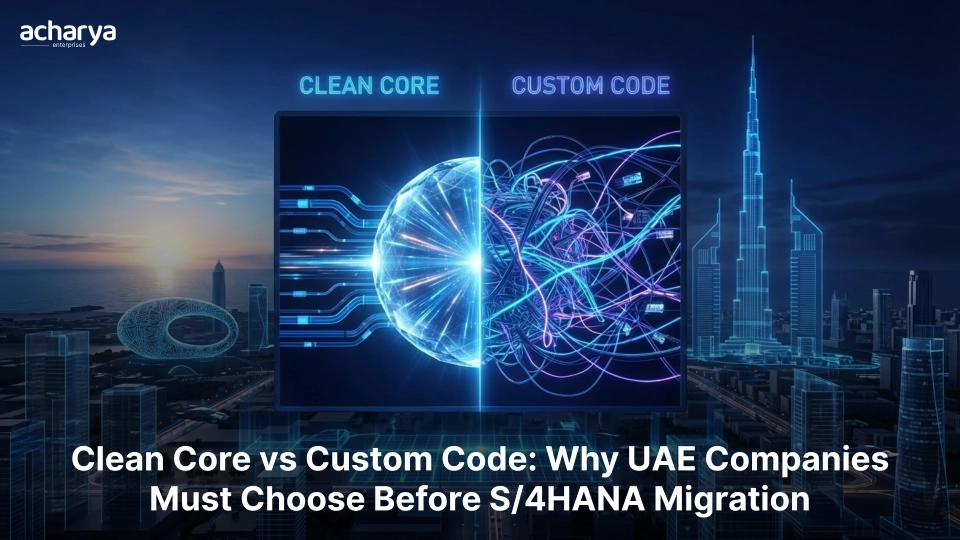
The Critical Choice: Clean Core vs Custom Code in Your S/4HANA Journey
Every UAE company planning S/4HANA migration faces a decision that will shape their SAP landscape for the next decade. The clean core vs custom code debate is no longer just a technical discussion between developers.
This choice determines your migration cost, implementation timeline, upgrade cycles, and ability to adopt new SAP innovations. It affects your IT budget for years to come.
Companies moving from SAP ECC to S/4HANA discover that their old approach to customization doesn’t work anymore. SAP’s architecture has fundamentally changed. The 2027 ECC support deadline adds urgency to these decisions.
Research shows that 91% of SAP users rely on custom code for essential business processes. Yet 60% of that custom code typically needs modification during S/4HANA migration. Some of it won’t work at all.
This blog explains what clean core really means, when custom code still makes sense, and how UAE companies can make the right choice before starting their migration.
What “Clean Core” Actually Means in SAP S/4HANA
Clean core isn’t about having zero customizations. That’s the biggest misconception UAE companies have.
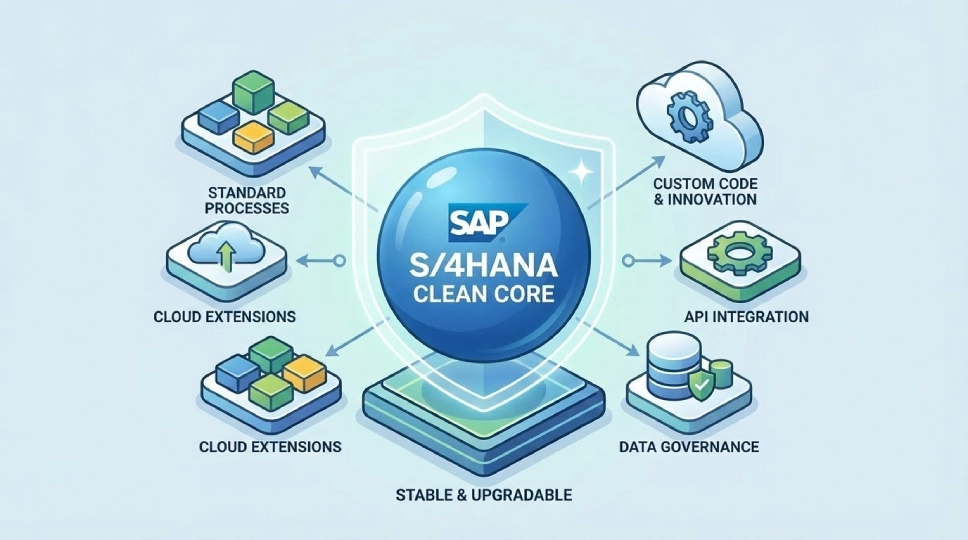
A clean core means keeping your SAP system as close as possible to the standard while handling modifications through proper extensibility methods. Think of it as keeping your ERP system organized and upgrade-ready.
Defining clean core beyond marketing language
SAP defines clean core through six key components:
- Processes: Use SAP standard processes wherever possible. Customize only when truly needed.
- Extensibility: Build extensions using approved SAP frameworks, not by modifying core code.
- Integration: Connect systems through clean APIs and integration platforms.
- Data: Maintain high-quality, complete, and accurate data throughout the system.
- Operations: Keep software current with regular updates and patches.
- Governance: Enforce rules that prevent new technical debt from accumulating.
The principles SAP expects customers to follow
SAP’s clean core approach requires companies to:
- Avoid modifications to standard SAP objects
- Use only released and documented APIs for extensions
- Build custom functionality outside the core system when possible
- Adopt SAP Best Practices instead of reinventing processes
- Maintain upgrade compatibility through proper development methods
These aren’t optional suggestions. They’re essential for staying current with SAP’s innovation roadmap.
What stays in the core and what moves outside
Core system includes:
- Standard SAP transactions and processes
- Configuration (customizing tables)
- Master data and transactional data
- Approved in-system extensions using SAP frameworks
Outside the core (on SAP Business Technology Platform):
- Custom applications and workflows
- Industry-specific differentiators
- Integrations with third-party systems
- Advanced analytics and reporting tools
The Reality of Custom Code in Legacy SAP Landscapes
Most UAE companies didn’t set out to create complex custom code environments. It happened gradually over 10-15 years of SAP usage.
Why custom code accumulated over time
UAE organizations built custom code for valid reasons:
- Industry regulations requiring specific functionality (VAT compliance, DHA requirements)
- Unique business processes providing competitive advantage
- Gaps in SAP standard functionality at the time of implementation
- Arabic language requirements and local reporting formats
- Integration needs with government systems and local banks
Each business requirement led to custom programs. Over time, companies accumulated hundreds or thousands of Z-programs.
Value-adding customizations versus technical debt
Not all custom code is equal. Companies need to distinguish between:
Value-adding customizations:
- Actively used in daily business operations
- Support processes that differentiate your business
- Meet regulatory or compliance requirements
- Directly contribute to revenue or cost savings
Technical debt:
- Obsolete programs nobody uses anymore
- Workarounds for problems SAP standard now solves
- Duplicate functionality across multiple custom programs
- Undocumented code with no clear business owner
Studies show 30-40% of custom code in mature SAP landscapes falls into the technical debt category.
Hidden maintenance and upgrade costs
Custom code creates ongoing costs that companies often don’t track:
- Every SAP upgrade requires testing all custom programs
- Broken code must be fixed before go-live
- Skilled ABAP developers needed for maintenance
- Documentation and knowledge transfer as developers leave
- Extended project timelines due to code remediation
A Dubai manufacturing company discovered their S/4HANA migration budget doubled because 800+ custom programs needed remediation work.
Why This Decision Matters More for UAE Companies
UAE organizations face unique pressures that make the clean core vs custom code choice especially critical.
Regulatory pressure, audits, and compliance expectations
UAE regulatory environment is evolving rapidly:
- Federal Decree-Law No. 11 for sustainability reporting
- VAT regulations requiring specific reporting formats
- DHA and HAAD compliance for healthcare providers
- DFSA and ADGM requirements for financial institutions
- Economic substance regulations affecting group structures
Custom code that doesn’t follow clean core principles becomes harder to audit and verify for compliance.
Complex group structures and shared services
Many UAE companies operate across multiple emirates and free zones:
- Separate legal entities in JAFZA, DMCC, ADGM, and mainland UAE
- Shared services centers supporting multiple business units
- Regional headquarters serving MENA operations
- Complex intercompany transactions and transfer pricing
Heavy custom code makes it difficult to standardize processes across these entities.
Regional talent and support constraints
UAE faces specific talent challenges:
- Limited pool of experienced ABAP developers locally
- High turnover as skilled resources move between projects
- Knowledge loss when expat developers leave the country
- Difficulty maintaining legacy custom code without original developers
- Cost of retaining specialized SAP development skills
Clean core reduces dependency on scarce technical resources.
How Clean Core Supports Faster, Safer S/4HANA Migration
Companies that adopt clean core principles before migration see dramatic improvements in project outcomes.
Reducing technical complexity during conversion
Clean core approach simplifies migration by:
- Eliminating custom code that’s no longer needed
- Replacing customizations with SAP standard functionality
- Moving extensions to upgrade-safe platforms
- Reducing the number of objects requiring remediation
Less custom code means less testing, less remediation, and lower migration risk.
Simplifying testing, data migration, and cutover
Projects with clean core achieve:
- 50-60% reduction in testing cycles
- Fewer integration issues during cutover
- Simpler data migration with standard processes
- Lower risk of critical errors at go-live
An Abu Dhabi retail company reduced their migration timeline by 4 months by cleaning up custom code before starting conversion.
Lowering migration risk and unplanned downtime
Clean core minimizes common migration failures:
- Custom code errors don’t break critical processes
- Standard SAP processes have proven stability
- Easier rollback if issues occur
- Faster recovery from unexpected problems
When Custom Code Still Makes Sense
Clean core doesn’t mean zero customization. Some business needs genuinely require custom development.
Business-critical differentiators that cannot be standardized
Custom code is justified when it:
- Provides competitive advantage you can’t get from standard SAP
- Supports proprietary business models or pricing strategies
- Enables unique customer experiences that drive revenue
- Protects intellectual property in formulas or algorithms
Industry-specific processes unique to UAE sectors
Certain UAE industries have legitimate custom code needs:
Oil and gas:
- Upstream production allocation methodologies
- OPEC reporting requirements
- Joint venture accounting specific to UAE regulations
Islamic finance:
- Sharia-compliant accounting calculations
- Murabaha and Ijara contract management
- Zakat computation specific to UAE rules
Free zone operations:
- Dual VAT registration handling
- Free zone inventory movements and declarations
- Special customs procedures
How to justify custom code with clear value case
Before approving custom development, require:
- Written business case with quantified benefits
- Confirmation that SAP standard cannot meet the need
- Analysis of build versus buy options
- Long-term maintenance cost projection
- Approval from business owner who will fund maintenance
Clean Core and the Extensibility Strategy
Modern extensibility allows innovation without compromising the core.
Using side-by-side extensions on SAP BTP
SAP Business Technology Platform enables:
- Building custom applications outside the ERP core
- Integration through standard APIs and events
- Independent deployment and update cycles
- Use of modern development frameworks (Java, JavaScript, Python)
- Low-code development for business users
BTP extensions don’t affect core system stability or upgradability.
Keeping innovation flexible without touching the core
Side-by-side approach provides:
- Faster development without lengthy change cycles
- Ability to experiment and iterate quickly
- Cloud-native scalability and performance
- No impact on core system during updates
Governance models that prevent new technical debt
Establish clear rules:
- All new extensions must use BTP unless specifically approved
- Regular architecture reviews of extension landscape
- Documentation requirements for all custom development
- Retirement plan for each extension (not permanent)
- Clear ownership and funding for ongoing maintenance
Cost Implications: Clean Core vs Custom Code
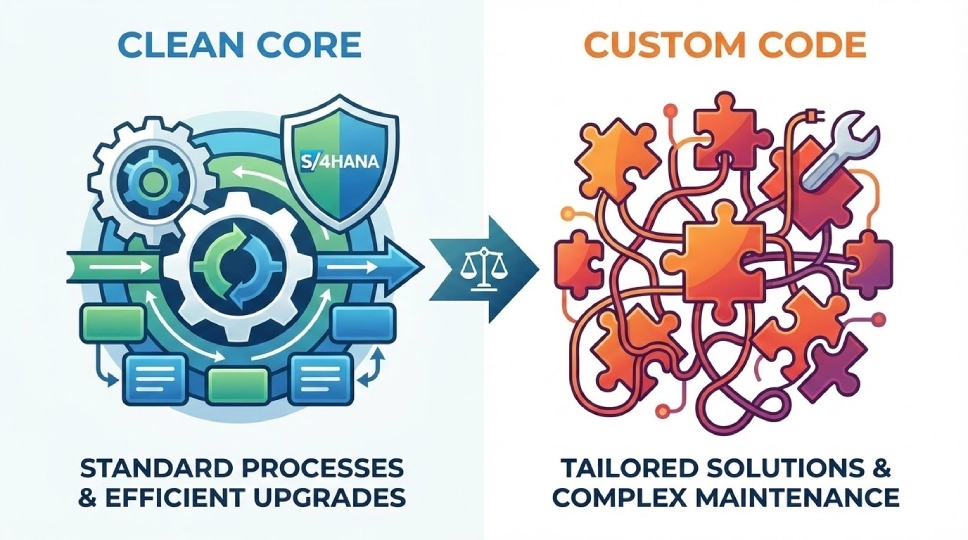
The financial case for clean core becomes clear when you look at total cost of ownership.
Short-term savings versus long-term ownership cost
Custom code approach:
- Lower initial migration cost (reuse existing code)
- Familiar processes for development team
- No need to change business processes
- But: Accumulating technical debt over time
Clean core approach:
- Higher upfront investment in code cleanup
- Some process re-engineering required
- Training needed for new extensibility methods
- But: Dramatically lower ongoing costs
Impact on upgrades, support, and cloud adoption
Clean core enables:
- Quarterly SAP release updates without major projects
- Faster adoption of new SAP features and AI capabilities
- Easier transition to cloud deployment models
- Lower support costs with standardized processes
Heavy custom code means:
- Each upgrade becomes a major project
- Delayed access to new SAP innovations
- Cloud migration significantly more complex
- Ongoing need for specialized development skills
Why clean core lowers total cost of ownership
Organizations adopting clean core report:
- Up to 75% more incremental business value over 10 years
- 50% reduction in maintenance and support costs
- Faster time to market for new capabilities
- Better ROI from SAP investment
Operational Impact After Go-Live
The clean core vs custom code decision affects daily operations for years.
Day-to-day support complexity with heavy custom code
Custom code creates ongoing operational burden:
- Support teams need to understand both SAP standard and custom logic
- Troubleshooting becomes more complex and time-consuming
- User training must cover custom screens and processes
- Documentation must be maintained separately
- Knowledge transfer becomes critical when team members leave
How clean core improves system stability and performance
Standard SAP processes benefit from:
- Extensive testing by SAP and thousands of customers
- Optimized performance on HANA database
- Regular bug fixes and security patches
- Better integration with new SAP features
The effect on internal IT and support teams
Clean core allows IT teams to:
- Focus on business value instead of maintaining old code
- Adopt new SAP technologies and innovations
- Spend time on strategic projects rather than firefighting
- Build skills in modern platforms like BTP
- Attract and retain talent with relevant technology experience
Upgrade Cycles, Innovation, and Future Readiness
Your architecture decision today determines your ability to innovate tomorrow.
Staying current with SAP releases and innovations
SAP delivers innovations through quarterly releases:
- New AI capabilities powered by Joule
- Advanced analytics and embedded intelligence
- Improved finance processes and automation
- Industry-specific enhancements
- Integration with emerging technologies
Clean core companies adopt these immediately. Heavy custom code companies wait months or years to verify compatibility.
Access to AI, analytics, and new finance capabilities
SAP’s innovation roadmap assumes clean core architecture:
- Joule AI copilot works with standard processes
- Embedded analytics require standard data structures
- Process automation relies on standard transactions
- Machine learning models trained on standard SAP
Custom code often blocks access to these capabilities.
Avoiding the trap of repeated reimplementation
Companies with heavy custom code face a painful cycle:
- Implement SAP with extensive customization
- System becomes difficult to upgrade
- Fall behind on SAP innovations
- Eventually forced to reimplement to catch up
- Repeat the cycle with new system
Clean core breaks this cycle permanently.
Common Mistakes UAE Companies Make During This Decision
Learn from others who’ve already been through S/4HANA migration.
Assuming all custom code is mandatory
Most common mistake: treating all existing customizations as sacred.
Reality check needed:
- Usage analysis shows which programs are actually used
- Business owners often can’t remember why customization was built
- Original business need may no longer exist
- SAP standard may now provide the same functionality
An objective review typically finds 30-50% of custom code can be eliminated.
Treating clean core as all-or-nothing approach
Some companies think clean core means:
- Zero customization allowed
- Must use only vanilla SAP
- No flexibility for business needs
This isn’t true. Clean core provides multiple extensibility options. The goal is upgrade-safe extensions, not zero extensions.
Ignoring governance after migration
Biggest post-migration mistake:
- Achieve clean core at go-live
- Don’t establish governance to maintain it
- New custom code accumulates without oversight
- Back to technical debt within 2-3 years
Clean core requires ongoing discipline, not just initial cleanup.
How to Make the Right Choice Before Migration
Follow a structured approach to the clean core vs custom code decision.
Assessing existing custom code objectively
Start with comprehensive custom code analysis:
- Inventory all Z-programs, enhancements, and modifications
- Run usage analysis to identify what’s actually used
- Categorize by business function and criticality
- Estimate remediation effort for S/4HANA compatibility
- Calculate maintenance costs over 10 years
SAP provides tools like Custom Code Migration app and ABAP Test Cockpit for this analysis.
Engaging business stakeholders in the decision
Technical teams can’t make this decision alone:
- Present usage data to business process owners
- Challenge them to justify each customization
- Explore SAP standard alternatives together
- Agree on acceptable process changes
- Get buy-in for clean core governance going forward
Defining principles that guide design and development
Establish clear rules before migration starts:
- Standard first: Always evaluate SAP standard before custom development
- Justify with data: Business case required for all customizations
- BTP by default: New extensions go on BTP unless technically impossible
- Document everything: No undocumented custom code allowed
- Plan for retirement: Every extension has defined lifespan
- Continuous review: Annual assessment of all customizations
Building a Balanced Path Forward
Success lies in combining clean core principles with pragmatic business needs.
Combining clean core principles with controlled extensibility
Best practice approach:
- Adopt SAP standard for 80% of processes
- Configure (don’t customize) for business variants
- Use BTP for differentiating capabilities
- Reserve in-system extensions for truly critical needs
- Maintain strict governance over all custom development
Creating a roadmap that evolves after go-live
Think beyond the initial migration:
Migration phase:
- Focus on eliminating technical debt
- Migrate only essential customizations
- Move extensions to BTP where feasible
First year post-go-live:
- Stabilize on standard processes
- Address remaining gaps with BTP extensions
- Train teams on new extensibility methods
Year two and beyond:
- Continuously improve and standardize
- Adopt new SAP innovations quarterly
- Reduce custom footprint over time
Turning S/4HANA into a platform for continuous improvement
Clean core enables ongoing transformation:
- Regular adoption of new SAP capabilities
- Faster response to business changes
- Lower cost to experiment and innovate
- Predictable upgrade cycles
- Sustainable competitive advantage through technology
Take Action on Your Clean Core vs Custom Code Decision
The 2027 ECC support deadline is approaching. UAE companies need to make their clean core vs custom code choice now, not during migration.
Next steps for UAE organizations:
- Run custom code analysis: Use SAP tools to assess your current landscape
- Engage business stakeholders: Get alignment on clean core approach
- Define governance framework: Establish rules for future development
- Create migration strategy: Plan code cleanup alongside S/4HANA conversion
- Build BTP capability: Develop skills in modern extensibility platforms
Companies that address this decision early see better migration outcomes and lower long-term costs.
Partner With UAE SAP Experts Who Understand Clean Core
Acharya Enterprise helps UAE organizations navigate the clean core vs custom code decision. Our team has deep experience with both S/4HANA migration and clean core implementation.
We don’t just convert your custom code. We help you build a sustainable SAP landscape that supports your business for the next decade.
Our Clean Core and S/4HANA Migration services include:
- Comprehensive custom code assessment and analysis
- Clean core readiness evaluation
- Business process standardization workshops
- SAP BTP extensibility strategy and implementation
- Custom code remediation and migration
- Clean core governance framework development
- Post-migration support and continuous optimization
Get a free custom code assessment. We’ll analyze your current SAP landscape and provide a clear roadmap for clean core adoption during S/4HANA migration.
About Acharya Enterprise
Acharya Enterprise is a leading SAP services provider in the UAE, specializing in S/4HANA migration, clean core implementation, and SAP extensibility. With SAP consultants across 10+ countries and deep expertise in UAE business requirements, we help organizations modernize their SAP landscapes while maintaining business continuity and competitive advantage.
Related services: S/4HANA Migration | Clean Core Assessment | Custom Code Remediation | SAP BTP Development | ABAP Modernization | SAP Managed Services