
The Hidden Cost Problem: Why UAE Companies Need to Reduce SAP Costs Now
Most UAE organizations running SAP don’t realize they’re overpaying. The numbers don’t lie.
Research shows companies waste between 10-30% of their SAP budget annually. When you add licensing inefficiencies, infrastructure waste, custom code debt, and poor governance together, some organizations are paying 34% more than necessary.
That’s not a small leak. For a company spending AED 10 million on SAP annually, that’s AED 3.4 million down the drain. Every year.
The problem isn’t that SAP is expensive. It’s that most companies don’t know where their SAP money actually goes. They renew contracts without questions, accept rising costs as inevitable, and they assume “this is just what SAP costs.”
It doesn’t have to be this way.
UAE companies across Dubai, Abu Dhabi, and the wider Emirates are starting to ask tough questions about their SAP investments. They’re discovering that with the right approach, they can reduce SAP costs significantly without cutting functionality or value.
The 34% Question: Where Your Extra SAP Spend Actually Goes
Let’s be clear about what “overpaying for SAP” means in practice.
It’s not about getting charged more than list price. It’s about paying for things you don’t use, need, or get value from.
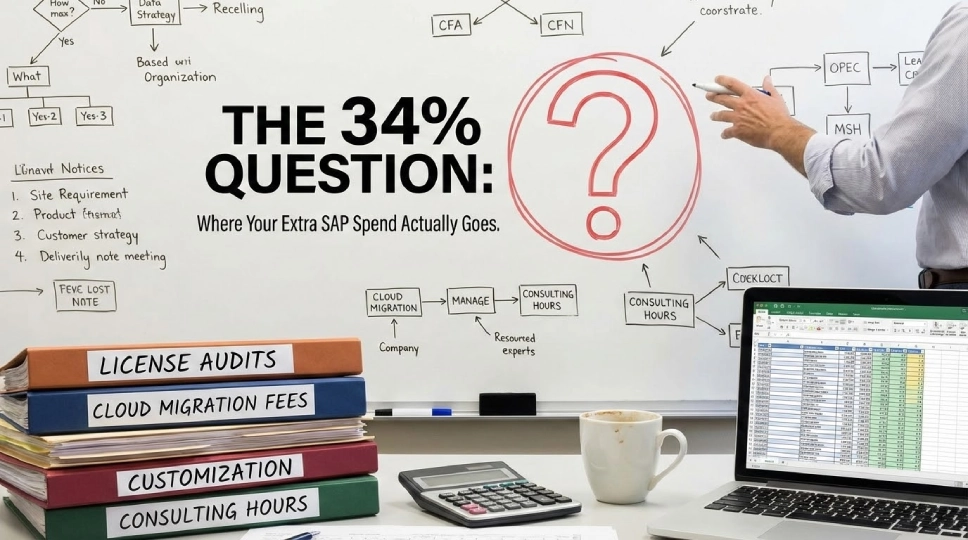
Here’s where the 34% typically hides:
- Licensing inefficiencies: 10-20% waste
- Technical debt and customizations: 5-8% extra costs
- Infrastructure inefficiency: 3-7% overspend
- Poor support models: 4-6% unnecessary expense
- Lack of governance: Creates ongoing cost leakage across all areas
These aren’t theoretical numbers. They come from real license audits, infrastructure reviews, and cost optimization projects across UAE organizations.
This problem is more common in mature SAP landscapes. Why? Because costs accumulate over time. Every year adds new users who never get removed, project adds custom code that needs maintaining, and every upgrade postponed increases technical debt.
The SAP environment becomes like a house that’s never been cleaned. The mess builds up slowly until one day you realize you’re paying rent on rooms you don’t even use.
Licensing Inefficiencies That Inflate Your SAP Budget
This is where most UAE companies lose the biggest chunk of money.
1. Overlicensed users and unused SAP roles
Your finance manager who left 8 months ago? Still has a Professional User license assigned. Cost: AED 15,000 per year.
That happens across 50 inactive users. Suddenly you’re paying AED 750,000 annually for people who don’t work for you anymore.
Industry data shows 20-25% of SAP licenses in mature environments are either unused or assigned to inactive users.
2. Paying for modules and functionality nobody uses
You bought SAP Ariba three years ago for procurement. Only 2 out of 45 procurement staff actually use it. The rest still use emails and spreadsheets.
But you’re paying full maintenance fees on all those licenses.
3. Indirect access and digital access exposure
This one catches UAE companies by surprise during audits.
Your e-commerce platform pulls customer data from SAP? That’s indirect access. Your logistics partner’s system interfaces with your SAP for shipment tracking? Also indirect access.
Without proper licensing, you could face unexpected bills during SAP audits. Some companies discover they need to pay AED 500,000+ for digital access licenses they didn’t know existed.
The fix to reduce SAP costs here is straightforward but requires discipline:
- Conduct regular license audits every 6 months
- Remove inactive users immediately when staff leave
- Match license types to actual user needs (not everyone needs Professional User licenses)
- Monitor and license indirect access proactively
Customization and Technical Debt Nobody Budgets For
Every UAE company has custom SAP code. Some have thousands of custom programs.
Here’s what nobody tells you: Every line of custom code is a long-term liability.
How excessive custom code drives costs:
When you upgrade to S/4HANA, all that custom code needs testing. Some will break. Some needs rewriting. Each custom program adds hours to upgrade projects.
A Dubai manufacturing company recently discovered their upgrade timeline doubled because of 800+ custom programs. The extra testing and remediation cost them AED 2.1 million more than budgeted.
Why legacy enhancements become expensive liabilities:
That custom report built in 2012? It works fine. But it uses outdated coding standards. It’s not compatible with Fiori. Nobody remembers exactly what it does or why it was built.
You can’t remove it (someone might need it). You can’t upgrade it easily (the developer left years ago). So you just keep paying to maintain it.
The real cost of maintaining non-standard SAP landscapes:
Standard SAP functionality gets automatic updates and support from SAP. Your custom code doesn’t.
Every SAP support pack needs custom code testing. Every security patch might conflict with custom programs. You need expensive ABAP developers to maintain code that might deliver zero business value today.
Smart UAE companies reduce SAP costs by:
- Auditing all custom code for business value
- Removing unused custom objects (50%+ are typically obsolete)
- Replacing custom code with standard SAP functionality where possible
- Documenting custom code properly for future maintenance
Infrastructure and Hosting Decisions That Add Unnecessary Spend
Your SAP infrastructure shouldn’t be too big or too small. But most companies get this wrong.
On-premise environments running inefficiently:
An Abu Dhabi government entity was running SAP on infrastructure sized for 2,000 users. They now have 800 users. They’re paying for server capacity, cooling, and maintenance they don’t need.
Cost of oversized infrastructure: AED 400,000+ per year in unnecessary expenses.
Other companies run undersized infrastructure. SAP performs poorly. Users complain. Business processes slow down. The cost isn’t just in infrastructure, it’s in lost productivity.
Cloud migrations that reduce CAPEX but increase OPEX:
Moving to cloud sounds great. No more server rooms. No more hardware refresh cycles.
But many UAE companies discover their monthly cloud bills are higher than they expected. Why?
- They didn’t optimize before migration (“lift and shift” of inefficiency)
- They chose wrong sizing for cloud resources
- They didn’t understand cloud pricing models
- They’re paying for development and test environments 24/7 when they’re only used 8 hours a day
To reduce SAP costs in infrastructure:
- Right-size your on-premise environment based on actual usage
- Clean up your SAP landscape before cloud migration
- Use cloud cost management tools
- Shut down non-production systems outside business hours
- Consider hybrid models (keep stable systems on-premise, move dynamic workloads to cloud)
Support and Maintenance Models That Drain Budgets
SAP maintenance fees are typically 22% of your license value annually. For a AED 5 million license portfolio, that’s AED 1.1 million per year.
Paying premium support rates without measurable value:
Many companies pay for Enterprise Support from SAP when Standard Support would work fine. The difference? About 3% of license value annually.
That might not sound like much. But for large SAP estates, it’s AED 100,000+ per year for services you rarely use.
In-house support teams with low utilization:
A Dubai retail company maintains a 5-person SAP support team. Analysis showed the team’s actual utilization was only 40%. Most tickets are simple (password resets, basic questions). The complex work happens only occasionally.
They’re paying for full-time resources that could be right-sized or supplemented with on-demand support.
Outsourced support that lacks governance and transparency:
On the flip side, some companies outsource support without proper SLAs or metrics. They pay monthly retainers but can’t answer:
- How many tickets were resolved?
- What’s the average resolution time?
- Are we getting value for money?
Better approaches to reduce SAP costs:
- Match support level to your actual needs
- Consider third-party support for stable, mature SAP environments (can be 50% cheaper than SAP official support)
- Use managed services with clear SLAs and metrics
- Implement self-service portals for basic user questions
- Build a hybrid model (in-house for critical, outsourced for routine)
Poor SAP Governance: The Root Cause of Cost Leakage
This is where all other problems start.
Lack of ownership over SAP cost decisions:
In most UAE organizations, nobody owns the SAP budget holistically. IT manages licenses. Finance tracks spending. Business units request new functionality.
But nobody connects the dots. Nobody asks “Should we actually buy this?” or “What will this cost long-term?”
Business units driving changes without cost accountability:
Marketing wants SAP Marketing Cloud. They see the features and demand it. IT implements it. Finance pays for it.
Six months later, adoption is 20%. But the annual license costs continue forever.
Why IT and finance rarely see the same SAP cost picture:
IT tracks license counts and maintenance fees. Finance sees vendor invoices and budget line items. They’re looking at the same spending from completely different angles.
Neither has the full picture. So nobody can make informed decisions about optimization.
Strong SAP governance helps reduce SAP costs by:
- Creating a single owner for SAP spending (often a SAP PMO)
- Requiring business cases for all SAP purchases
- Tracking ROI on SAP investments
- Monthly SAP cost reviews with IT and Finance together
- Making business units accountable for the SAP costs they create
Upgrade Delays and the Cost of Standing Still
The 2027 SAP ECC support deadline is approaching. Many UAE companies are still on old SAP versions.
How postponing upgrades increases costs:
Old SAP versions need more support effort. Security vulnerabilities multiply. Integration with new systems becomes harder. You pay more to keep outdated systems running than upgrading would cost.
The hidden financial impact of staying on outdated SAP versions:
- Higher support costs (older versions need specialized skills)
- Security risks (unpatched vulnerabilities could lead to data breaches)
- Compliance issues (old versions may not meet current UAE regulations like VAT requirements)
- Lost business agility (can’t implement new business models on old technology)
Why technical stagnation limits business value:
Your competitors on S/4HANA can process month-end close in 2 days. You need 10 days on your old ECC system. That’s 8 days lost every month where you can’t make informed business decisions.
That’s a competitive disadvantage you pay for every single month.
Data, Security, and Compliance Gaps That Create Financial Risk
Poor SAP security doesn’t just risk data breaches. It creates direct costs.

Audit findings that lead to unplanned remediation spend:
A Dubai healthcare provider failed their DHA compliance audit. Their SAP security controls were inadequate. Remediation cost: AED 850,000 in emergency consulting and system changes.
That’s pure waste. It could have been prevented with proper security design.
Access control and Segregation of Duties (SoD) issues:
The same person can create vendors and approve payments in your SAP system. That’s an SoD violation. During audits, this creates findings that need expensive remediation.
Fixing SoD conflicts after they exist is 5-10 times more expensive than designing proper security from the start.
Reactive compliance fixes versus proactive design:
Companies that build security and compliance into their SAP landscape from day one avoid these unplanned costs. Companies that ignore it pay later, always at higher prices and under time pressure.
How Leading UAE Companies Are Reducing SAP Spend Without Cutting Value
The smart approach isn’t to cut SAP investment. It’s to optimize it.
Shifting from reactive to strategic SAP cost management:
Instead of: “SAP invoiced us AED 200,000, pay it.”
Leading companies ask: “What are we paying for? Do we use it? Can we optimize it?”
Rationalizing licenses, roles, and customizations:
- Quarterly license reviews removing inactive users immediately
- Annual custom code audits removing obsolete programs
- Right-sizing license types to actual user needs
- Replacing custom code with standard functionality where possible
Aligning SAP investments with measurable business outcomes:
Every SAP purchase now requires:
- Clear business case with ROI projection
- Defined success metrics
- Regular value reviews after implementation
- Decision to continue or discontinue based on actual results
One Abu Dhabi company saved AED 1.2 million annually by canceling SAP add-ons that showed no adoption or business value six months after purchase.
A Smarter Way Forward: Turning SAP From Cost Center Into Value Platform
Building transparency across SAP costs and usage:
You can’t optimize what you can’t see. Successful UAE companies implement:
- Centralized SAP cost tracking dashboards
- Usage analytics showing which features get used
- License optimization tools providing continuous monitoring
- Regular reporting to executive leadership
Creating a continuous optimization mindset:
SAP cost optimization isn’t a one-time project. It’s an ongoing discipline.
Leading companies:
- Review licenses quarterly
- Audit custom code annually
- Track SAP spending against business value monthly
- Benchmark their SAP costs against industry standards
Using governance, data, and discipline to stop overpaying:
The companies that successfully reduce SAP costs share three things:
- Strong governance – Clear ownership and accountability for SAP spending
- Good data – They know what they’re paying for and what they’re using
- Consistent discipline – They make optimization a habit, not a one-time effort
Take Control of Your SAP Costs Today
If you’re a CIO or IT Director at a UAE company running SAP, you’re likely overpaying right now. Not because you’re making bad decisions, but because SAP cost leakage is invisible until you specifically look for it.
The good news? You can reduce SAP costs by 15-30% without cutting functionality, users, or business value. You just need the right approach.
Start with these three steps:
- Conduct a SAP license audit – Find your unused licenses and mis-assigned license types
- Review your custom code – Identify obsolete programs consuming maintenance effort
- Assess your support model – Are you paying for support levels you don’t use?
These three actions alone typically uncover AED 500,000 to 2 million in annual savings for mid-sized UAE companies.
Partner With UAE SAP Experts Who Understand Cost Optimization
Acharya Enterprise specializes in helping UAE organizations optimize their SAP investments. Our team has conducted cost optimization reviews for companies across Dubai, Abu Dhabi, and the wider Emirates.
We don’t just find waste. We help you build sustainable practices that keep SAP costs under control long-term.
Our SAP Cost Optimization services include:
- Comprehensive license audits and optimization
- Custom code analysis and rationalization
- Infrastructure right-sizing recommendations
- Support model assessment and optimization
- SAP governance framework implementation
Get a free SAP cost assessment – We’ll analyze your SAP landscape and identify your top 5 cost reduction opportunities. No obligation.
Contact Acharya Enterprise today to stop overpaying for SAP and start getting maximum value from your investment.
About Acharya Enterprise
Acharya Enterprise is a leading SAP services provider in the UAE, offering end-to-end SAP support, dedicated resource outsourcing, and full implementation services. With SAP consultants across 10+ countries and deep expertise in the UAE market, we help organizations modernize and streamline their SAP workloads with the highest ROI and lowest TCO.
Related services: SAP License Optimization | SAP Cost Reduction | SAP Support Services | S/4HANA Migration | SAP Managed Services