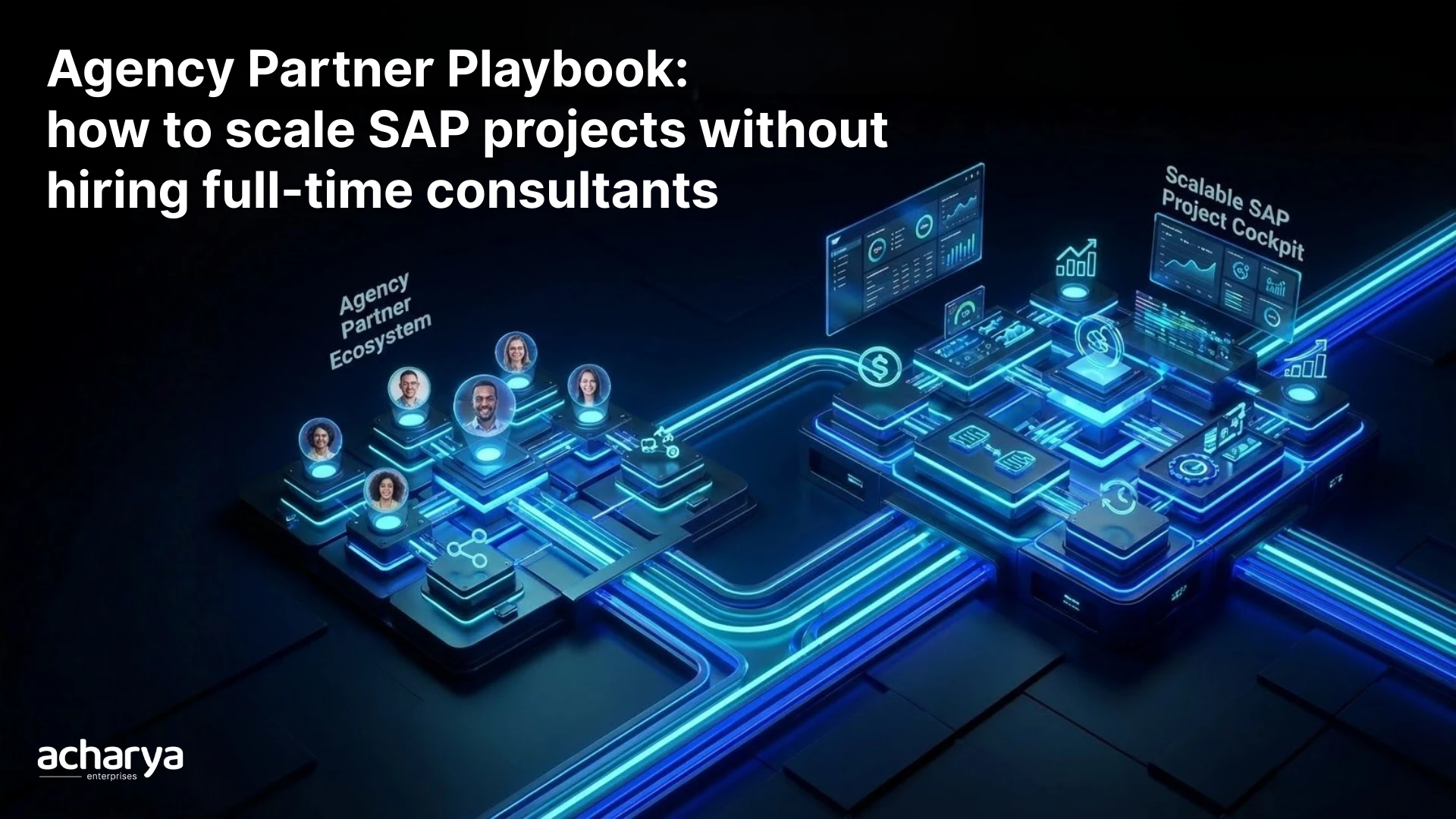
Agency Partner Playbook: How to Scale SAP Projects Without Hiring Full-Time Consultants
UAE SAP agencies face a scaling paradox: winning large projects requires more consultants, but hiring full-time staff creates bench costs during slow periods. SAP resource augmentation solves this by letting agencies scale project teams dynamically without fixed payroll.
This playbook shows how elite agencies use resource outsourcing to grow revenue 3x while reducing labor costs 25-40%.
Why Full-Time Hiring No Longer Works for Project-Based SAP Agencies
Project-based SAP work creates cyclical demand where consultants sit idle between engagements, destroying agency profitability even during revenue growth.
Traditional agency economics force hiring decisions based on peak project needs. When projects end, staff have nothing billable, yet salaries continue. A single consultant sitting on bench for 8-12 weeks costs AED 80k-120k in lost profitability.
Most UAE agencies maintain 30-40% bench capacity to handle project peaks. This bench time destroys margins. Growing revenue requires growing headcount, which increases bench risk. At some point, fixed costs exceed project revenue.
SAP resource augmentation breaks this cycle by converting fixed costs to variable costs. Pay only for consultants when projects need them.

The Real Cost of Keeping SAP Consultants on Your Bench Between Projects
Bench costs consume 25-40% of agency revenue annually through salaries, benefits, office space, and lost billable capacity while consultants wait for project assignments.
Calculate true bench costs: A senior SAP consultant costs AED 250k-400k annually (salary, benefits, insurance, taxes). Sitting idle 10 weeks annually costs AED 50k-75k in lost billable revenue plus full salary expense.
Office infrastructure scales with headcount. Adding 10 consultants requires additional workspace costing AED 30k-50k monthly. Professional development and training add AED 20k-40k annually per consultant.
Agencies carrying 8-12 consultants typically lose AED 400k-800k annually to bench costs. This overhead makes competing on project pricing impossible while maintaining margins.
The Resource Augmentation Model That’s Changing SAP Agency Economics
Resource augmentation lets agencies access specialized consultants for specific projects without hiring, converting fixed employment costs to variable project expenses.
Instead of hiring, agencies partner with resource providers to augment teams for specific projects. When projects end, resource relationships end. No bench costs. No fixed overhead.
Models include: Staff augmentation adding consultants to your team short-term, subcontracting engaging external firms to deliver project components, and managed services outsourcing entire service lines.
Elite agencies combine models strategically: keep core architects and delivery leads in-house for client relationships, augment with specialists for implementation, subcontract infrastructure work, and use managed services for support.
Five Scenarios Where Resource Partners Outperform Full-Time Hires
Resource partners excel at sudden project needs, niche expertise requirements, multi-country deployments, white-label services, and emergency backfill when team members leave.
Scenario 1: Sudden Large Project
Your client wins a major S/4HANA migration requiring 8 consultants deployed in two weeks. Hiring takes 4-8 weeks. Resource partners fill the team in 7-10 days.
Scenario 2: Niche Expertise
You need a SuccessFactors specialist for three months. Hiring a full-time specialist for 12-week projects destroys economics. Resource partners provide specialists on-demand.
Scenario 3: Multi-Country Deployments
Government contracts across UAE and Saudi Arabia require Arabic-speaking SAP consultants. Building permanent MENA teams costs millions. Resource augmentation provides regional expertise as needed.
Scenario 4: White-Label Support
Larger agencies offer 24/7 SAP support but lack technical depth. Subcontracting support tiers to specialists lets you focus on client relationships while maintaining service coverage.
Scenario 5: Emergency Backfill
Your senior ABAP developer leaves mid-project. Replacing them takes 6-12 weeks. Resource partners provide experienced backfill within days, preventing project delays.
The Economics: Actual Numbers Behind Resource Outsourcing vs. Hiring
Hiring full-time: AED 300k annual cost for 50% utilization. Resource augmentation: AED 200k-250k for same consultant on 100% billable time, paid only when deployed.
| Cost Category | Full-Time Hire | Resource Augmentation | Difference |
|---|---|---|---|
| Base Salary | AED 250k | AED 0 (project only) | Savings: AED 250k |
| Benefits & Taxes | AED 50k | AED 0 | Savings: AED 50k |
| Office/Infrastructure | AED 25k | AED 0 | Savings: AED 25k |
| Bench Cost (30% idle) | AED 75k | AED 0 | Savings: AED 75k |
| Resource Partner Fee | AED 0 | AED 180k (80 billable days) | Cost: AED 180k |
| Total Annual Cost | AED 400k | AED 180k | Savings: AED 220k |
For a 10-person agency, resource augmentation reduces annual labor costs AED 1.5-2.2M while increasing capacity 3x.

Building Your Resource Partner Network: What Elite SAP Agencies Do Differently
Top agencies maintain relationships with 3-5 specialized resource providers covering different practice areas, geographic regions, and expertise levels to ensure availability when needed.
Elite agencies don’t use single providers. Dependence on one partner creates vulnerability. S/4HANA migrations need different skill sets than SuccessFactors implementations. UAE agencies need Arabic-speaking resources for government work.
Portfolio approach: One partner for S/4HANA core functionality, one for SuccessFactors, one for infrastructure/integration, one for Arabic-speaking resources, one for backup capacity.
Relationships are tested through pilot projects before major commitments. Agencies evaluate technical capability, cultural fit, response time, and pricing alignment before trusting partners with critical delivery.
The Vetting Framework: Six Questions That Separate Reliable Partners from Risky Ones
Vet resource partners through six filters: technical skill verification, UAE market experience, cultural fit, contract flexibility, pricing alignment, and response time guarantees.
Question 1: Technical Skill. Review actual project work not just certifications. Request client references. Assess hands-on capability through technical interviews.
Question 2: UAE Experience. Global credentials matter less than local expertise. UAE government projects require understanding DHA/DFSA compliance, vendor procurement rules, and cultural practices.
Question 3: Cultural Fit. Will these consultants represent your brand well with clients? Assess professionalism, communication style, and client management capability.
Question 4: Bench Depth. Do they have capacity when you need them? Request resource availability calendars. Confirm deployment speed.
Question 5: Pricing Alignment. Do margins work for your business model? Calculate delivered cost vs. billable rates. Ensure profitability at your project pricing.
Question 6: Response Time. Can they deploy consultants within your required timeline? Confirm deployment SLAs contractually.
The Hybrid Delivery Model: Combining Your Core Team with Outsourced Expertise
Elite agencies keep core architects and project managers in-house for client relationships, then augment with specialists for implementation components, subcontract infrastructure work, and outsource support services.
What to Keep In-House
Account management and client relationships require continuity. Keep senior architects and project managers who own client relationships. These roles build trust and credibility.
What to Augment
Technical specialists needed for specific implementation phases work best as augmented resources. S/4HANA configuration specialists, ABAP developers, and data migration experts deploy as needed.
What to Subcontract
Infrastructure, network setup, and server configuration often outsource better than building internal capability. Subcontracting these components to infrastructure specialists reduces risk.
What to Manage as Service
24/7 support, hypercare, and ongoing optimization work well as managed services. Partner absorbs staffing complexity while you focus on client relationship.
Quality Assurance When You Don’t Control Daily Work Conditions
Maintain quality through service level agreements defining deliverables, response times, and quality standards, combined with clear communication protocols and regular performance reviews.
SLAs should specify: deliverable definitions, quality standards, response times for issues, escalation procedures, and performance metrics. Ambiguous expectations cause conflicts.
Communication protocols matter. Designate single points of contact. Schedule weekly status reviews. Establish escalation procedures for quality issues. Clear communication prevents misalignment.
Performance monitoring uses objective metrics: on-time delivery, defect rates, client satisfaction, and budget variance. Monthly reviews identify trends enabling course correction.
Client Disclosure Strategy: When and How to Mention Subcontractors
Transparent disclosure from project start builds trust. Disclose subcontractors in proposals and contracts, emphasizing their expertise and how they enhance delivery capability.
Most sophisticated clients expect augmented delivery. Position it as accessing specialized expertise not available in-house. Government contracts often require disclosure.
Frame augmentation positively: “We partner with specialized SAP experts ensuring you get best-in-class implementation rather than generalizing across all phases.” Clients respect expertise specialization.
Contracts should address subcontracting: what approvals you require, what client approves upfront, and what’s disclosed as project progresses. Clear terms prevent surprises.
Real Agency Success Stories: How UAE Partners Are Scaling Profitably
Dubai boutique agency 3x’d revenue in 18 months without adding headcount by using resource augmentation for S/4HANA migrations while keeping 4-person core team.
Agency won large government S/4HANA implementation requiring 12 consultants. Rather than hiring, they augmented core team with 10 specialists from partner network. Project delivered on-time with 90% margin vs. 40% if fully hired.
Government sector entry: Abu Dhabi agency lacked government experience. Partnered with specialist providing Arabic-speaking consultants and compliance expertise. Successfully bid government contracts without building government team.
Cost transformation: One agency reduced labor costs from 60% to 35% of revenue by keeping senior architects in-house while augmenting with implementation specialists. Margin improvement: AED 500k annually from AED 2M revenue.
Avoiding the Pitfalls: Where Most Agencies Go Wrong with Resource Outsourcing
Agencies fail when over-relying on single partners, sacrificing quality for price, neglecting communication, or forgetting knowledge transfer leaving expertise outside the firm.
Over-Reliance on Single Partner
Partnering with one resource provider creates vulnerability. Partner loses capacity or increases prices and you’re stuck. Maintain 3-5 partner relationships.
Price-Shopping That Sacrifices Quality
Lowest-cost partners often underdeliver. Quality issues damage client relationships and agency reputation. Prioritize reliability and quality over lowest pricing.
Communication Breakdown
Unclear expectations between your team and augmented resources cause misalignment. Establish communication protocols, weekly reviews, and escalation procedures proactively.
Knowledge Loss
When external consultants leave, specialized knowledge leaves with them. Require documentation, knowledge transfer sessions, and internal training to capture learnings.
Taking Action: Building Your Resource Augmentation Strategy This Quarter
Start by identifying projects where external resources make economic sense, then develop RFP templates for UAE SAP providers, and pilot projects with potential partners before major commitments.
Your first 30 days: Review last 12 months of projects identifying where resource augmentation would have reduced costs or accelerated delivery. Calculate specific savings.
Develop RFP template addressing technical requirements, UAE market experience, pricing, deployment speed, and reference verification. Use consistently for partner evaluation.
Run pilot projects with 2-3 promising providers. Small projects test capability and cultural fit before trusting major delivery. Successful pilots inform long-term partnership decisions.
Contact Acharya Enterprise to discuss resource augmentation strategy for your agency. Our team helps you build partner networks, evaluate provider capability, and structure engagements delivering profitable growth.
We work as your partner enabling agency scaling without fixed hiring costs, maximizing flexibility while maintaining delivery excellence and client satisfaction.