The Revenue Leakage Problem UAE Manufacturers Rarely See with SAP Process Mining
UAE manufacturers are losing millions in revenue without realizing it. Strong demand and healthy profit margins hide serious inefficiencies.
SAP Process Mining reveals these hidden revenue leaks that traditional reporting never catches. Companies typically discover 3-5 million AED bleeding out through small process gaps that nobody noticed.
Research shows companies lose about 20% of annual revenue due to inefficient processes. For a UAE manufacturer with 100 million AED revenue, that’s 20 million AED in potential losses.
Why strong demand masks profit loss
When customer orders keep flowing, problems stay hidden:
- Sales teams celebrate hitting targets while billing delays cost thousands daily
- Production runs at full capacity but rework waste eats 15% of margins
- Inventory turnover looks acceptable but expired materials get written off monthly
- Shipping deadlines get met through expensive rush orders nobody tracks
- Finance closes books on time but nobody questions why costs keep climbing
Dubai manufacturing companies often run SAP systems for years without seeing actual process performance. They trust that SAP works properly because transactions process successfully.
How small inefficiencies compound into millions of dirhams
Individual process problems seem minor:
- Credit check delays one order by 2 days: No big deal
- Manual pricing override on high-value contract: Just helping customer
- Production confirmation posted next day instead of real-time: Saves time
- Partial delivery created due to inventory mismatch: Customer understands
- Invoice correction needed for pricing error: Happens sometimes
But multiply these across hundreds of orders monthly:
- 500 delayed credit checks = 25,000 AED in financing costs monthly
- 200 manual pricing overrides = 150,000 AED revenue leakage monthly
- 1,000 late production confirmations = inventory visibility gaps costing 75,000 AED monthly
- 300 partial deliveries = 200,000 AED in extra shipping costs monthly
- 150 invoice corrections = 50,000 AED in delayed cash collection monthly
Total monthly leakage: 500,000 AED. Annual impact: 6 million AED.
What SAP Process Mining Really Is
SAP Process Mining isn’t another dashboard or reporting tool. It’s fundamentally different from traditional SAP analysis.
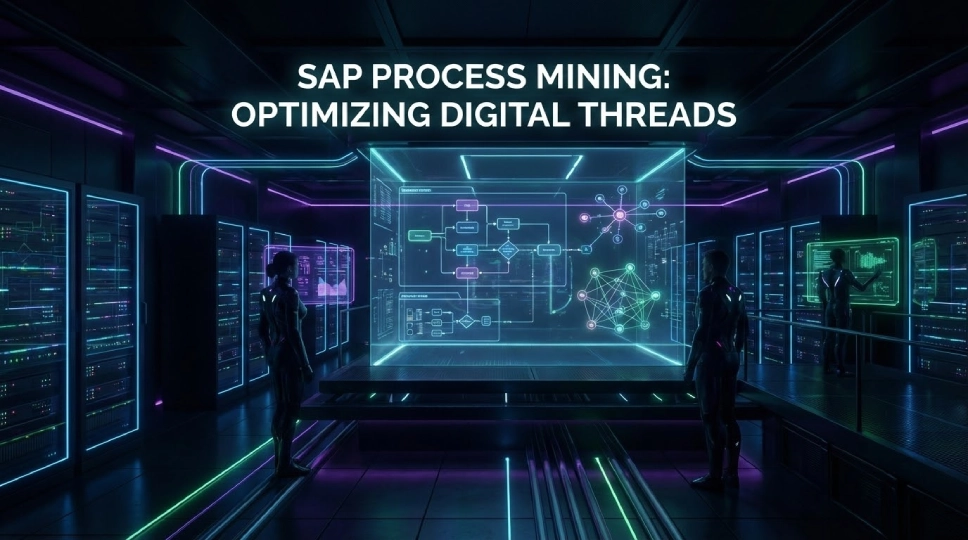
Moving beyond dashboards and traditional reporting
Traditional SAP reporting shows what happened:
- Sales reports show revenue totals
- Production reports show output volumes
- Inventory reports show stock levels
- Financial reports show P&L results
SAP Process Mining shows how things actually happened:
- Which exact steps each order followed through your SAP system
- How long each activity took
- Where processes got stuck or went backward
- Which users or departments created bottlenecks
- What variations exist from standard processes
How process mining uses actual transaction data
Every transaction in SAP creates event logs:
- Sales order created by user Ahmed at 9:15 AM
- Credit check completed automatically at 9:17 AM
- Delivery created by user Fatima at 2:30 PM
- Goods issue posted by warehouse at 4:45 PM
- Invoice generated by finance at 11:00 AM next day
SAP Process Mining connects these events into complete process flows. It shows the entire journey of each order, not just summary totals.
Tools like SAP Signavio Process Intelligence extract this data automatically from SAP S/4HANA or SAP ECC systems.
Why manufacturing processes are ideal candidates
Manufacturing creates massive transaction volumes:
- Thousands of purchase orders monthly
- Hundreds of production orders daily
- Continuous goods movements
- Frequent quality inspections
- Regular confirmations and postings
This rich data reveals patterns traditional analysis misses. Process mining thrives on high-volume, repetitive processes with clear steps and outcomes.
Why UAE Manufacturing Is Especially Vulnerable to Revenue Leaks
UAE manufacturers face unique challenges that create more leakage opportunities.
Complex make-to-order and make-to-stock models
Many UAE manufacturers run hybrid production models:
- Standard products made to stock for quick delivery
- Customized variants made to order for specific customers
- Different pricing logic for each model
- Separate planning and scheduling approaches
- Mixed inventory management strategies
This complexity creates gaps:
- Wrong production type selected causing delays
- Stock reservations not released after order changes
- Custom pricing not applied to make-to-order items
- Planning run misses urgent custom orders
Multi-plant, multi-warehouse, multi-entity operations
UAE operations spread across:
- JAFZA free zone manufacturing plant
- Dubai mainland warehouse
- Abu Dhabi distribution center
- Sharjah spare parts facility
- Multiple legal entities for different emirates
Each location adds process complexity:
- Stock transfers between plants creating duplicate movements
- Inter-company sales requiring multiple postings
- Different approval workflows per location
- Inconsistent master data across plants
- Transfer pricing calculations adding steps
Manual interventions driven by urgency
UAE business culture emphasizes customer service and speed:
- “VIP customer needs it today” – bypass normal process
- “Rush order from key account” – manual priority override
- “Just do it quickly” – skip standard checks
- “We’ll fix paperwork later” – complete transaction first, document after
These helpful shortcuts become expensive habits:
- Manual credit limit overrides creating bad debt risk
- Rush production orders disrupting schedules
- Backdated postings causing inventory inaccuracy
- Incomplete documentation preventing proper billing
Where the 3-5 Million AED Typically Leaks Out
Process mining consistently finds revenue leaks in specific areas.
Order-to-cash delays impacting revenue realization
Common patterns found through SAP Process Mining:
Credit check delays:
- 30% of orders wait 2+ days for credit approval
- Average delay: 3.5 days per affected order
- Impact: Late delivery penalties and lost sales
- Annual cost: 800,000 AED
Billing delays:
- 25% of deliveries not invoiced within 24 hours
- Some invoices created 5-7 days after delivery
- Each day delay costs financing charges
- Annual cost: 600,000 AED
Partial deliveries:
- 40% of orders split into multiple deliveries
- Extra shipping, handling, and invoice processing costs
- Customer dissatisfaction
- Annual cost: 900,000 AED
Production bottlenecks and rework increasing cost per unit
Manufacturing process inefficiencies revealed:
Rework loops:
- 15% of production orders require rework
- Quality inspection failures sending batches back
- Material consumption double-counted
- Labor hours wasted
- Annual cost: 1,200,000 AED
Production confirmation delays:
- 50% of confirmations posted next day instead of real-time
- Inventory accuracy problems
- Planning based on outdated data
- Stock shortages or overproduction
- Annual cost: 500,000 AED
Unplanned stoppages:
- Production halts due to material unavailability
- Setups repeated unnecessarily
- Rush orders disrupting schedules
- Overtime costs increasing
- Annual cost: 700,000 AED
Inventory mismatches leading to write-offs and expedited shipping
Inventory process problems causing losses:
Stock discrepancies:
- Physical inventory doesn’t match SAP records
- Write-offs during annual count
- Obsolete materials not flagged timely
- Annual cost: 400,000 AED
Rush material procurement:
- Expedited shipping for urgent needs
- Premium pricing for quick delivery
- Airfreight instead of sea freight
- Annual cost: 600,000 AED
Total identified leakage: 5.7 million AED annually.
Key Manufacturing Processes SAP Process Mining Exposes
Certain SAP processes consistently reveal the biggest revenue leaks.
Order-to-cash process deviations and billing delays
SAP Process Mining maps complete order-to-cash flow:
- Sales order creation (VA01)
- Credit check execution
- Delivery document creation (VL01N)
- Picking and packing
- Goods issue posting (VL02N)
- Invoice generation (VF01)
- Payment receipt (F-28)
Deviations discovered:
- Orders skipping credit checks entirely
- Deliveries created without proper stock availability check
- Invoices manually held for “customer relationship” reasons
- Payment terms extended without authorization
- Discounts applied outside approval limits
Procure-to-pay inefficiencies affecting material availability
Purchase order to payment process analysis reveals:
- Purchase requisitions sitting in approval queues for weeks
- POs created bypassing requisition process
- Goods receipts (MIGO) posted without quality inspection
- Invoice processing delayed by 3-way matching failures
- Payment runs missing early payment discounts
Impact on manufacturing:
- Production delays waiting for materials
- Lost volume discounts from fragmented ordering
- Missed cash discounts costing 2% of purchase value
- Duplicate orders increasing inventory
Production planning versus actual execution gaps
Production process mining compares planned versus actual:
- Planned production sequence rarely followed
- Setup times 50% longer than standard
- Batch sizes frequently changed mid-production
- Material substitutions not properly documented
- Scrap rates higher than planned
How SAP Process Mining Works Inside an SAP Landscape
Understanding the technical approach helps appreciate the insights.
Extracting event data from SAP S/4HANA and ECC
SAP systems record every transaction:
- Change documents (CDHDR, CDPOS tables)
- Application logs
- Status history
- User actions and timestamps
- System-generated events
Process mining tools extract this data:
- SAP Signavio connects directly to SAP systems
- Pre-built data extraction templates for common processes
- Automated data refresh (daily, weekly, or real-time)
- No custom coding required
- Minimal impact on SAP system performance
Visualizing real process flows versus designed processes
Process mining creates visual maps showing:
- Happy path: Most efficient route through process
- Variations: Different paths orders actually take
- Rework loops: Steps that repeat unnecessarily
- Bottlenecks: Where processes get stuck
- Conformance: How actual differs from intended
These visualizations are called “process graphs” or “spaghetti diagrams” when complex.
Identifying bottlenecks, rework loops, and compliance breaches
Analysis capabilities include:
Performance analysis:
- Average process duration
- Cycle time by variant
- Waiting time between activities
- Resource utilization rates
Conformance checking:
- Which transactions skip required steps
- Who bypasses approval workflows
- Where segregation of duties violations occur
- When processes deviate from policy
Root cause analysis:
- Why certain orders take longer
- What characteristics predict delays
- Which conditions trigger rework
- How user behavior affects outcomes
Revenue Leak Patterns Commonly Found in UAE Plants
Certain problems appear repeatedly in UAE manufacturing SAP implementations.
Delayed confirmations and partial postings
Typical pattern in UAE operations:
- Shift ends at 6 PM but confirmations posted next morning
- Partial confirmations instead of complete batch postings
- Production reported in summary, not transaction-by-transaction
- Scrap quantities estimated rather than measured
- Time tickets completed days after work finished
Why this happens:
- Shop floor workers focused on production, not data entry
- SAP access limited to office hours
- Complex confirmation screens taking too long
- Network connectivity issues in factory
- “We’ll catch up on paperwork later” mindset
Revenue impact:
- Inventory records incorrect during month
- Planning decisions based on outdated status
- Customer promises made with wrong availability data
- Month-end close delayed fixing discrepancies
Manual overrides in pricing, discounts, and approvals
Process mining reveals override patterns:
- 15% of orders have manual price changes
- Average override reduces price by 8%
- No consistent approval trail
- Same customer getting different prices on similar orders
- Volume discounts applied to small quantities
Common justifications heard:
- “Long-term customer relationship”
- “Competitive pressure”
- “Special circumstances”
- “Management instruction” (undocumented)
Annual revenue leakage: 2-3% of total sales.
Unplanned production stoppages and rush orders
Production disruptions discovered through mining:
- 25% of production orders marked as “rush” or “urgent”
- Normal schedule interrupted 3-4 times daily
- Setup costs increased 40% due to frequent changes
- Planned batch sizes reduced to accommodate rush orders
- Overtime premium labor costs up 30%
Root causes identified:
- Sales promising delivery before checking production capacity
- Forecasting disconnected from actual demand
- Large customers expecting immediate response
- Material shortages forcing schedule changes
- Quality issues creating unplanned rework
Turning Process Insights Into Measurable Financial Impact
Process mining data must translate to money saved or earned.
Quantifying revenue leakage in financial terms
Convert process metrics to financial impact:
Example 1: Credit check delays
- Finding: 30% of orders delayed average 3 days
- Volume: 500 orders monthly affected
- Average order value: 25,000 AED
- Financing cost: 2% per month
- Calculation: 500 × 25,000 × 2% × (3/30) = 25,000 AED monthly
- Annual impact: 300,000 AED
Example 2: Rework costs
- Finding: 15% of production orders require rework
- Volume: 200 orders monthly affected
- Average additional cost per rework: 5,000 AED
- Calculation: 200 × 5,000 = 1,000,000 AED monthly
- Annual impact: 12,000,000 AED
Prioritizing fixes based on value, not effort
Not all improvements are equal. Prioritize by:
Financial impact:
- How much money does this leak cost annually?
- What’s the potential savings from fixing it?
Implementation complexity:
- Simple process change or major system modification?
- Quick win (weeks) or long project (months)?
Risk level:
- Low risk: Process training and governance
- High risk: Core SAP configuration changes
Prioritization matrix:
- High impact, low effort: Do immediately
- High impact, high effort: Plan carefully and execute
- Low impact, low effort: Quick wins for momentum
- Low impact, high effort: Defer or skip
Linking process improvements directly to P&L outcomes
Connect process changes to financial statements:
- Revenue increase: Faster billing, fewer billing errors, better pricing discipline
- Cost of goods sold reduction: Less rework, lower scrap rates, efficient material usage
- Operating expense reduction: Less overtime, fewer rush shipments, reduced write-offs
- Working capital improvement: Lower inventory, faster collections, optimized payables
From Insights to Action: Fixing What Process Mining Reveals
Analysis is worthless without implementation. SAP Process Mining insights must drive real changes.

Redesigning processes instead of adding controls
Common mistake: Adding more approval steps to prevent errors.
Better approach: Redesign process to eliminate error opportunities:
Before redesign:
- Sales creates order
- Manual credit check by finance
- Manual pricing review by sales manager
- Manual inventory check by warehouse
- Manual delivery creation
Result: 5-day cycle time, many manual touchpoints, frequent errors.
After redesign:
- Sales creates order with automated credit check
- System applies pricing rules automatically
- ATP (Available-to-Promise) checks inventory real-time
- Delivery auto-created for approved orders
- Exceptions only routed for manual review
Result: Same-day processing, 90% automated, fewer errors.
Automating high-frequency manual interventions
Process mining identifies repetitive manual work:
- Price adjustments for volume discounts
- Stock transfer postings between warehouses
- Invoice corrections for common errors
- Production confirmations with standard quantities
- Purchase requisition approvals under threshold
Automation opportunities:
- Configure SAP pricing conditions for volume breaks
- Set up automatic stock transfers based on rules
- Implement data validation preventing invoice errors
- Enable backflushing for repetitive production
- Auto-approve small requisitions within budget
Aligning operations, finance, and supply chain teams
Process mining shows cross-functional impacts:
- Sales pricing decisions affecting finance revenue recognition
- Production schedule changes impacting warehouse space
- Procurement delays causing manufacturing stoppages
- Quality issues creating finance write-off transactions
Use process mining insights to:
- Show each department their role in overall process
- Quantify how one team’s actions affect others
- Build consensus on improvement priorities
- Create shared accountability for end-to-end results
Governance and Ownership: Making Improvements Stick
Initial improvements often regress without proper governance.
Assigning clear process ownership across departments
Every process needs an owner:
- Order-to-cash: Sales Director owns overall, Finance owns billing portion
- Procure-to-pay: Supply Chain Director owns, Finance owns payment portion
- Production: Manufacturing Director owns, Quality owns inspection portion
Process owner responsibilities:
- Monitor process performance metrics monthly
- Review process mining dashboards regularly
- Investigate deviations and exceptions
- Drive continuous improvement initiatives
- Report results to management
Embedding monitoring into daily operations
Make process mining part of routine management:
- Daily dashboard review by supervisors
- Weekly process performance meetings
- Monthly deep-dive analysis sessions
- Quarterly business reviews including process metrics
Automated alerts for:
- Credit checks exceeding 24-hour threshold
- Invoices not created within 2 days of delivery
- Production orders with rework flags
- Purchase orders stuck in approval over 5 days
- Manual price overrides beyond authority limits
Preventing regression after initial improvements
Improvements fade without reinforcement:
- New employees unaware of improved processes
- Urgent situations reverting to old workarounds
- System updates accidentally breaking automations
- Management turnover losing improvement momentum
Sustainability strategies:
- Document new standard processes clearly
- Include process compliance in performance reviews
- Refresh training annually
- Celebrate teams maintaining performance
- Re-run process mining quarterly to catch regression
Why Process Mining Delivers Faster ROI Than Traditional Initiatives
Traditional process improvement projects take months or years. Process mining delivers results in weeks.
Weeks instead of months to uncover value
Traditional approach timeline:
- Months 1-2: Plan project, assemble team, define scope
- Months 3-5: Interview stakeholders, document current processes
- Months 6-8: Analyze problems, identify root causes
- Months 9-12: Design improvements, get approvals
- Months 12+: Implement and monitor
Process mining timeline:
- Week 1: Connect to SAP, extract data
- Week 2: Generate process visualizations
- Week 3: Identify top revenue leaks
- Week 4: Validate findings with teams
- Weeks 5-8: Implement quick wins
A Forrester study showed process mining projects achieving payback within 6 months and 383% ROI over 3 years.
Minimal disruption to ongoing manufacturing operations
Process mining doesn’t interrupt production:
- Reads SAP data passively without changing transactions
- No need to stop processes for observation
- Minimal time required from operational staff
- Analysis happens offline without affecting performance
- Improvements implemented incrementally
Manufacturing continues while analysis proceeds.
Data-driven decisions reducing internal debate
Traditional improvement projects involve endless discussions:
- “I think the problem is…”
- “In my experience…”
- “That’s not how we do it…”
- “The real issue is…”
Process mining shows facts:
- Exactly how many orders delayed
- Precisely how long each step takes
- Which users create most exceptions
- What financial impact results
Data settles arguments. Teams focus on solutions instead of debating problems.
Common Mistakes Manufacturers Make With Process Mining
Avoid these pitfalls to ensure SAP Process Mining success.
Treating it as one-time diagnostic exercise
Some companies run process mining once:
- Find problems
- Fix them
- Declare victory
- Move on
Result: Problems return within 6 months.
Better approach: Continuous process intelligence
- Ongoing monitoring detecting new problems
- Regular analysis finding emerging patterns
- Quarterly reviews ensuring sustained improvements
- Process mining becomes part of management system
Focusing only on visualization, not change execution
Pretty process maps don’t save money.
Some projects produce:
- Impressive process diagrams
- Detailed dashboards
- Comprehensive analysis presentations
But nothing changes. No money saved.
Success requires:
- Clear action plans with owners
- Implementation timelines and milestones
- Budget and resources committed
- Progress tracking and accountability
- Financial results measured
Ignoring human and operational side of process change
Technology alone doesn’t fix processes. People do.
Common failure: Implement SAP changes without preparing users.
- Users resist new processes
- Workarounds develop immediately
- Benefits never materialize
Change management essentials:
- Explain why changes matter to each team
- Show financial impact of current inefficiencies
- Involve users in solution design
- Provide adequate training and support
- Recognize teams making improvements
Building a Sustainable Process Excellence Program
Turn SAP Process Mining from project into ongoing capability.
Using process mining as continuous improvement engine
Establish regular rhythm:
- Daily: Exception alerts and immediate response
- Weekly: Key metrics review with process owners
- Monthly: Deep analysis of problem areas
- Quarterly: Business review with senior leadership
- Annually: Strategic process improvement planning
Build capability:
- Train internal team on process mining tools
- Develop standard analysis templates
- Create library of improvement playbooks
- Share best practices across facilities
Expanding from manufacturing into finance and logistics
Start with manufacturing, then expand:
Finance processes:
- Accounts payable invoice processing
- Accounts receivable collections
- Month-end financial close
- Purchase requisition approvals
Logistics processes:
- Warehouse receiving and putaway
- Picking and packing operations
- Shipping and delivery execution
- Returns and reverse logistics
Supply chain processes:
- Demand planning and forecasting
- Supplier onboarding and management
- Contract management
- Quality management
Creating culture of transparency and accountability
Process mining makes everything visible:
- No more hiding inefficiencies
- Performance gaps clearly shown
- Best practices identified and shared
- Continuous improvement expected
Cultural shifts needed:
- Data transparency is positive, not threatening
- Problems are opportunities, not failures
- Everyone owns process performance
- Continuous learning and improvement valued
Getting Started: Practical Roadmap for UAE Manufacturers
Launch SAP Process Mining initiative successfully.
Selecting high-impact processes to analyze first
Don’t try to analyze everything at once. Start with processes that:
Have high revenue impact:
- Order-to-cash for revenue realization
- Procure-to-pay for cash management
- Production for cost control
Show visible pain points:
- Customer complaints about delivery delays
- Month-end close taking too long
- Inventory accuracy issues
- Frequent rush orders disrupting schedule
Generate rich transaction data:
- High volume (hundreds or thousands monthly)
- Clear start and end points
- Multiple steps creating event logs
Recommended first processes for UAE manufacturers:
- Order-to-cash: Highest revenue impact
- Production execution: Biggest cost opportunity
- Procure-to-pay: Working capital improvement
Preparing SAP data for accurate insights
Data quality determines insight quality:
Required SAP data elements:
- Document numbers (orders, deliveries, invoices)
- Timestamps for each activity
- User IDs performing actions
- Status changes and approvals
- Key master data (customers, materials, plants)
Data preparation steps:
- Verify change documents are active in SAP
- Ensure timestamp accuracy (timezone consistency)
- Clean obvious data quality issues
- Define analysis period (typically 6-12 months)
- Extract representative sample initially
SAP Signavio requirements:
- SAP S/4HANA or SAP ECC access
- Read-only user credentials
- Network connectivity between SAP and Signavio
- Process mining license
Building momentum through quick, visible wins
Three-month quick win approach:
1st Month: Setup and discovery
- Week 1: Connect SAP system to process mining tool
- Week 2: Extract order-to-cash data
- Week 3: Generate initial process visualizations
- Week 4: Present findings to management
2nd Month: Analysis and planning
- Week 5: Deep-dive into top 3 revenue leaks
- Week 6: Quantify financial impact
- Week 7: Design improvement solutions
- Week 8: Get approval for implementation
3rd Month: Implementation and results
- Week 9-10: Implement quick wins
- Week 11: Monitor results
- Week 12: Calculate ROI and present success
Target: Achieve 500,000 – 1,000,000 AED annual savings in first 3 months.
Uncover Millions in Hidden Revenue with SAP Process Mining
UAE manufacturers are sitting on 3-5 million AED in hidden revenue leaks. Strong sales and healthy margins hide the problems.
SAP Process Mining reveals exactly where money disappears:
- Order-to-cash delays costing hundreds of thousands monthly
- Production rework wasting millions annually
- Inventory mismatches requiring expensive workarounds
- Manual overrides bleeding revenue quietly
The data exists in your SAP system today. Process mining makes it visible and actionable.
Partner With UAE SAP Experts for Process Mining Success
Acharya Enterprise helps UAE manufacturers implement SAP Process Mining that delivers measurable financial results.
Our team combines deep SAP technical knowledge with manufacturing process expertise and proven process mining methodologies.
Our SAP Process Mining services:
- Process mining opportunity assessment
- SAP Signavio implementation and configuration
- Order-to-cash process analysis
- Production process optimization
- Procure-to-pay efficiency improvement
- Revenue leakage quantification
- Process redesign and automation
- Ongoing process intelligence and monitoring
Get a free process mining assessment. We’ll analyze one key SAP process and show you where revenue is leaking. No obligation.
Contact Acharya Enterprise today to find your 3-5 million AED in hidden revenue.
About Acharya Enterprise
Acharya Enterprise is a leading SAP services provider in the UAE, specializing in S/4HANA optimization, process mining, and manufacturing solutions. With SAP consultants across 10+ countries and deep expertise in UAE manufacturing requirements, we help organizations unlock value from their SAP investments through data-driven process intelligence.
Related services: SAP Process Mining | SAP Signavio Implementation | Manufacturing Process Optimization | Order-to-Cash Improvement | Revenue Leakage Analysis | SAP S/4HANA | Production Planning | SAP Managed Services