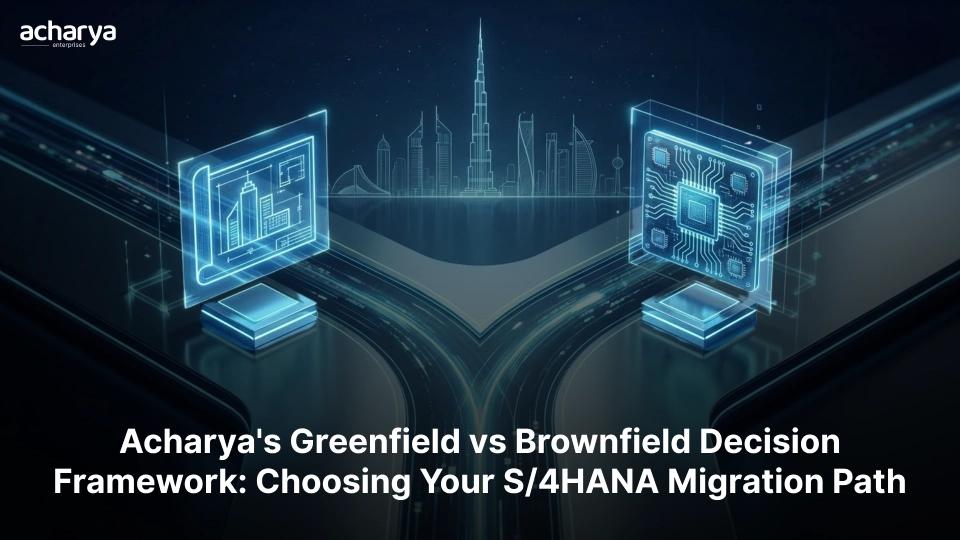
Why the Greenfield vs Brownfield S/4HANA Decision Shapes Your Entire Journey
The Greenfield vs Brownfield S/4HANA choice isn’t just a technical decision. It’s a business decision that affects your company for years.
This single choice determines:
- How much money you’ll spend upfront and long-term
- How much risk your business faces during migration
- How flexible your SAP system will be in the future
- How long the project takes to complete
- How much disruption your users experience
Many UAE companies rush this decision without understanding the long-term consequences. The wrong choice can lock you into problems for 5-10 years.
This is a business choice, not a technical one
IT teams often drive the Greenfield vs Brownfield decision. This is a mistake.
The right approach depends on:
- Your business strategy and growth plans
- How well current processes serve your needs
- Your appetite for change and disruption
- Budget and timeline constraints
- Risk tolerance across the organization
Business leaders must own this decision, not just IT.
How early decisions lock in cost and risk for years
Once you commit to Greenfield or Brownfield, changing course becomes expensive.
If you choose wrong:
- Brownfield locks in old problems you could have eliminated
- Greenfield creates massive change management challenges
- Switching mid-project doubles costs and delays
- Your team loses confidence in leadership
Understanding Greenfield and Brownfield in Simple Terms
Let’s explain these approaches without technical jargon.
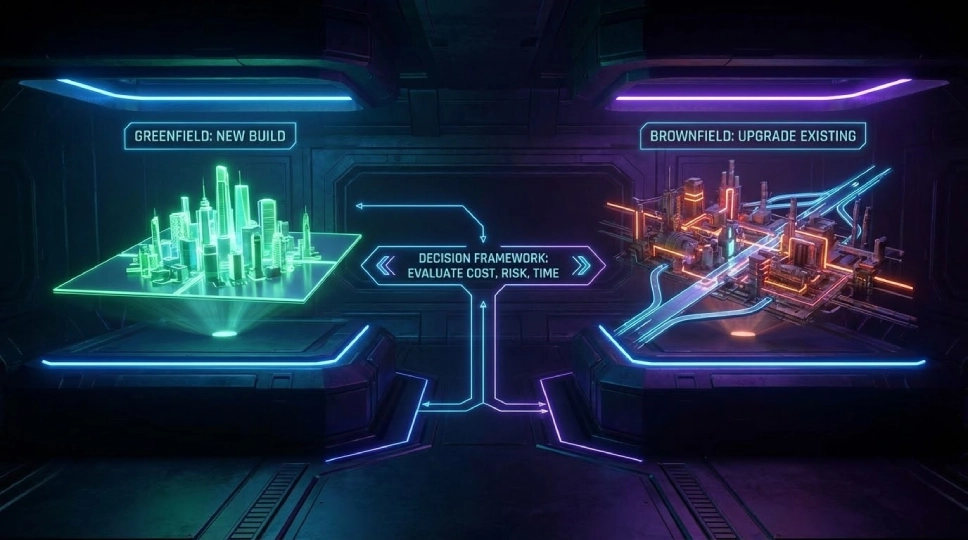
What Greenfield S/4HANA actually involves
Greenfield means starting completely fresh with SAP S/4HANA.
Think of it like building a new house instead of renovating:
- New SAP S/4HANA installation from scratch
- Redesign all business processes using SAP best practices
- No old customizations or configurations carried forward
- Only essential data migrated from old system
- Complete re-implementation of everything
You get a clean, modern system. But everything changes.
What Brownfield system conversion really means
Brownfield means upgrading your existing SAP ECC system to S/4HANA.
Think of it like renovating your current house:
- Convert existing SAP system to S/4HANA platform
- Keep current business processes mostly unchanged
- Preserve all customizations and configurations
- Migrate all historical data automatically
- Maintain business continuity throughout
You get S/4HANA technology while keeping familiar processes. But old problems remain.
Common misconceptions that confuse decisions
Many companies believe myths about these approaches:
Myth 1: “Greenfield is always better because it’s modern”
Reality: Modern doesn’t mean better for your business. If current processes work well, Greenfield wastes time redesigning them.
Myth 2: “Brownfield is just a technical upgrade”
Reality: Brownfield still requires significant testing, data cleanup, and change management. It’s not automatic.
Myth 3: “You must choose pure Greenfield or pure Brownfield”
Reality: Hybrid approaches combining both exist. Many companies use selective Greenfield for specific areas.
Why Most Organizations Struggle With This Decision
The Greenfield vs Brownfield choice creates intense internal debates.
Emotional attachment to existing SAP investments
Companies have spent millions on current SAP systems over decades:
- Custom developments that cost years to build
- Processes refined through painful lessons learned
- Integrations with other systems that work reliably
- Employee expertise in current system
Executives struggle to abandon these investments. Finance teams ask: “Why throw away what we paid for?”
Pressure to move fast versus minimize disruption
SAP ECC support ends in 2027. This creates urgency.
But businesses also need stability:
- Sales teams can’t afford system downtime
- Manufacturing must maintain production schedules
- Finance needs reliable month-end close
- Customers expect consistent service
Speed favors Brownfield. Transformation favors Greenfield. You can’t have both.
Why “best practice” advice often fails
Consultants and industry experts give generic recommendations:
- “Greenfield is best for digital transformation”
- “Brownfield is best for risk-averse companies”
- “Hybrid is best for large organizations”
This advice ignores your specific situation. What worked for other companies may fail for yours.
What Are You Really Trying to Achieve?
Start by clarifying your true business objectives.
Transformation versus continuity as strategic choice
Ask yourself honestly:
Do you need transformation?
- Current processes significantly hold the business back
- Competitive pressure demands new capabilities
- Merger or acquisition requires standardization
- New business model needs different processes
If yes, consider Greenfield.
Do you value continuity?
- Current processes work well for your business
- Users are productive with existing system
- Stability more important than innovation
- Cannot afford major business disruption
If yes, consider Brownfield.
When process redesign delivers more value than speed
Sometimes slower is better.
Greenfield takes longer but delivers greater value when:
- Current processes cause customer complaints
- Manual workarounds waste significant time
- Data quality problems create business risks
- Compliance issues need process changes
- Multiple systems need consolidation
Aligning migration with growth and governance goals
Match your approach to business strategy:
Growth-focused companies:
- Expanding to new markets or products
- Need flexible, scalable processes
- Can absorb change management challenges
- Greenfield often better fits growth strategy
Stability-focused companies:
- Mature markets with established operations
- Proven processes that work reliably
- Risk-averse culture and governance
- Brownfield preserves what works
Assessing Your Current SAP Landscape
Evaluate your existing system honestly before deciding.
Age, stability, and complexity of ECC system
System age matters:
- 10+ years old: Likely has significant technical debt, favors Greenfield
- 5-10 years old: Could go either way depending on customizations
- Less than 5 years: Recent implementation suggests Brownfield
System stability matters:
- Frequent issues and workarounds suggest problems to eliminate
- Stable, reliable operation suggests preserving investments
Custom code and technical debt considerations
Assess your customization level:
Heavy customization (30%+ custom code):
- Brownfield carries forward complexity
- Greenfield requires expensive redevelopment
- Hybrid approach may work best
Light customization (under 10% custom):
- Either approach works well
- Greenfield easier to adopt
Data quality and master data consistency
Poor data quality favors Greenfield:
- Opportunity to cleanse during migration
- Fresh start with clean data governance
- Eliminate duplicate or obsolete records
Good data quality supports Brownfield:
- Preserve well-maintained data automatically
- Less migration effort required
- Maintain historical accuracy
The Greenfield Path: When Starting Fresh Makes Sense
Greenfield works best in specific situations.
When legacy processes hold the business back
Choose Greenfield if:
- Processes designed 15+ years ago no longer fit business
- Workarounds and manual steps waste significant time
- Customer complaints trace back to process problems
- Compliance gaps exist in current workflows
- New business strategy needs different processes
Opportunities to standardize and modernize
Greenfield enables:
- Adopting SAP S/4HANA best practices fully
- Standardizing processes across business units
- Eliminating unnecessary customizations
- Implementing modern user experience with SAP Fiori
- Leveraging embedded analytics and AI
Risks of underestimating change management
Greenfield challenges:
- Higher cost: Complete reimplementation costs 30-50% more than Brownfield
- Longer timeline: Typically 18-24 months versus 9-12 months for Brownfield
- Massive user retraining: Everything changes, requiring extensive training
- Resistance to change: Users comfortable with current system resist new ways
- Business disruption: Process changes impact daily operations significantly
The Brownfield Path: When Preserving the Core Makes Sense
Brownfield offers advantages for many organizations.
When stability and speed are critical
Choose Brownfield if:
- Business cannot afford extended disruption
- Tight 2027 deadline pressure exists
- Limited budget for migration project
- Users highly resistant to change
- Current processes serve business well
Lower disruption for large or risk-averse organizations
Brownfield benefits:
- Faster implementation: System conversion in 9-12 months possible
- Lower initial cost: 30-40% less expensive than Greenfield
- Minimal retraining: Users see similar interface and processes
- Preserved data: All historical information migrates automatically
- Business continuity: Less disruption to daily operations
Hidden risks of carrying forward complexity
Brownfield challenges:
- Old problems remain in new system
- Technical debt continues accumulating
- Customizations may not work in S/4HANA
- Data quality issues migrate forward
- May need future cleanup projects
Comparing Risk Profiles: Greenfield vs Brownfield
Both approaches carry different risk types.
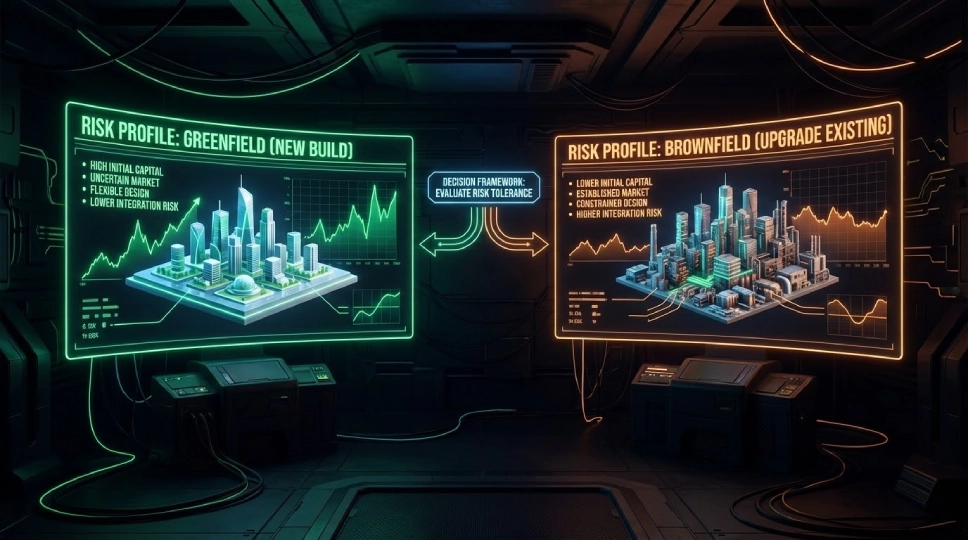
Operational risk during migration
Greenfield risks:
- Process gaps causing business disruption
- User adoption failures
- Data migration errors or losses
- Extended timeline overruns
Brownfield risks:
- Technical conversion failures
- Custom code compatibility issues
- Performance problems post-migration
- Data inconsistencies during conversion
Business disruption versus long-term optimization
Trade-off to consider:
- Greenfield: High short-term disruption, better long-term position
- Brownfield: Low short-term disruption, technical debt remains
Cost and Timeline Trade-Offs
Understand true total cost of ownership.
Short-term project cost versus long-term TCO
Greenfield costs:
- Higher upfront implementation (1.5-2x Brownfield)
- Lower ongoing support costs (cleaner system)
- Better TCO over 10+ years
Brownfield costs:
- Lower upfront implementation
- Higher ongoing support costs (complexity remains)
- May need future transformation project
Timeline predictability and resource requirements
Typical project timelines:
- Greenfield: 18-24 months for medium complexity
- Brownfield: 9-12 months for standard conversion
- Hybrid: 12-18 months depending on scope
Hybrid Approaches: When the Answer Is Not Either-Or
Many companies choose selective combinations.
Combining Brownfield conversion with targeted Greenfield redesign
Hybrid approach allows:
- Convert most modules using Brownfield approach
- Redesign specific problem areas using Greenfield
- Balance speed with selective transformation
- Manage risk through phased approach
Example: Brownfield for finance and manufacturing, Greenfield for sales and distribution.
How hybrid paths reduce extremes on both sides
Hybrid benefits:
- Avoid “all or nothing” decision
- Reduce change management burden
- Allow learning and adjustment mid-project
- Address specific pain points without complete overhaul
Applying Acharya’s Decision Framework
Use structured questions to guide your choice.
Key diagnostic questions
Answer these honestly:
- Do current business processes significantly limit growth or competitiveness?
- Is your organization capable of managing major change?
- What’s your true deadline pressure for going live?
- How much budget do you realistically have?
- Is your current SAP data quality good or poor?
- How much custom code exists in your system?
- What level of business disruption can you tolerate?
- Do you need to standardize across multiple entities?
Weighing business, technical, and people factors together
Create a decision scorecard considering:
- Business factors: Strategy alignment, process fit, competitive needs
- Technical factors: System age, customization level, data quality
- People factors: Change readiness, skill availability, leadership support
Using evidence instead of assumptions
Conduct proper assessment before deciding:
- SAP system technical health check
- Custom code analysis and sizing
- Data quality assessment
- Process fit-gap analysis
- Change readiness evaluation
Building Confidence in Your Chosen Path
Validate the decision before full commitment.
Validating through pilots or assessments
De-risk your choice:
- Proof-of-concept for critical processes
- Data migration pilot with sample data
- User acceptance testing with key stakeholders
- Performance testing in S/4HANA environment
Setting realistic expectations with stakeholders
Communicate clearly:
- Honest timeline and cost projections
- Expected business disruption levels
- Training requirements and duration
- Benefits realization timeframe
- Risks and mitigation strategies
Choose the Path That Serves Your Business
There’s no universally right answer to Greenfield vs Brownfield S/4HANA migration.
The right choice depends on your specific business context, technical landscape, and organizational capabilities.
How a structured framework reduces regret
Using Acharya’s decision framework helps you:
- Evaluate all factors systematically
- Involve right stakeholders in decision
- Base choice on evidence, not assumptions
- Align migration approach with business strategy
- Build confidence through validation
Turning the migration into long-term success
Whichever path you choose, success requires:
- Strong executive sponsorship
- Adequate budget and resources
- Robust change management
- Realistic timeline expectations
- Continuous stakeholder communication
Partner With UAE S/4HANA Migration Experts
Acharya Enterprise helps UAE organizations make confident Greenfield vs Brownfield decisions through structured assessment and proven implementation expertise.
Our team combines deep SAP technical knowledge with business process understanding to guide you to the right migration path for your specific situation.
Our S/4HANA migration services:
- Greenfield vs Brownfield decision assessment
- Current SAP system health evaluation
- Custom code analysis and remediation planning
- Data quality assessment and migration strategy
- Greenfield S/4HANA implementation
- Brownfield system conversion
- Hybrid migration approach design
- Change management and user adoption support
Get a free migration path assessment. We’ll evaluate your current SAP landscape and recommend the optimal approach for your business needs.
About Acharya Enterprise
Acharya Enterprise is a leading SAP services provider in the UAE, specializing in S/4HANA migrations, implementations, and managed services. With SAP consultants across 10+ countries and deep expertise in both Greenfield and Brownfield approaches, we help organizations navigate their SAP transformation journey successfully.
Related services: S/4HANA Migration | Greenfield Implementation | Brownfield Conversion | SAP System Assessment | Data Migration | Change Management | SAP Managed Services | Custom Code Remediation | UAE SAP Consulting