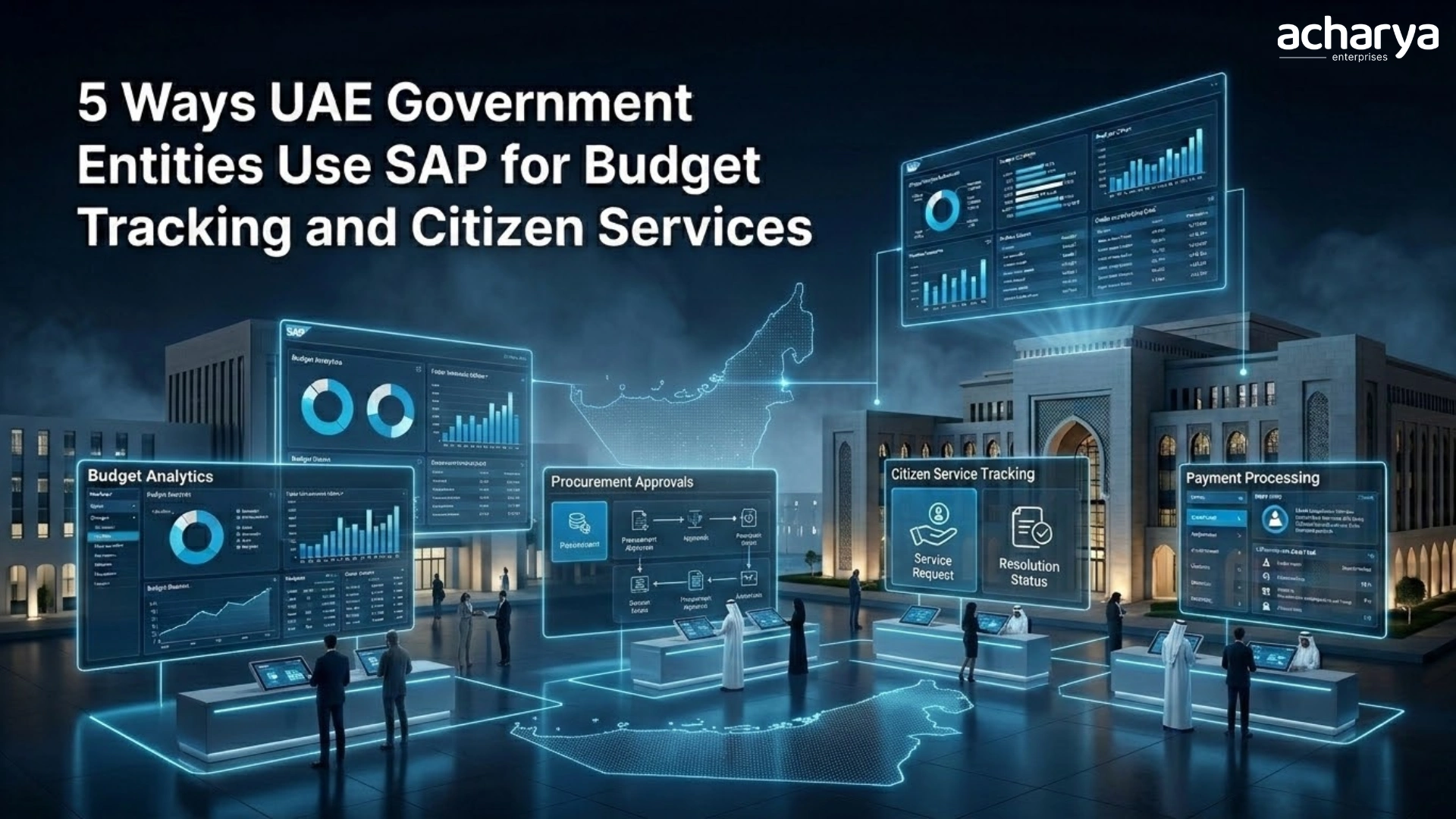
5 Ways UAE Government Entities Use SAP for Budget Tracking and Citizen Services
UAE government entities use SAP to plan budgets, track spending, and deliver digital services to millions of citizens. The UAE federal budget reached AED 71.5 billion in 2025, a 9 percent increase over the previous year. Managing funds of this scale requires connected financial systems that provide real time visibility across every department.
A proper SAP Implementation gives government leaders the tools to monitor budgets, automate compliance, and connect citizen services into one unified platform.
How do UAE government entities use SAP for budget tracking and citizen services?
UAE government entities use SAP to manage budgets, automate financial processes, integrate departments, and deliver faster citizen services through unified digital platforms.

- Centralized Budget Planning and Financial Control
The platform helps government entities plan, allocate, and monitor budgets in one connected system.
The UAE federal budget grew from AED 200 million in 1972 to AED 71.5 billion in 2025. At this scale, manual spreadsheets and disconnected tools create dangerous blind spots in fund allocation. Centralized budget planning ensures every dirham is tracked from approval to expenditure.
- Real time budget tracking across all departments
- Department level fund allocation with automated workflows
- Financial transparency for public accountability
About 35.7 percent of the 2025 budget was allocated to the Government Affairs sector, including smart government infrastructure and cybersecurity initiatives.
- Real Time Expense Tracking and Reporting
Connected systems enable government spending tracking with live reporting
dashboards and built in analytics.
Government entities handle thousands of transactions daily across procurement, payroll, and operations. Without live expense visibility, finance teams rely on outdated reports that delay critical decisions by days or weeks. Automated financial reporting replaces manual processes and gives leaders current data at all times.
This shift from periodic reporting to continuous monitoring allows government leaders to catch budget deviations early and redirect funds before small variances become costly overruns.
- Instant expense visibility across all government units
- Automated financial reports generated on demand
- Better decision making with built in analytics dashboards
- Automated eInvoicing and Compliance Management
The platform automates invoicing and ensures compliance with UAE financial regulations including the upcoming mandate.
The UAE eInvoicing mandate takes effect for B2B and B2G transactions starting July 2026. Government entities must integrate their financial systems with the Federal Tax Authority framework to remain compliant. Automated eInvoicing eliminates manual paperwork, reduces errors, and ensures every invoice meets regulatory standards before submission.
The Federal Tax Authority will oversee the accreditation of technology providers who connect government systems to the national eInvoicing infrastructure.
- Secure invoice generation and digital validation
- Direct integration with Federal Tax Authority systems
- Reduced manual paperwork and faster processing cycles
- Integrated Citizen Service Portals
Connected platforms power unified portals where citizens access multiple government services through a single interface.
The DubaiNow app offers more than 55 smart government services in one place, from visa processing to utility payments. In the sap dubai ecosystem, several government entities have adopted similar unified platforms to deliver seamless digital experiences.
The Department of Human Resources in Ras Al Khaimah received recognition from the platform vendor for its successful implementation of a cloud based human capital management solution. This achievement shows how public sector organizations can modernize operations when they invest in the right technology.
- Single platform for all government service requests
- Real time status tracking and push notifications
- Online payments and digital document interactions
- Data Integration Across Departments for Better Services
The system connects finance, HR, procurement, and service delivery to improve coordination across government entities.
Government departments have traditionally operated in silos with separate systems for finance, HR, and procurement. This fragmentation delays service delivery and creates data gaps that hurt decision quality.
A sap erp deployment connects these functions into one platform where data flows freely between departments. SEWA became the first utilities organization in the UAE running live on a fully integrated system, aligning with the government digitalization strategy.
- Unified data across all government departments
- Faster service response through connected workflows
- Improved citizen experience with seamless data sharing
Key Takeaways
- Centralized budget planning and real time expense tracking eliminate blind spots in government spending
- About 38 percent of the 2025 federal budget supports government affairs including digital infrastructure
- The eInvoicing mandate starting July 2026 requires B2B and B2G transaction compliance across all entities
- Connected platforms like DubaiNow deliver 55 plus government services through a single citizen portal
- Data integration across finance, HR, and procurement departments improves service delivery speed