Modernizing Finance and HR as One Integrated Strategy
Finance and HR are the backbone of every organization, yet most UAE companies modernize them separately. Your finance team gets S/4HANA while your HR team stays on outdated systems. S/4HANA and SuccessFactors implementation together solves this problem. When you modernize both systems at the same time, your finance and HR processes integrate seamlessly, your data flows in real-time, and your organization achieves complete digital transformation instead of incomplete modernization.
This guide explains why both systems matter together, how they integrate, how long implementation takes, what it costs, and how to execute successfully. If your organization is planning digital transformation, understanding the integrated approach determines your success.
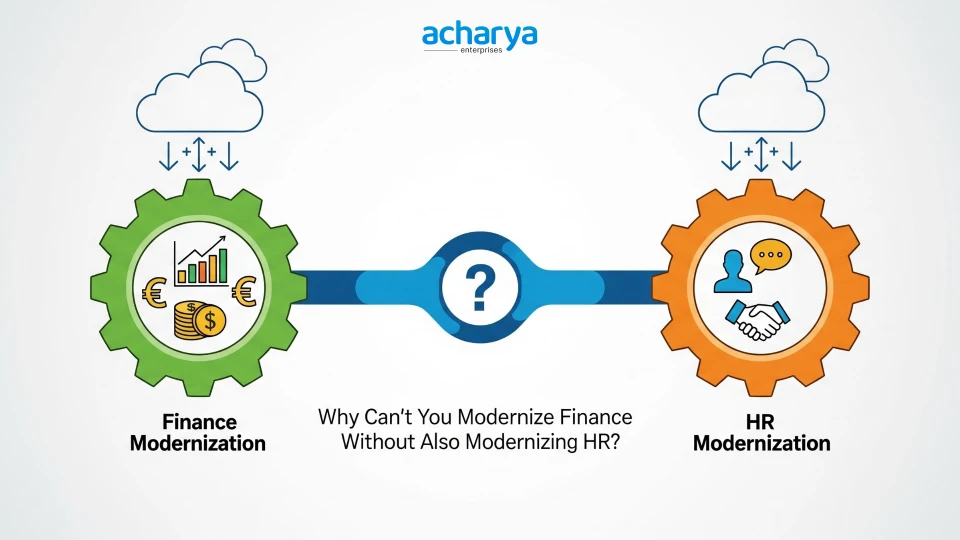
Why Can’t You Modernize Finance Without Also Modernizing HR in UAE Organizations?
Modernizing only finance with S/4HANA leaves your HR team on outdated systems that don’t communicate with your new financial platform.
The incomplete modernization problem:
Many UAE organizations implement S/4HANA to modernize finance and operations. They ignore HR systems running on decade-old technology. Your finance team gets real-time insights while HR struggles with manual payroll processes. Your operational data flows instantly while employee information stays siloed.
This creates several business problems:
- Payroll data sits in separate HR systems, requiring manual entry into finance
- Employee costs don’t flow accurately to project codes and cost centers
- Organizational changes take days to flow from HR to financial reporting
- Budget forecasting can’t integrate headcount and compensation data
- Compliance reporting becomes complex with data in multiple systems
Why both systems matter for complete transformation:
S/4HANA modernizes financial and operational processes. SuccessFactors modernizes HR and talent management processes. Together, they create an integrated platform where employee data, payroll information, and financial reporting connect seamlessly. Real-time integration means your finance team sees accurate labor costs instantly. Your HR team enables self-service for employees while finance gets clean, reliable data.
UAE government digital transformation context:
Government sector digital initiatives expect modern, integrated systems. Healthcare organizations need DHA-compliant HR systems alongside financial compliance. Banking organizations need DFSA-compliant payroll integration. Private sector organizations competing for talent need modern employee experience platforms. Running outdated HR systems while finance modernizes puts your organization at competitive disadvantage.
The business case for integrated transformation:
Organizations that implement S/4HANA and SuccessFactors implementation together see faster ROI because integration eliminates manual work. Payroll processes shrink from days to hours. Financial close cycles shorten. Employee self-service reduces HR headcount needs. Accurate labor cost allocation improves project profitability.
How Do S/4HANA and SuccessFactors Share Data and Work Together?
S/4HANA and SuccessFactors integrate through automated data feeds that synchronize employee, payroll, and cost information between systems.
Understanding the integration flow:
SuccessFactors manages employee master data: names, roles, departments, cost centers, compensation details. S/4HANA manages financial transactions and operational processes. The systems connect through integration services that automatically flow information from SuccessFactors to S/4HANA financial modules.
Key integration points:
- Employee master data flows from SuccessFactors to S/4HANA automatically
- Payroll costs calculate in SuccessFactors and post to S/4HANA general ledger
- Organizational hierarchy in SuccessFactors updates cost center structures in S/4HANA
- Headcount changes trigger budget line updates in financial planning
- Project assignments in SuccessFactors allocate labor costs to S/4HANA projects
Why real-time integration matters:
When payroll runs in SuccessFactors, salary expenses post to S/4HANA financial modules immediately. Your finance team doesn’t wait for manual data entry or Excel imports. Cost allocations happen automatically based on employee assignments. Budget forecasts update instantly when headcount changes occur.
Technical simplicity:
Modern integration tools make S/4HANA and SuccessFactors implementation straightforward. Data mapping happens during planning phase. Integration testing validates data accuracy before go-live. Post-implementation, integrations run automatically with minimal manual intervention. When done right, integration requires less ongoing maintenance than manual processes it replaces.
Data quality and compliance benefits:
Integrated systems enforce data consistency. One employee record exists in both systems, eliminating duplicate entry and data conflicts. Compliance audits become simpler because financial records match HR records. UAE compliance requirements for VAT reporting, payroll accuracy, and financial controls become easier to prove.
How Long Does Implementing S/4HANA and SuccessFactors Together Actually Take?
Most organizations complete S/4HANA and SuccessFactors implementation in 24-36 months total, typically implemented sequentially rather than in parallel.
Sequential implementation timeline (most common approach):
Phase 1: S/4HANA implementation
- Months 1-3: Assessment and planning
- Months 4-15: Implementation and testing
- Month 16-18: Go-live and stabilization
- Duration: 12-18 months
Phase 2: SuccessFactors implementation
- Months 19-21: Planning and resource allocation
- Months 22-30: Implementation and change management
- Months 31-36: Go-live and optimization
- Duration: 6-12 months after S/4HANA stabilizes
Total duration: 24-36 months from start to completion
Parallel implementation timeline (faster but higher risk):
Both systems run simultaneously with staggered phases:
- Months 1-6: S/4HANA and SuccessFactors assessment and planning
- Months 7-18: S/4HANA implementation while SuccessFactors planning continues
- Months 12-24: SuccessFactors implementation while S/4HANA optimizes
- Months 24-30: Integration testing and refinement
- Month 30: Final go-live and hypercare
Total duration: 24-30 months but requires 40% more resources
Why most organizations choose sequential:
Sequential approach reduces risk by allowing time to stabilize S/4HANA before adding SuccessFactors complexity. Your team gains experience with SAP transformation before managing dual implementations. Resource requirements stay manageable. Budget spreads across multiple years more easily. Parallel approach accelerates timeline but increases project risk and resource strain.
UAE market factors affecting timeline:
Availability of local SAP expertise impacts timeline. Competition for skilled consultants during peak implementation seasons (late 2025 onwards due to 2027 ECC deadline) extends timelines 10-15%. Government sector approvals and change control processes add 2-4 weeks. Healthcare compliance requirements add compliance validation steps. Most mid-size UAE organizations realistically budget 28-32 months for comfortable implementation.
Critical success factor:
Starting timeline planning early matters significantly. Organizations beginning assessment in late 2025 can complete by mid-2028. Organizations delaying until mid-2026 face compressed timelines and higher costs. Early planning prevents timeline compression and allows proper resource allocation.
What’s the Total Cost of Implementing S/4HANA Plus SuccessFactors in UAE?
Combined S/4HANA and SuccessFactors costs range from AED 15 million to AED 60+ million depending on organization size, complexity, and chosen approach.
Cost breakdown by component:
S/4HANA Implementation:
- Software licensing: AED 2-8 million (one-time)
- Professional services: AED 4-20 million (design, build, testing, go-live)
- Internal resources: AED 2-8 million (salary costs, opportunity costs)
- Infrastructure: AED 1-4 million (cloud or on-premise)
- Total S/4HANA: AED 10-40 million
SuccessFactors Implementation:
- Software licensing: AED 1-3 million (one-time)
- Professional services: AED 2-8 million (design, configuration, training)
- Internal resources: AED 1-5 million (salary costs, change management)
- Integration and customization: AED 1-4 million (data migration, integration development)
- Total SuccessFactors: AED 5-20 million
Combined Total:
- Simple organizations: AED 15-25 million
- Mid-size organizations: AED 20-35 million (most common)
- Complex organizations: AED 40-60+ million
Cost variations by organization type:
Small organizations (500 employees):
- AED 10-18 million for both systems
- Simple processes, less customization needed
Mid-size organizations (2,000-5,000 employees):
- AED 20-35 million for both systems
- Some customization, integration complexity moderate
Large/complex organizations (10,000+ employees):
- AED 40-60+ million for both systems
- Significant customization, multiple locations, complex integrations
Hidden costs to include in budget:
Organizations often overlook:
- Change management consulting: AED 800k-2 million
- Extended training programs: AED 500k-1.5 million
- Data migration and cleansing: AED 300k-1 million
- Infrastructure optimization: AED 400k-1.2 million
- Post-implementation optimization: AED 500k-2 million
Add 15-20% contingency to estimates to cover unforeseen costs.
UAE-specific cost factors:
Local SAP expertise in UAE costs 15-25% more than offshore resources. However, local teams reduce timezone delays and travel expenses, often making total cost comparable or better. Government sector implementations often budget 20% more due to compliance complexity and security requirements. Healthcare organizations need DHA compliance validation adding AED 300k-700k.
Financial benefits justifying investment:
Annual operating cost reduction: 15-25% through process automation Faster financial close: 5-7 days reduction in month-end close cycle Improved payroll accuracy: 95%+ reduction in manual adjustments Better labor cost allocation: 20-30% improvement in project profitability Faster hiring: 30-40% reduction in time-to-hire with SuccessFactors
These benefits generate ROI typically within 24-36 months after implementation completion.
Is It Better to Implement S/4HANA and SuccessFactors Together or One After Another?
Sequential implementation (S/4HANA first, then SuccessFactors 6-12 months later) is typically lower risk and more manageable for most organizations.
Sequential approach advantages and disadvantages:
Advantages:
- Lower project risk (only manages one major transformation at a time)
- More manageable resource requirements
- Allows time to stabilize S/4HANA before SuccessFactors complexity
- Budget spreads across multiple years
- Team gains SAP experience before second implementation
- Easier change management (one transformation phase at a time)
- Lower organizational disruption
Disadvantages:
- Longer total timeline (24-36 months instead of 24-30)
- Longer time before realizing integrated benefits
- S/4HANA runs without SuccessFactors integration initially
- Manual payroll interfaces needed during transition period
- More implementation cycles for teams to manage
Parallel approach advantages and disadvantages:
Advantages:
- Faster total timeline (24-30 months vs 24-36 months)
- Integrated from initial go-live
- Single change management cycle
- Faster benefit realization
Disadvantages:
- Higher project risk and complexity
- Requires 40% more resources (competing for skilled consultants)
- Higher cost due to resource requirements
- Greater organizational change impact
- More integration testing needed
- Parallel go-lives increase failure risk
Which approach is right for your organization?
Choose sequential if:
- Resource constraints exist (can’t staff two large projects)
- Risk tolerance is low
- Organization has limited SAP experience
- Budget is constrained
- You want time to stabilize before next major change
- Your industry requires careful change management (government, healthcare, finance)
Choose parallel if:
- Strong project management capabilities exist
- Adequate budget for larger team
- Organizational change capacity is high
- Timeline pressure exists
- You want integrated transformation immediately
- Risk tolerance is higher
Reality for UAE organizations:
Most mid-size UAE organizations choose sequential approach. Resource constraints in UAE SAP market make parallel implementation difficult. Government sector organizations typically must choose sequential due to change control requirements. Healthcare organizations choose sequential to manage compliance carefully. Sequential approach remains most common choice for good reasons.
What’s the Planning Framework for Transforming Finance and HR with S/4HANA and SuccessFactors?
Successful digital transformation requires integrated planning covering both systems across six critical dimensions.
Planning phase duration: 8-12 weeks before implementation begins
Six planning dimensions:
1. Business Case Development
- Define clear business objectives for both systems
- Identify specific benefits: cost reduction, time savings, compliance improvement
- Calculate expected ROI and payback period
- Establish success metrics for measuring transformation value
- Get leadership alignment on objectives and investment
2. Organizational Readiness Assessment
- Evaluate current state of finance and HR processes
- Assess technology maturity and team capabilities
- Identify change management requirements
- Determine training needs across organization
- Clarify governance structure and decision rights
3. Integrated Architecture Design
- Design how S/4HANA and SuccessFactors will integrate
- Map data flows between systems
- Plan integration points (payroll, employee master, cost centers)
- Define technical infrastructure requirements
- Plan security and compliance controls
4. Resource Allocation Planning
- Determine internal resources needed (people, time, budget)
- Identify skill gaps requiring external expertise
- Plan vendor selection and partner engagement
- Budget for professional services and tools
- Schedule resource availability across timeline
5. Timeline Development
- Create detailed project schedule with phases
- Set realistic milestone dates with buffers
- Align with business cycle (avoid busy seasons)
- Plan go-live timing for minimal disruption
- Build in testing and validation time
6. Governance Structure
- Establish steering committee with executive sponsors
- Define decision-making authority and escalation paths
- Create program management office structure
- Set communication protocols
- Establish change control and scope management
Planning deliverables:
After planning phase, you should have documented:
- Executive summary with business case
- Detailed requirements from finance and HR
- Technical architecture diagram
- Implementation roadmap with timeline
- Budget and resource plan
- Risk register and mitigation strategies
- Change management and training plan
- Success metrics and benefits tracking approach
Why planning determines success:
Organizations that plan thoroughly complete implementation on time and budget. Organizations that skip or shortcut planning face delays, cost overruns, and adoption challenges. Planning builds organizational alignment so everyone understands why S/4HANA and SuccessFactors implementation matters.
How Do You Get HR Teams to Adopt SuccessFactors While S/4HANA Implementation is Happening?
Managing dual adoption requires clear communication, phased training approach, and emphasizing benefits that matter to HR teams and employees.
The adoption challenge:
S/4HANA transformation creates significant change for finance, operations, and systems teams. Adding SuccessFactors simultaneously creates change for HR teams and all employees. Managing both transformations requires careful change management to prevent adoption fatigue and resistance.
Change management strategy for dual adoption:
Communication approach:
- Communicate why both systems matter (integrated transformation vision)
- Explain benefits clearly: faster payroll, easier employee experience, better HR insights
- Emphasize what doesn’t change: employee policies, salary structure, compensation philosophy
- Share timeline transparently: when S/4HANA goes live, when SuccessFactors starts, when both integrate
- Use success stories from early implementations to build confidence
Phased training approach:
- Phase 1 (Months 1-3): Awareness and orientation for all staff
- Phase 2 (Months 12-14): SuccessFactors deep-dive training for HR team
- Phase 3 (Months 22-24): Role-based training for employee population
- Phase 4 (Months 30-32): Refresher training and system optimization
Role-based adoption focus:
HR team:
- New system improves their job (less manual work, better insights)
- Self-service capabilities reduce administrative burden
- Analytics help them make better people decisions
- Mobile capabilities enable remote work
Managers:
- Self-service approvals streamline their workflows
- Real-time dashboards show team costs and headcount
- Easier performance management and development planning
- Better visibility into talent pipeline
Employees:
- Self-service for benefits, expense reports, leave requests
- Mobile access from anywhere (iPad, mobile phone)
- Easier career development planning
- Better communication from HR
SuccessFactors benefits emphasis:
Instead of focusing on “new system,” emphasize:
- Less time on administrative tasks
- Faster leave and expense request approvals
- Better work-life integration with mobile access
- Improved career development conversations
- Easier access to compensation and benefits information
Preventing adoption failure:
Adoption fails when people don’t see personal benefit. SuccessFactors adoption succeeds when employees see it makes their jobs easier. Share this clearly in communications. Train managers to coach their teams on new capabilities. Make benefits concrete (“Your travel expense report approves in 2 days instead of 2 weeks”).
Timeline consideration:
Implement SuccessFactors after S/4HANA stabilizes (not during S/4HANA chaos). Your organization needs time to absorb S/4HANA change before adding SuccessFactors transformation. Sequential approach prevents adoption fatigue.
What Integration Points Must You Plan When Implementing S/4HANA and SuccessFactors Together?
Critical integration points require detailed planning during design phase and extensive testing before go-live.
Five critical integration areas:
1. Employee Master Data Integration
- Single employee record syncs between SuccessFactors and S/4HANA
- Employee updates in SuccessFactors (name, address, role changes) flow to S/4HANA automatically
- New hires appear in S/4HANA immediately after SuccessFactors enrollment
- Terminations trigger deprovisioning in both systems
- Testing requirement: Verify employee changes flow within 1 hour
2. Payroll to Finance Integration
- Payroll calculations in SuccessFactors flow to S/4HANA general ledger
- Salary expenses post to cost centers assigned in SuccessFactors
- Deductions and taxes calculate correctly in financial reports
- Month-end payroll reconciliation happens automatically
- Testing requirement: Validate payroll amounts match exactly in both systems
3. Organizational Hierarchy Synchronization
- Department structure in SuccessFactors syncs to S/4HANA cost center hierarchy
- Reporting lines in SuccessFactors update profit center assignments in S/4HANA
- Org changes flow to both systems simultaneously
- Cost center budget allocations reflect organizational structure
- Testing requirement: Verify all 50,000+ cost center combinations work correctly
4. Cost Center and Project Allocation
- Employee assignments to projects in SuccessFactors drive cost allocations in S/4HANA
- Resource costs allocate to projects based on SuccessFactors assignments
- Project profitability reflects accurate labor cost allocation
- Budget vs. actuals reporting integrates headcount and compensation
- Testing requirement: Test 100+ project assignments with various employee categories
5. Headcount Reporting Integration
- Real-time headcount from SuccessFactors feeds into S/4HANA financial reports
- Budget forecasting uses headcount from SuccessFactors
- Workforce planning integrates with financial planning
- Headcount changes trigger financial impact immediately
- Testing requirement: Verify headcount changes appear in financial reports within 2 hours
Integration complexity factors:
- Data format differences between systems require transformation
- Timing considerations (payroll runs monthly, sales commission runs quarterly)
- Error handling (what happens if integration fails?)
- Reconciliation procedures (monthly verification of data accuracy)
- Audit trails (compliance and financial controls)
Planning integration correctly:
During planning phase, identify all integration points. In design phase, map data flows and transformation logic. And in build phase, develop and test integrations. During testing phase, validate extensively with real data volumes. During cutover, monitor integrations continuously.
Post-implementation integration management:
After go-live, monitor integrations daily for 30 days. Review error logs and reconciliation reports. Validate that all integration points work as designed. Document any manual workarounds needed. Plan optimization of integrations after stabilization.
What Success Metrics Should You Track for Your S/4HANA and SuccessFactors Transformation?
Measure transformation success through business outcomes, not just technical completion. Identify metrics before implementation and track throughout transformation journey.
S/4HANA specific metrics:
- Financial close cycle time: Target 5-7 day reduction (AED cost savings: AED 200k-500k annually)
- General ledger accuracy: Target 99%+ (reduced audit adjustment costs)
- Cash flow forecast accuracy: Target 95%+ (better working capital management)
- Inventory optimization: Target 15-20% inventory reduction (AED 2-5 million cash release)
- Order-to-cash cycle: Target 20-30% reduction (faster cash collection)
- Procure-to-pay cycle: Target 25-35% reduction (improved supplier relationships)
SuccessFactors specific metrics:
- Time-to-hire: Target 30-40% reduction (competitive advantage in UAE talent market)
- Employee onboarding time: Target 25-30% reduction
- Performance review completion: Target 95%+ (from 60-70% typical)
- Employee engagement scores: Target 10-15% improvement
- Internal promotion rate: Target 20-30% increase (better talent development)
- Voluntary turnover: Target 5-10% reduction (improved retention)
Integration metrics (both systems):
- Payroll processing accuracy: Target 99.5%+ (from 95% typical)
- Month-end close timeline: Target 2-3 day reduction through payroll automation
- Cost allocation accuracy: Target 99%+ (from 85-90% manual allocation)
- Budget vs. actual variance: Target 5% variance (from 10-15% typical)
- Data reconciliation time: Target 50% reduction (automation benefits)
Organizational metrics:
- System adoption rate: Target 90%+ for SuccessFactors (measured by active users)
- User satisfaction: Target 4/5 or higher
- Support ticket volume: Target 40% reduction after 6 months
- Training completion: Target 100% (all staff trained)
- Productivity improvement: Target 10-15% through process automation
ROI metrics:
- Total cost of ownership reduction: 15-25% annually
- Process automation benefits: AED 2-5 million annually
- Labor cost optimization: AED 1-3 million annually
- Working capital release: AED 5-10 million
- Payback period: 24-36 months typically
Tracking methodology:
Establish baseline metrics before implementation begins. Track metrics monthly during transformation. Compare to targets to identify gaps needing attention. Celebrate wins when metrics meet or exceed targets. Address underperformance with targeted improvements. Report metrics to leadership monthly to maintain executive visibility.
Why metrics matter:
Metrics demonstrate whether transformation delivered promised benefits. Organizations that track metrics realize benefits faster because metrics drive accountability. Metrics justify investment and support continued business case. Metrics identify optimization opportunities post-implementation.
What Level of Expert Support and Partnership Does S/4HANA and SuccessFactors Digital Transformation Require?
Successful transformation requires experienced partners who understand both S/4HANA and SuccessFactors integration, not just implementation vendors.
Why internal teams struggle alone:
Organizations attempting S/4HANA and SuccessFactors implementation without experienced partners face several challenges:
- Limited SAP expertise on staff (few people know both systems deeply)
- First-time implementation mistakes consume time and budget
- Integration complexity exceeds in-house technical capability
- Change management failure leads to poor adoption
- Integration issues discovered after go-live become expensive fixes
- Lack of best practice guidance leads to suboptimal designs
- Post-implementation optimization gets deprioritized
Partnership requirements:
Implementation expertise: Deep knowledge of S/4HANA and SuccessFactors configuration, customization, and integration. Partners who have implemented both systems 50+ times bring proven methodologies that accelerate your implementation.
Integration technical expertise: Understanding data mapping, integration middleware, real-time synchronization, and error handling. Integration expertise prevents post-go-live surprises.
Change management guidance: Helping you prepare organization for transformation, managing resistance, building adoption, training teams effectively. Change management expertise determines whether adoption succeeds or fails.
Local UAE expertise: Understanding UAE government requirements, industry compliance (DHA, DFSA), business practices, and labor law. Local expertise prevents compliance surprises and regulatory issues.
Industry expertise: Healthcare organizations need different configuration than manufacturing or retail. Industry expertise accelerates relevant design and testing.
Post-implementation optimization: After go-live, organizations need guidance on optimizing configurations, improving performance, realizing full benefits. Long-term partnership ensures ROI realization continues beyond go-live.
Acharya’s partnership approach:
Acharya Enterprise combines 10+ years of global SAP expertise with deep UAE market knowledge. We understand S/4HANA and SuccessFactors integration from extensive implementation experience across 10+ countries, with concentrated focus on UAE organizations.
Our approach positions us as your partner, not vendor:
- Dedicated teams assigned to your transformation, not rotating staff
- Long-term support through implementation and beyond
- Proactive optimization recommendations based on performance data
- Training for your team so you become self-sufficient over time
- Flexible engagement models matching your needs and constraints
We work with government entities navigating compliance complexity, healthcare organizations needing DHA alignment, manufacturing companies optimizing supply chain, and service firms leveraging talent capabilities. This experience ensures we anticipate your challenges and position solutions accordingly.
What partnership investment looks like:
Expect your partner to:
- Understand your business before proposing solutions
- Design integrations specific to your processes (not generic)
- Build your team’s capability alongside implementation
- Provide post-go-live optimization for 12-24 months
- Report progress transparently with clear milestones
- Escalate issues immediately with solutions proposed
- Act as extension of your team, not external vendor
Successful transformations happen when organizations and partners share commitment to success. Your success becomes their success. That partnership mindset makes the difference between transformations that deliver ROI and transformations that frustrate and disappoint.
Complete Digital Transformation Requires Both Systems
Finance modernization without HR modernization leaves your organization incomplete. HR modernization without finance integration loses the benefits both systems deliver together.
Organizations across UAE successfully transforming recognize that S/4HANA and SuccessFactors implementation together represents complete digital transformation. Finance teams work with accurate employee cost data. HR teams deliver modern employee experience. Payroll processes become reliable and efficient. Financial forecasting improves significantly.
The choice isn’t whether to implement both systems. The deadline realities (SAP ECC ending in 2027, competitive pressures from digital leaders) make modernization inevitable. The choice is whether you modernize thoughtfully, planning integrated transformation, or reactively, implementing systems separately and struggling with integration later.
Starting transformation planning now positions your organization to modernize confidently. Early planning prevents timeline compression. Integrated approach prevents costly post-implementation integration rework. Partnership with experienced guides ensures you navigate complexity successfully.
Your next step: Contact Acharya Enterprise for a confidential digital transformation assessment. Our team evaluates your current finance and HR systems, clarifies realistic timeline and cost for your organization, and recommends the implementation approach that works best for your situation.
We work as your partner through the entire transformation journey, not just implementing systems and leaving. Your success with modernization is our success. Let’s talk about how complete digital transformation enables your organization to compete and grow in UAE’s increasingly digital business environment.