SAP BTP: What It Is and How UAE Companies Use It to Extend SAP
What SAP BTP Really Is, Without the Buzzwords
SAP BTP (Business Technology Platform) is SAP’s platform for building, integrating, extending, and automating business applications, all in one place.
Think of it as the layer that sits between your core SAP system and everything around it. It connects your ERP to other systems, lets you build new apps and workflows, and gives you better data and analytics, without touching or breaking what’s already working inside SAP.
SAP officially launched BTP in 2021 by bringing together multiple tools and services under one platform. According to SAP, customers using BTP report a three-year ROI of 514%. It’s used by more than 27,000 organizations globally as of late 2024.
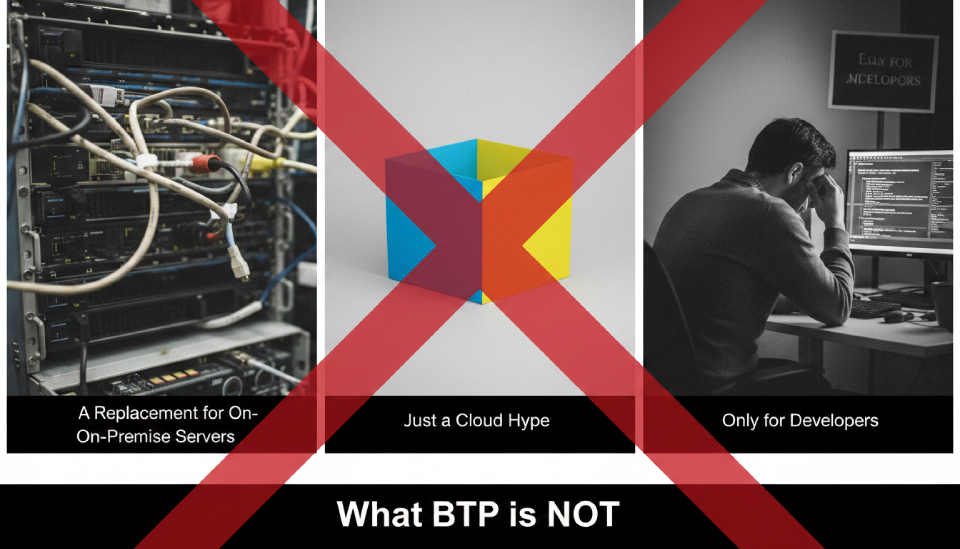
What BTP is not
Before going further, a few things worth clearing up:
- BTP is not a replacement for S/4HANA or SAP ECC
- It is not just a reporting or analytics tool
- It’s not only for large enterprises, UAE SMEs use it too
- It does not require rebuilding your existing SAP setup
Why SAP BTP Matters for UAE Companies Right Now
UAE businesses face a specific set of pressures that make BTP relevant today, not someday.
- Regulatory change is constant: VAT amendments, AML updates, PDPL compliance, and ESG reporting all demand system responses fast
- Integration backlogs are real: banks, government portals, logistics platforms, customs systems, and CRMs all need to connect to SAP reliably
- User experience expectations have risen: employees and customers expect mobile-friendly, role-specific interfaces, not complex SAP screens
- Digital transformation mandates from leadership require innovation without disruption
The old answer was to customize the core SAP system. That created years of technical debt, made upgrades painful, and slowed everything down.
BTP offers a different answer: innovate outside the core, keep S/4HANA clean and standard, and build everything else on the platform around it.
The Five Pillars of SAP BTP and What They Do
SAP BTP is structured around five core capabilities. Each one solves a different type of business problem.
Application Development Build new apps, workflows, and user experiences on top of SAP. Low-code tools like SAP Build let business teams create apps without heavy coding. Developers can build more complex applications using professional-grade tools and environments.
Integration Connect SAP and non-SAP systems cleanly and securely. Instead of point-to-point connections that break every time a system changes, BTP Integration Suite creates reusable, governed API connections between your ERP, banks, logistics providers, and third-party platforms.
Data and Analytics Turn SAP data into better decisions. SAP Analytics Cloud, hosted on BTP, gives teams real-time dashboards and reporting across finance, supply chain, and operations without exporting spreadsheets.
Automation Remove manual work from repetitive processes. Approval workflows, document processing, exception handling, and handoffs that currently live in email chains can all be automated through SAP Build Process Automation and RPA tools.
Artificial Intelligence AI on BTP is used for practical tasks today: extracting data from unstructured documents, demand forecasting, fraud detection, and intelligent recommendations. The AI services connect directly to business data already inside SAP.
How UAE Companies Use SAP BTP: The Most Common Patterns
Side-by-side extensions
Instead of modifying S/4HANA to add new capability, UAE companies build the new functionality on BTP and connect it to the core via APIs. The core stays clean. Upgrades stay simple. New features deploy independently.
User experience upgrades
Complex SAP screens are replaced with role-based Fiori apps that show only what each person needs. A procurement manager gets a mobile approval app. A warehouse supervisor gets a simple stock movement view. A finance director gets a live dashboard, none of it touching the underlying system.
Process automation
Approval workflows that used to move through email chains and WhatsApp messages become structured, trackable, auditable processes. Purchase approvals, vendor onboarding, exception handling, and credit limit requests are common automation targets for UAE businesses.
Integration as a product
Instead of building one-off connections every time a new system appears, BTP Integration Suite lets teams build a standard API layer. Banks, payment gateways, UAE government portals, customs systems, logistics platforms, and CRM tools all connect through governed, monitored interfaces that survive system upgrades.
Data products for better decisions
Finance teams, procurement leads, and executives often suffer from multiple conflicting versions of the same numbers. BTP-based data layers create governed datasets with one agreed definition for revenue, margin, inventory value, and cash position, shared across the business.
Real-World Scenarios UAE Teams Build on SAP BTP
These are the use cases that come up most often in UAE implementations:
- Mobile procurement approvals: purchase requests reviewed and approved on mobile without logging into SAP
- Customer self-service portals: orders, invoice status, service requests, and returns handled online
- VAT compliance workflows: document validation, audit evidence packs, and filing support built as BTP extensions
- Trade and logistics visibility: integrating warehouse and transport management systems with customs data and delivery tracking
- HR and onboarding automation: connecting SAP SuccessFactors with onboarding workflows, document management, and employee portals
- Executive dashboards: pulling SAP and non-SAP data into one decision layer, sales, margin, cash, and headcount in a single view
- Retail and omnichannel connectors: bridging SAP with POS systems, e-commerce platforms, and loyalty programs
Choosing the Right BTP Tool for Each Job
SAP BTP offers several development and extension approaches. The right one depends on what you’re building and who is building it.
- SAP Build (low-code/no-code): Quick apps and approval workflows for business teams with little or no development background
- SAP Fiori extensions: Modernizing how users interact with SAP without changing the underlying business logic
- CAP (Cloud Application Programming Model): For more complex, scalable applications that need proper software engineering
- ABAP in the cloud: For teams that already know ABAP and want to extend SAP with familiar skills while still protecting the clean core
- Event-driven extensions: Reacting in real time to business events, an order is placed, a shipment is delayed, a payment is received, and triggering automated responses
Simple approvals and basic apps belong in SAP Build. Complex integrations and multi-entity workflows belong in CAP or Integration Suite. When in doubt, start simple and build from there.
Integration in the UAE: Connecting SAP to Everything Around It
UAE businesses have a specific integration landscape that BTP handles well:
- Local bank connectivity for payment runs and bank statement reconciliation
- UAE Federal Tax Authority portal connections for VAT filing
- Customs and trade platform integrations for import/export companies
- Logistics and third-party warehousing platform connections
- E-invoicing system compliance
The biggest mistake UAE teams make with integration is building direct, brittle connections that break whenever a system changes. BTP Integration Suite creates a standard middleware layer. All integrations run through it. When a bank or logistics provider changes their API, you fix one integration, not ten.
Security and Compliance: What UAE Leaders Need to Get Right
BTP-built extensions and integrations must meet the same compliance standards as the core SAP system.
Key requirements:
- Role-based access with least privilege, users only see and do what their job requires
- UAE PDPL compliance for any workflows that process personal data: employee records, customer information, supplier contacts
- Full auditability across all approvals, integrations, and automated processes
- Segregation of duties built into extension design from the start, not added after the audit flags it
- Secure development practices: separate development, test, and production environments with proper change control
Compliance is a design requirement, not a final checklist.
Common Mistakes When Adopting SAP BTP
These are the patterns that consistently cause problems for UAE BTP programs:
- Treating BTP as a one-off project rather than a long-term platform capability
- Rebuilding core ERP logic inside BTP extensions, this defeats the entire purpose
- Skipping integration standards and creating the same point-to-point spaghetti in a new environment
- Underestimating data quality, BTP analytics and AI are only as good as the master data feeding them
- Building great tools that nobody uses because change management was skipped
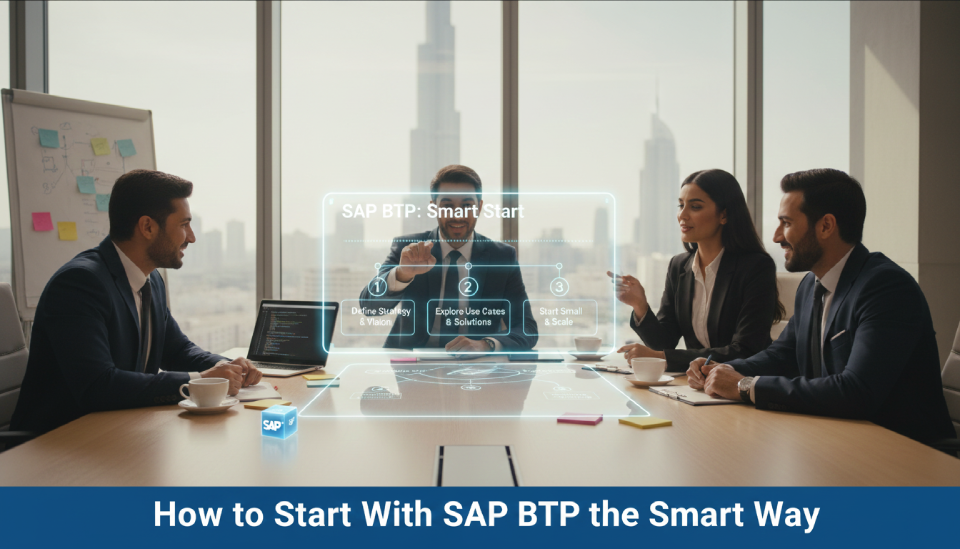
How to Start With SAP BTP the Smart Way
Starting with BTP doesn’t require a massive program. A focused approach works better.
- Identify one or two clear extension candidates, things that shouldn’t go into the core but are currently creating pain
- Define principles upfront: clean core commitment, reusable APIs, and consistent UX standards for everything built on the platform
- Run a focused pilot on one process with measurable outcomes, mobile approvals, a customer portal, or an integration that currently breaks regularly
- Establish governance from day one: architecture review, security sign-off, and change control before scaling
- Build a reusable foundation: shared templates, logging, monitoring, and deployment processes that every future project inherits
Scale with a prioritized backlog. Every new BTP use case should justify itself by value, reuse potential, and risk.
Is SAP BTP Right for Your UAE Organization?
Strong fit signals:
- Your core SAP processes are reasonably stable
- You have clear integration pain points with banks, logistics, or government systems
- Business teams are requesting better mobile access or simpler interfaces
- Compliance teams need better audit trails across approvals and workflows
- Leadership wants better data visibility without more custom reports
Consider simplifying first if:
- Master data is messy and inconsistent across entities
- Process ownership is unclear or constantly changing
- Your core SAP implementation is still unstable
- Scope keeps expanding before any project concludes
Partner With UAE SAP BTP Experts
Acharya Enterprise helps UAE organizations design, build, and govern SAP BTP landscapes that deliver real business outcomes, from faster approvals and cleaner integrations to compliant extensions and better analytics.
Our SAP BTP services cover:
- BTP readiness assessment and architecture design
- SAP Integration Suite implementation for UAE-specific connections
- SAP Build and low-code application development
- Clean core extension strategy for S/4HANA programs
- UAE compliance and security design for BTP environments
- Analytics and data layer development
- Managed services and platform operations post-go-live
Contact Acharya Enterprise for a free BTP workshop. We’ll map your top three extension and integration candidates and show you what a 90-day value plan looks like for your specific landscape.
About Acharya Enterprise
Acharya Enterprise is a UAE-based SAP services provider with consultants across 10+ countries. We specialize in SAP implementations, S/4HANA migrations, BTP extensions, security and controls, and managed services for UAE enterprises and agencies.
Related services: SAP BTP | SAP Integration Suite | SAP Build | Clean Core Strategy | S/4HANA Migration | SAP Fiori | UAE SAP Compliance | SAP Analytics Cloud | SAP Managed Services | SAP Implementation UAE