S/4HANA Production Scheduling: Why Production Orders Still Miss Their Planned Dates
S/4HANA Production Scheduling helps UAE manufacturers plan production order start dates, finish dates, capacity use, material needs, and shop floor execution more accurately.
For factories in Dubai, Abu Dhabi, Sharjah, Ras Al Khaimah, and UAE free zones, missed production dates create AED cost leakage through overtime, urgent procurement, delayed deliveries, excess WIP, and customer escalations.
The problem is rarely SAP alone. Production orders usually miss planned dates because master data, materials, capacity, quality, and shop floor updates are not reliable enough.
What does production scheduling mean in SAP S/4HANA?
Production scheduling in SAP S/4HANA means planning when production orders should start, finish, use materials, consume capacity, and deliver finished goods.
The SAP S/4HANA production scheduling process connects dates, operations, work centers, material availability, and production order execution.
In simple terms, SAP scheduling answers: when should the order start, when should each operation happen, and when should the finished product be ready?
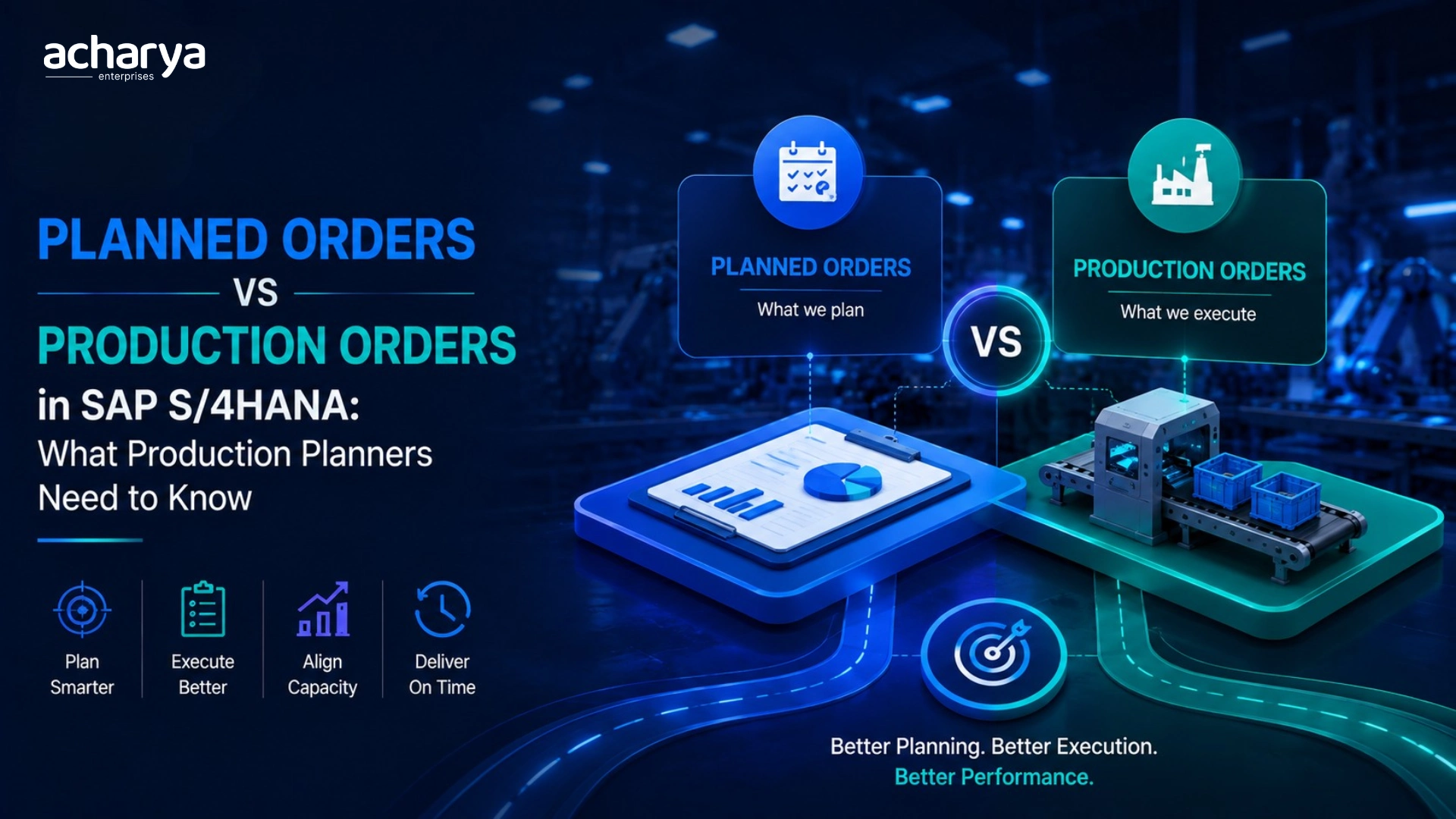
For teams comparing planned orders versus production orders , this distinction matters because planned dates can change when orders become executable factory work.
Why do production orders still miss their planned dates?
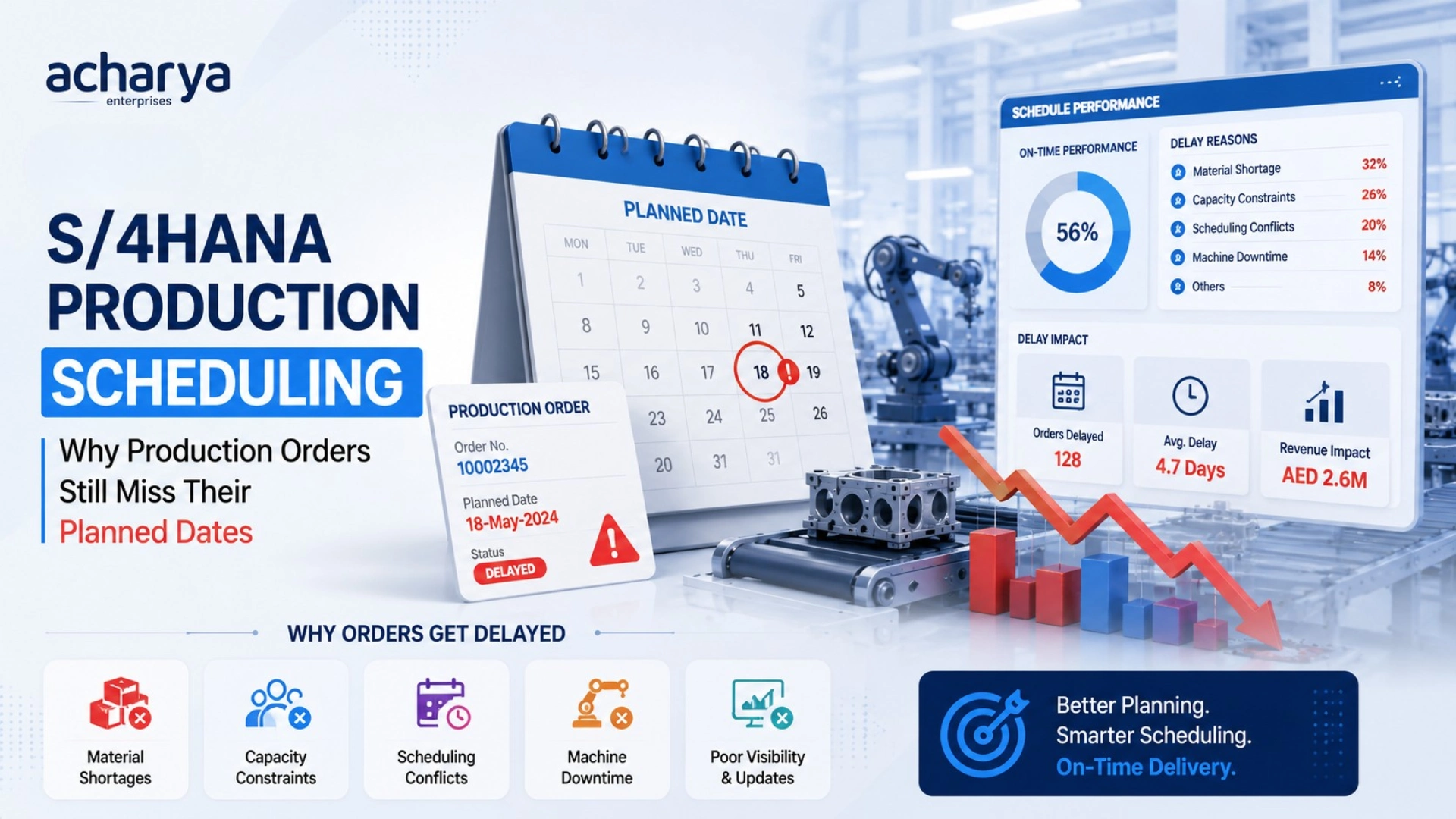
Production orders miss planned dates when schedules are created without accurate material, capacity, machine, labor, quality, and shop floor status.
Why are production orders delayed in SAP? The answer is usually a mix of planning and execution gaps.
A schedule may look realistic in the system, but production fails when materials are missing, work centers are overloaded, or confirmations arrive late.
Common signals include late starts, partial confirmations, repeated rescheduling, urgent material follow-ups, and production supervisors correcting plans manually.
How does poor master data create unrealistic production schedules?
Poor master data creates unrealistic schedules when BOMs, routings, production versions, work center capacities, and lead times do not match actual factory conditions.
What causes missed production deadlines? Often, the schedule is already wrong before production begins.
If routing time is outdated, SAP may calculate a finish date that the shop floor cannot meet. If work center capacity is incorrect, the order may be assigned to a line that is already overloaded.
For UAE manufacturers, this is risky when multiple plants, shifts, warehouses, and free-zone operations share the same planning model.
Why do material shortages delay production orders in SAP S/4HANA?
Material shortages delay production orders when raw materials, packaging, components, or spare parts are not available at the scheduled start time.
Production planning SAP depends on accurate material availability.
If a production order is scheduled before critical material is received, released from quality, or moved to the right storage location, the order may sit idle.
This affects food, FMCG, packaging, automotive, and industrial manufacturers where one missing component can stop a full line.
How does capacity overload affect production order dates?
Capacity overload affects production order dates when planners assign more work than available machines, labor, shifts, or maintenance windows can handle.
Capacity overload is one of the most common SAP production order scheduling issues.
A machine may be planned for more hours than it can physically run. A work center may have downtime, cleaning time, changeovers, or maintenance that was not reflected in the schedule.
This is where capacity issues affecting production schedules fits naturally because capacity gaps often explain why planned dates slip.
Why do shop floor updates matter for production scheduling?
Shop floor updates matter because planners need current information on progress, downtime, rework, scrap, and quality holds to keep schedules realistic.
SAP manufacturing execution depends on disciplined confirmations.
If operators do not confirm progress on time, planners continue using outdated production status. If downtime is not recorded, the next order may be scheduled too early.
In UAE plants running multiple shifts, delayed confirmations can create morning surprises for planners, warehouse users, procurement teams, and customer service teams.
How do quality checks and rework push planned dates forward?
Quality checks and rework push planned dates forward when batches are blocked, rejected, reprocessed, or delayed before the next operation can begin.
A production order may be planned correctly, but quality issues can still stop it.
For food, packaging, chemicals, healthcare-linked manufacturing, or regulated industrial products, inspection and release steps affect production timing.
If quality holds are not visible early, planners may schedule downstream work that cannot start.
How can SAP S/4HANA improve production scheduling visibility?
SAP S/4HANA improves production scheduling visibility by connecting production orders, materials, procurement, inventory, capacity, and shop floor status.
How does SAP schedule production orders? It uses order dates, operation data, work center calendars, and capacity requirements to calculate realistic timing when data is maintained properly.
SAP PP production order management helps teams see where the order is, what is blocking it, and which action is needed next.
For advanced cases, SAP PP/DS scheduling optimization supports more detailed planning where capacity, sequencing, and constraints need closer control.
What should UAE manufacturers check before blaming SAP S/4HANA?
UAE manufacturers should check master data, MRP settings, inventory discipline, capacity rules, confirmation habits, and user adoption before blaming SAP S/4HANA.
Improve production scheduling with SAP S/4HANA by first reviewing the inputs behind the schedule.
Key checks include:
| Check | Why it matters |
| BOM accuracy | Prevents wrong material demand |
| Routing times | Improves operation dates |
| Work center capacity | Reduces overload risk |
| Inventory accuracy | Prevents false availability |
| Confirmations | Keeps schedule current |
| User training | Reduces manual workarounds |
SAP S/4HANA scheduling optimization works best when the business process is disciplined.
How can Acharya Enterprise help improve S/4HANA production scheduling?
Acharya Enterprise can support UAE manufacturers with SAP S/4HANA assessment, implementation, optimization, troubleshooting, training, and ongoing support.
Acharya’s Full Implementation + License + Support + Training package fits this problem because missed dates often come from configuration, master data, migration, user adoption, and post-go-live issues.
For UAE CIOs, IT Directors, SAP PMOs, and plant leadership, the goal is not only to run SAP. The goal is to make production plans reliable enough for daily execution.
Acharya can help review scheduling gaps, assess production planning data, support zero-data-loss migration, improve controls, and train users to reduce repeated planning errors.
Key Takeaways
S/4HANA Production Scheduling helps UAE manufacturers improve planned dates when master data, materials, capacity, and shop floor updates are reliable.
- Production orders miss planned dates when planning data and factory reality are disconnected.
- Poor BOMs, routings, work centers, and lead times create unrealistic schedules.
- Material shortages can stop orders before production starts.
- Capacity overload pushes planned dates forward.
- Shop floor confirmations keep SAP schedules current.
- Quality holds and rework must be visible early.
- UAE manufacturers should review process discipline before blaming SAP.
- Better scheduling improves delivery, cost control, and plant reliability.