SAP Ariba and the UAE E-Invoicing Mandate
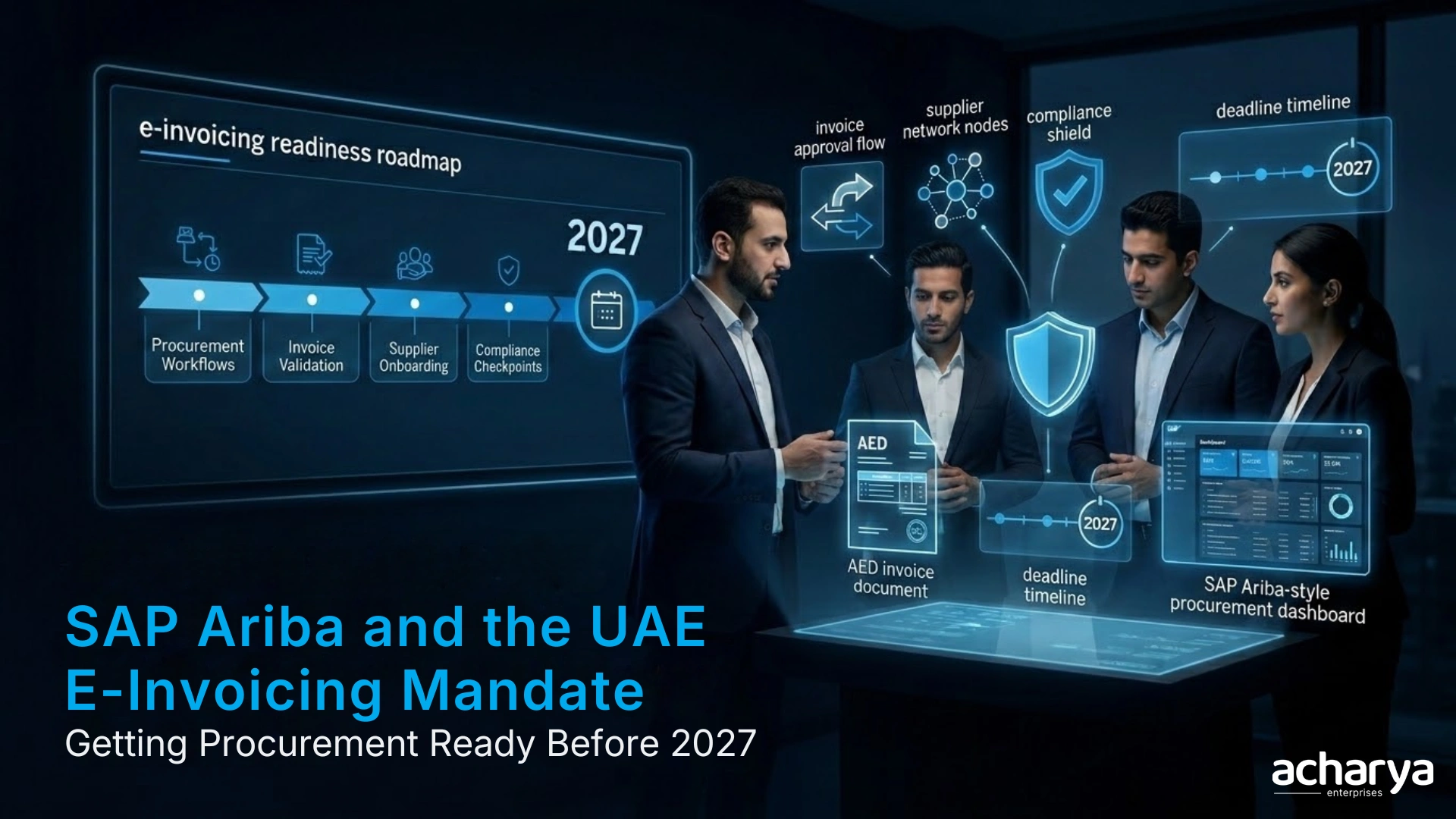
The UAE e-invoicing mandate SAP Ariba conversation is now a procurement readiness issue, not only a finance or tax project. UAE businesses need to prepare procurement, finance, supplier data, invoice workflows, and system integrations before phased implementation becomes mandatory in 2027.
For UAE groups running SAP across mainland entities, free zones, shared services, logistics hubs, retail networks, healthcare operations, or government procurement, invoice data quality will decide how smooth the change feels.
The UAE rollout includes pilot and voluntary adoption from July 2026, followed by phased mandatory implementation from 2027. If your procurement team is already reviewing system connectivity, SAP Ariba integration with S/4HANA is a useful starting point.
What Is the UAE E-Invoicing Mandate?
The UAE e-invoicing mandate requires in-scope businesses to issue, exchange, and report invoice data electronically through approved structures and service-provider workflows.
The Ministry of Finance guidelines define electronic invoices as structured digital invoices issued, transmitted, and received through the UAE Electronic Invoicing System.
This is not the same as sending a PDF invoice by email. It requires structured invoice data, supplier and buyer identifiers, system readiness, and exchange through Accredited Service Provider workflows.
For procurement leaders, the mandate changes how supplier invoices are received, validated, matched, approved, reported, and archived.
Why Does the UAE E-Invoicing Mandate Matter for Procurement Teams?
The UAE e-invoicing mandate matters because procurement controls the supplier, PO, catalog, and approval data that finance needs for compliant invoice processing.
Finance may own tax reporting, but procurement owns many upstream records that determine invoice accuracy.
If supplier names, TRNs, TINs, PO references, item codes, tax categories, and approval paths are inconsistent, invoices may fail validation or require manual correction.
For UAE multi-entity groups, the risk is higher because supplier records may differ across Dubai, Abu Dhabi, Sharjah, free-zone entities, and mainland operations.
Key insight: E-invoicing 2027 readiness starts before the invoice arrives.
How SAP Ariba Fits Into E-Invoicing Readiness
SAP Ariba fits into e-invoicing readiness by helping connect procurement, suppliers, purchase orders, invoices, approvals, and reporting into a more controlled procure-to-pay process.
SAP Ariba Buying and Invoicing supports procurement visibility, supplier collaboration, guided buying, invoice management, and compliance-focused procure-to-pay workflows.
For UAE procurement teams, this means SAP Ariba can help reduce the gap between what was ordered, what was received, what was invoiced, and what finance needs to report.
SAP e-invoicing readiness should not be treated as one technical connector. It should include supplier onboarding, PO discipline, invoice validation, approval workflows, exception handling, and audit trails.
What Should Procurement Teams Fix Before 2027?
Procurement teams should fix supplier master data, PO discipline, invoice workflows, approval rules, reporting gaps, and supplier readiness before 2027.
The biggest readiness checks are practical:
| Readiness area | What to check | Why it matters |
| Supplier master | TRN, TIN, address, entity mapping | Reduces invoice rejection |
| PO process | PO accuracy and matching rules | Improves validation |
| Invoice workflow | Approval and exception paths | Reduces delays |
| Integration | SAP Ariba, ERP, ASP connection | Supports compliant exchange |
| Reporting | Audit trail and finance visibility | Supports governance |
For UAE healthcare, government, manufacturing, logistics, retail, and FMCG teams, this checklist should be tested by entity and supplier category.
Step 1: Review Supplier Master Data in SAP Ariba
Supplier master data should be reviewed first because e-invoicing depends on accurate buyer, supplier, tax, and entity information.
UAE businesses should verify supplier legal names, TRNs, TINs, trade license details, addresses, banking data, and entity relationships.
This is especially important for multi-branch vendors, local service providers, free-zone suppliers, and group companies with intercompany transactions.
Supplier onboarding should also confirm whether each supplier can exchange structured invoices through the required model. This is where SAP Ariba supplier lifecycle management naturally supports compliant supplier qualification and ongoing data updates.
Step 2: Clean Up Purchase Order and Invoice Workflows
Purchase order and invoice workflows should be cleaned up so invoices can be validated against correct procurement records.
Procurement teams should review how often invoices arrive without POs, wrong PO references, duplicate supplier records, missing receipt confirmations, or unclear approval ownership.
These issues may be manageable manually today. Under FTA e-invoicing expectations, they can create delays, failed validation, and weak audit trails.
A stronger workflow should connect requisition, PO, goods receipt, invoice, exception handling, and approval in one controlled path.
Step 3: Align Procurement, Finance, Tax, and IT Teams
Procurement, finance, tax, and IT teams must align early because e-invoicing affects process ownership, system design, tax data, and reporting controls together.
Procurement should own supplier and PO discipline. Finance should own invoice processing, payment, and reporting.
Tax should define compliance interpretation, VAT treatment, and documentation requirements. IT should manage system integration, data mapping, access controls, and testing.
Without clear ownership, UAE e-invoicing projects can become late-stage technical fixes instead of controlled business readiness programs.
Step 4: Check Supplier Readiness for Structured E-Invoices
Supplier readiness should be checked because compliant invoice exchange depends on both the buyer and supplier being able to send and receive structured invoice data.
Procurement teams should segment suppliers into high-volume, high-value, critical, and occasional vendors.
High-volume suppliers should be tested first because they create the biggest operational impact if invoice exchange fails.
Useful checks include:
- Can the supplier issue structured invoices?
- Is the supplier’s tax and entity data correct?
- Does the supplier understand your PO requirements?
- Can the supplier handle corrections or credit notes?
- Is there an escalation path for failed invoice exchange?
Step 5: Connect SAP Ariba With Approved E-Invoicing Systems
SAP Ariba should be connected with approved e-invoicing systems through a design that supports invoice exchange, validation, reporting, and error handling.
The Ministry of Finance guidelines require businesses to work through Accredited Service Provider processes for electronic invoice exchange and reporting.
For SAP environments, this means procurement, ERP, finance, and ASP connectivity must be mapped before go-live.
Teams asking if SAP Ariba e-invoicing FTA compliant should avoid a simple yes-or-no assumption. Compliance depends on the final architecture, configured workflows, ASP connectivity, required invoice fields, testing, and live governance.
Step 6: Test Invoice Validation, Approval, and Reporting Flows
Invoice validation, approval, and reporting flows should be tested end to end before mandatory implementation begins.
Testing should cover supplier invoice receipt, data validation, PO matching, approval routing, exception handling, ASP confirmation messages, and tax data reporting.
Procurement should test realistic UAE scenarios, not only clean sample invoices.
Include invoices for mainland suppliers, free-zone entities, service contracts, goods receipts, credit notes, and high-volume recurring vendors.
Step 7: Build Audit Trails for Every Procurement Transaction
Audit trails should show who requested, approved, received, matched, corrected, and released every procurement transaction.
This matters for compliance, internal controls, and board-level governance.
SAP Ariba can support stronger audit readiness when procurement actions, supplier records, invoice approvals, and exceptions are traceable.
Acharya’s security and controls experience fits naturally here because SoD, access control, approval delegation, and exception handling need to be reviewed before workflows go live.
What Risks Do Companies Face If Procurement Is Not Ready?
Companies risk failed invoice exchange, payment delays, supplier disputes, weak audit evidence, manual rework, and possible compliance exposure if procurement is not ready.
The most common risks are operational, not theoretical.
A supplier may send an invoice with incorrect data. A PO may not match the invoice. An approval may sit with the wrong person. A finance team may lack the reporting evidence needed for audit review.
For UAE businesses operating on tight payment cycles, these issues can affect supplier trust and working capital.
How SAP Ariba Helps Reduce Manual Invoice Errors
SAP Ariba helps reduce manual invoice errors by supporting automated invoice processing, PO matching, supplier collaboration, and exception workflows.
Manual invoice handling often creates duplicate entries, missed PO references, incorrect supplier data, and delayed approvals.
SAP Ariba invoice workflows can help procurement and finance teams move from email-based correction to controlled exception handling.
That does not remove the need for governance. It makes errors easier to detect, route, and resolve before they become payment or compliance problems.
How E-Invoicing Improves Spend Visibility and Compliance
E-invoicing improves spend visibility and compliance by turning invoice activity into structured data that finance and procurement can track more consistently.
When invoice data is structured, procurement leaders can better see supplier spend, invoice exceptions, PO gaps, tax issues, and approval bottlenecks.
This supports stronger AED-denominated cost control across UAE business units and entities.
When invoice data feeds finance reporting, [Link: SAP Ariba spend visibility → /sap-ariba-spend-visibility-gaps-uae-finance] becomes important because visibility helps leaders connect spend leakage, supplier behavior, and compliance exceptions.
What Should UAE Procurement Leaders Prioritize First?
UAE procurement leaders should prioritize supplier data, PO discipline, ASP readiness, system integration, and end-to-end testing first.
Start with the suppliers and categories that create the highest invoice volume.
Then test the most common exception cases. Do not wait until every policy is perfect.
For large UAE groups, the first priority should be a phased readiness plan by entity, supplier type, spend category, and mandatory deadline.
Final Thoughts: Prepare Procurement Before the 2027 Deadline
Procurement should prepare before the 2027 deadline because e-invoicing readiness depends on clean upstream data and tested workflows.
The e-invoicing deadline for UAE businesses is close enough that waiting for finance or tax teams to lead alone is risky.
Procurement has to clean supplier records, enforce PO discipline, align approval workflows, and support invoice exchange testing.
Acharya’s Full Implementation + License + Support + Training package can support this type of readiness through assessment, license support, implementation, data migration, go-live, hypercare, and user training without turning the project into a hard-sell software exercise.
For UAE CIOs and IT Directors, the best next step is a procurement and invoice readiness assessment before 2027 planning becomes urgent.
Key Takeaways
UAE e-invoicing readiness is a procurement, finance, tax, and IT responsibility, not only a compliance task.
- UAE e-invoicing becomes mandatory in phases from 2027.
- Procurement owns supplier and PO data that affects invoice compliance.
- SAP Ariba can support controlled procure-to-pay and invoice workflows.
- Supplier readiness must be tested before go-live.
- ASP connectivity, reporting, and error handling need early planning.
- Clean supplier data reduces manual invoice errors and compliance risk.
- UAE groups should prioritize high-volume suppliers and entities first.