How SAP S/4HANA Helps Manufacturers Find Capacity Bottlenecks Before Production Starts
Capacity bottlenecks can stop UAE production plans before they reach the shop floor, especially when machines, labor, work centers, or materials are not available at the right time.
For manufacturers in Dubai, Abu Dhabi, Sharjah, Ras Al Khaimah, and UAE free zones, a bottleneck is not only an operations issue. It can create AED cost leakage through overtime, urgent procurement, late deliveries, idle resources, and missed customer commitments.
SAP S/4HANA helps manufacturers see capacity pressure earlier, compare planned workload with available capacity, and correct production plans before execution begins.
When teams need to test planning pressure before committing production resources, SAP S/4HANA pMRP simulations gives useful context for scenario-based planning.
How does SAP S/4HANA help manufacturers find capacity bottlenecks before production starts?
SAP S/4HANA helps manufacturers find capacity bottlenecks by comparing planned production workload with available machine, labor, and work-center capacity before production starts.
A capacity bottleneck happens when demand for a resource is higher than the available capacity.
That resource may be a machine, production line, work center, labor team, inspection station, packaging line, or critical operation.
SAP capacity planning helps planners see whether the production plan is realistic before it becomes a shop floor problem.
For UAE manufacturers, this matters because factories often manage urgent orders, export commitments, seasonal demand, and shared production lines at the same time.
What are capacity bottlenecks and why do they impact manufacturing operations?
Capacity bottlenecks are resource constraints that slow production, delay orders, increase operational cost, and reduce manufacturing reliability.
Manufacturing bottlenecks often appear when one machine, work center, or labor group cannot handle the planned load.
The rest of the factory may be ready, but one constrained area can delay the full production schedule.
Common causes include:
- Limited machine availability
- Labor or shift constraints
- Maintenance downtime
- Quality inspection delays
- Material staging delays
- Setup and changeover time
- Overloaded work centers
- Poor production sequencing
What causes production capacity issues? In most factories, the answer is not one single problem. It is usually a mix of demand pressure, inaccurate master data, limited visibility, and late planning decisions.
How do manufacturers identify capacity constraints without SAP S/4HANA?
Without SAP S/4HANA, manufacturers often identify capacity constraints through spreadsheets, manual calculations, supervisor updates, and delayed production reports.
This creates planning risk.
A planner may build a schedule from expected demand, but the shop floor may already know that a machine is down or a line is overloaded.
When capacity data is not connected, teams often rely on phone calls, shift meetings, Excel files, or production supervisors to validate the plan.
This can work for a small plant, but it becomes difficult for UAE multi-plant manufacturers managing several production lines, warehouses, suppliers, and customer delivery dates.
Manual planning also makes SAP production planning weaker because decisions are based on partial or outdated information.
How does SAP S/4HANA provide real-time capacity visibility?
SAP S/4HANA provides real-time capacity visibility by connecting work centers, production orders, planned workload, resource availability, and capacity evaluation data.
SAP Help describes capacity planning as a way to determine production capacity required to meet changing product demand.
It also confirms that capacity evaluation helps analyze capacity loads by planning horizon and area of responsibility.
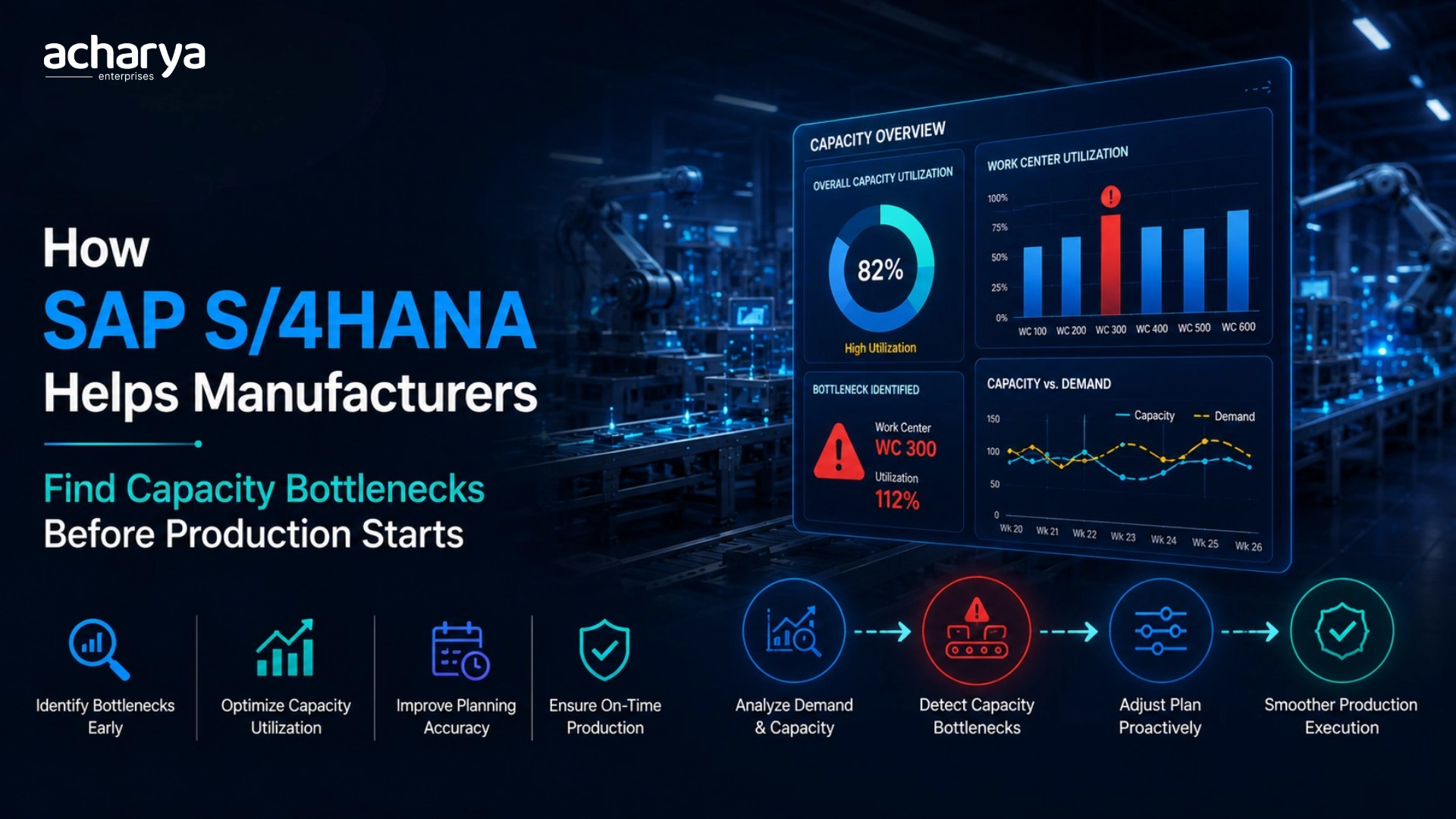
In practical terms, SAP S/4HANA production capacity analysis helps planners see where production load is building before execution starts.
A useful capacity view should show:
| Capacity signal | Why it matters |
| Work-center load | Shows overload risk |
| Available capacity | Shows realistic resource limits |
| Planned orders | Shows upcoming production pressure |
| Production orders | Shows committed factory work |
| Backlog risk | Shows where delays may build |
| Utilization | Shows underuse or overload |
For UAE factories, this helps connect production planning with operational reality.
How does SAP S/4HANA detect overloaded resources before production begins?
SAP S/4HANA detects overloaded resources by comparing planned workload with available capacity and highlighting where work centers or resources may exceed their limits.
An overloaded resource is a warning signal.
It means the current plan may not be executable without rescheduling, adding shifts, moving work, changing priorities, or adjusting customer promises.
How SAP identifies production bottlenecks depends on planning data such as work-center capacity, routing times, production requirements, planned orders, and production orders.
If this data is accurate, planners can see conflicts earlier and take corrective action before the bottleneck disrupts the shop floor.
This supports SAP capacity constraint management because capacity risk becomes visible before production starts, not after the order is already delayed.
How does SAP S/4HANA help planners optimize production schedules?
SAP S/4HANA helps planners optimize production schedules by showing resource conflicts, capacity loads, production order timing, and workload balance across work centers.
Production scheduling is where capacity planning turns into action.
If one work center is overloaded, planners may adjust sequence, split work, change production dates, use alternate resources, or review shift capacity.
This is where production scheduling issues caused by capacity constraints often become visible. production scheduling issues caused by capacity constraints
For UAE manufacturers, better scheduling can reduce overtime, emergency rework, missed delivery dates, and last-minute customer escalations.
The goal is not to create a perfect schedule once. The goal is to create a schedule that can respond when demand, capacity, or material conditions change.
How does SAP S/4HANA support what-if analysis for capacity planning?
SAP S/4HANA supports what-if analysis by helping planners compare demand, capacity, and production scenarios before finalizing a plan.
Can SAP predict production delays? SAP should not be treated as a magic prediction engine, but it can help planners identify risks based on current planning, capacity, and production data.
What-if analysis helps answer practical planning questions:
- What if demand increases next week?
- What if one line is unavailable?
- What if a critical work center is overloaded?
- What if production moves to another plant?
- What if an urgent order is added?
- What if capacity is extended with another shift?
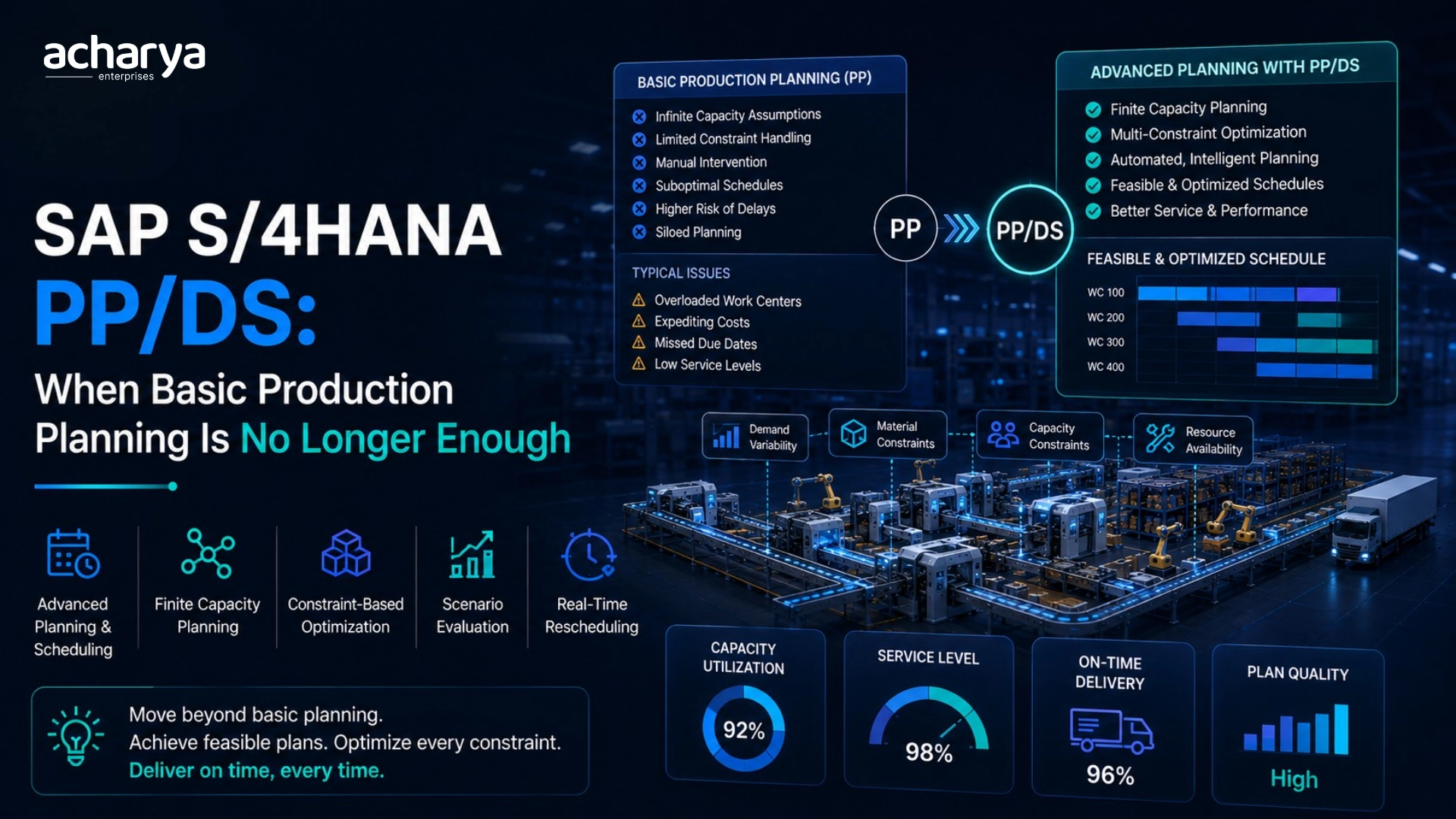
For more complex planning environments, advanced capacity planning with PP/DS connects naturally because advanced planning helps evaluate constrained capacity and detailed scheduling options.
This is useful for UAE manufacturers with multiple product families, shared work centers, export deadlines, and seasonal demand swings.
What benefits do manufacturers gain from proactive capacity planning with SAP S/4HANA?
Manufacturers gain fewer delays, better machine utilization, improved delivery performance, reduced downtime, lower overtime pressure, and more reliable production plans.
Proactive capacity planning helps teams act before a production plan fails.
For UAE CIOs, IT Directors, SAP Practice Leads, and SAP PMOs, the business case is not only operational speed. It is stronger planning reliability, better resource use, and lower firefighting cost.
Key benefits include:
- Fewer production delays
- Better machine utilization
- Improved delivery performance
- Reduced downtime and overtime
- More reliable production plans
- Faster response to changing demand
- Better coordination between planning and plant teams
- Stronger inventory and procurement alignment
How can manufacturers improve capacity planning? They should start by cleaning work-center data, validating routings, reviewing production order accuracy, training planners, and defining escalation rules for overloads.
Acharya’s Full Implementation + License + Support + Training package fits this need because capacity planning success depends on assessment, implementation, data migration, go-live, hypercare, user adoption, and strong security controls.
Key Takeaways
SAP S/4HANA helps UAE manufacturers find capacity bottlenecks earlier by connecting production plans, work centers, resource loads, and scheduling decisions.
- Capacity bottlenecks happen when planned workload exceeds available resources.
- Bottlenecks can delay production, increase cost, and weaken customer delivery.
- Manual capacity planning often depends on spreadsheets and delayed updates.
- SAP S/4HANA gives planners better visibility into work-center capacity and production load.
- Overloaded resources can be identified before production starts.
- What-if analysis helps planners compare demand and capacity scenarios.
- Proactive capacity planning can reduce delays, overtime, downtime, and firefighting.
- Clean master data and trained users are essential for reliable SAP resource planning.
Improve Your Manufacturing Capacity Planning with SAP S/4HANA
Get better visibility into resources, identify bottlenecks earlier, and build more reliable production plans with SAP S/4HANA.
If your UAE manufacturing team still discovers overloads after production starts, the next step is a SAP S/4HANA capacity planning readiness review.