S/4HANA Production Planning: A Complete Guide for UAE Manufacturers
UAE manufacturers are under pressure to deliver faster, reduce AED inventory waste, avoid production delays, and prepare for SAP ECC 2027 decisions. S/4HANA Production Planning helps manufacturing leaders connect demand, materials, capacity, scheduling, and shop floor activity in one planning process.
For factories in Dubai, Abu Dhabi, Sharjah, Ras Al Khaimah, and free-zone manufacturing hubs, planning accuracy is no longer only an operations issue. It affects finance, procurement, customer delivery, margin control, and audit readiness.
What is S/4HANA Production Planning for UAE manufacturers?
S/4HANA Production Planning helps UAE manufacturers plan, schedule, and control production processes using real-time data. It connects demand, materials, capacity, and shop floor activities to improve efficiency, reduce delays, and support smarter manufacturing decisions.
S/4HANA Production Planning gives manufacturers a structured way to convert demand into production plans, material requirements, work-center schedules, and production orders.
For UAE manufacturing companies, the value is practical. Teams can see what needs to be made, which materials are available, which machines are constrained, and whether production is on track.
This matters when a business manages multiple plants, warehouses, product lines, suppliers, and customer commitments across mainland and free-zone operations. Clean SAP S/4HANA production master data components are the foundation because planning output depends on accurate material masters, BOMs, routings, and work centers.
Why do UAE manufacturers need S/4HANA Production Planning?
UAE manufacturers need S/4HANA Production Planning because demand changes fast, material shortages disrupt production, and disconnected planning weakens delivery performance.
Many factories still manage planning through a mix of SAP, spreadsheets, email updates, and manual shop floor feedback.
This creates five common pressure points:
- Changing customer demand
- Production delays
- Material availability issues
- Limited planning visibility
- Need for operational efficiency
For UAE manufacturers serving construction, food and beverage, FMCG, packaging, industrial goods, automotive parts, and export markets, even small planning errors can create late deliveries or excess stock.
SAP production planning becomes valuable when the business needs one planning view across sales, procurement, production, inventory, and finance.
How does S/4HANA Production Planning work?
S/4HANA Production Planning works by connecting demand planning, material requirements planning, production scheduling, capacity planning, and shop floor execution.
The SAP S/4HANA production planning process explained simply starts with demand.
Customer orders, forecasts, or internal requirements create a need. The system checks material availability, calculates requirements, supports production scheduling, and helps teams release and monitor production orders.
A simplified flow looks like this:
| Planning area | What it does | Business impact |
| Demand planning | Captures expected need | Reduces guesswork |
| MRP | Calculates material needs | Prevents shortages |
| Scheduling | Plans production timing | Improves delivery |
| Capacity planning | Checks resources | Reduces bottlenecks |
| Shop floor execution | Tracks actual progress | Improves control |
This is why SAP ERP production planning modernization matters for manufacturers still using older processes or delayed reporting.
How does S/4HANA Production Planning improve demand planning?
S/4HANA Production Planning improves demand planning by helping manufacturers align production with expected customer, forecast, and internal requirements.
Demand planning is where production risk often begins.
If demand is overstated, the factory may produce too much and hold excess inventory. If demand is understated, production may run short and miss customer timelines.
For UAE manufacturers, demand can shift because of seasonal retail cycles, project-based construction demand, export orders, government supply contracts, and distributor commitments.
S/4HANA PP helps teams connect demand signals with production requirements, making it easier to choose between make-to-stock and make-to-order production strategies depending on product type, customer promise, and inventory risk.
How does S/4HANA Production Planning optimize material availability?
S/4HANA Production Planning optimizes material availability by checking inventory, demand, procurement timing, and production requirements before shortages affect the factory.
Material availability is one of the biggest reasons production plans fail.
SAP’s official documentation describes material requirements planning as a process used to procure or produce required quantities on time for internal and sales needs.
For UAE manufacturers, this helps answer urgent planning questions:
- Do we have enough raw material for tomorrow’s production?
- Which purchase orders are still open?
- Which materials are blocked or under quality check?
- Which component can stop the line?
- Which supplier lead time affects the schedule?
This is where SAP manufacturing planning gives procurement and production a shared view of material risk before a shortage becomes downtime.
How does S/4HANA Production Planning improve production scheduling?
S/4HANA Production Planning improves production scheduling by helping teams plan production orders around material availability, work-center capacity, and delivery requirements.
Production scheduling is where plans become factory action.
A schedule must consider machine availability, labor capacity, maintenance windows, material readiness, changeovers, and customer timelines.
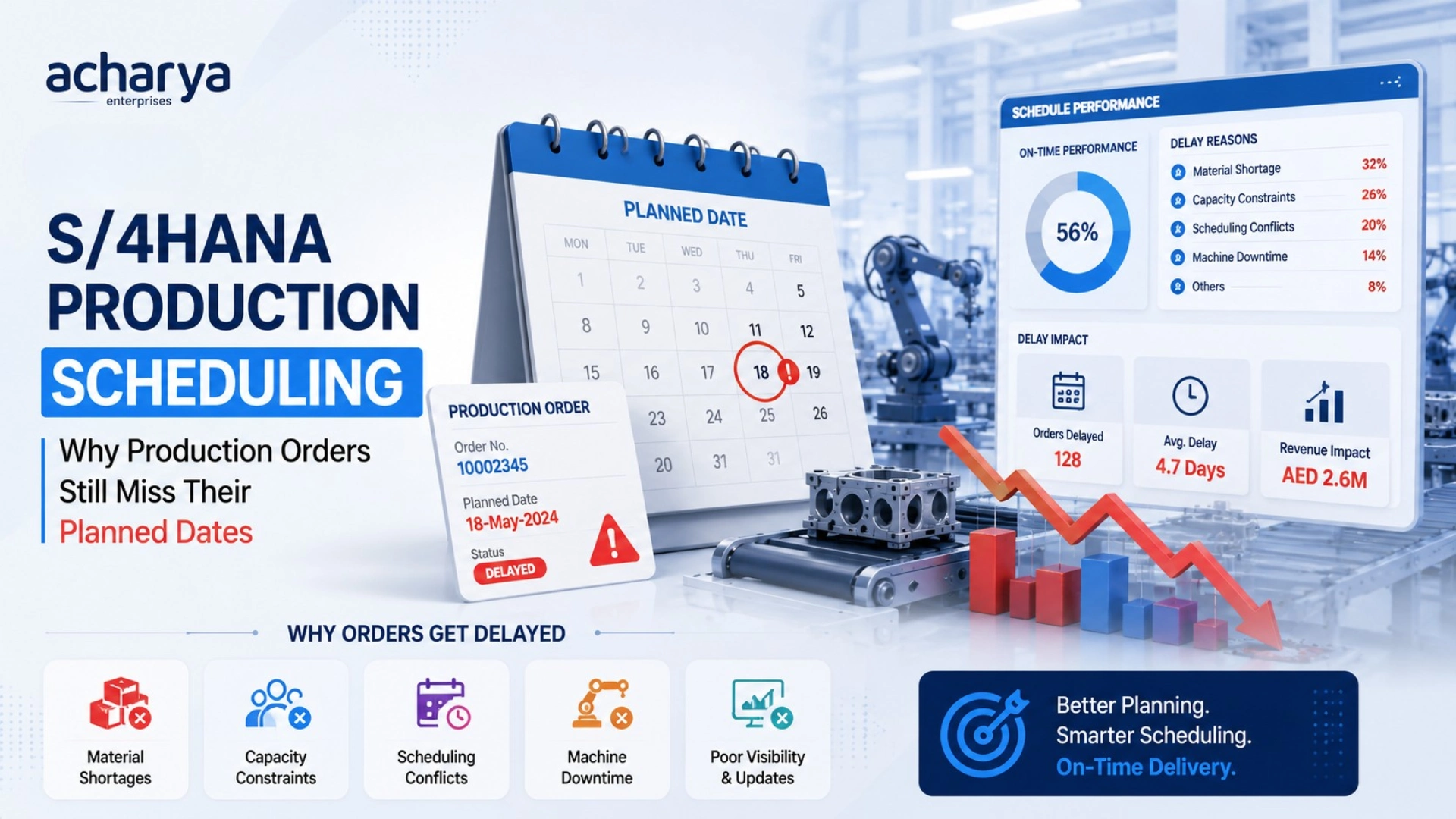
If scheduling is done manually, conflicts are often discovered too late. One machine may be overloaded while another is underused, or one urgent order may block several planned orders.
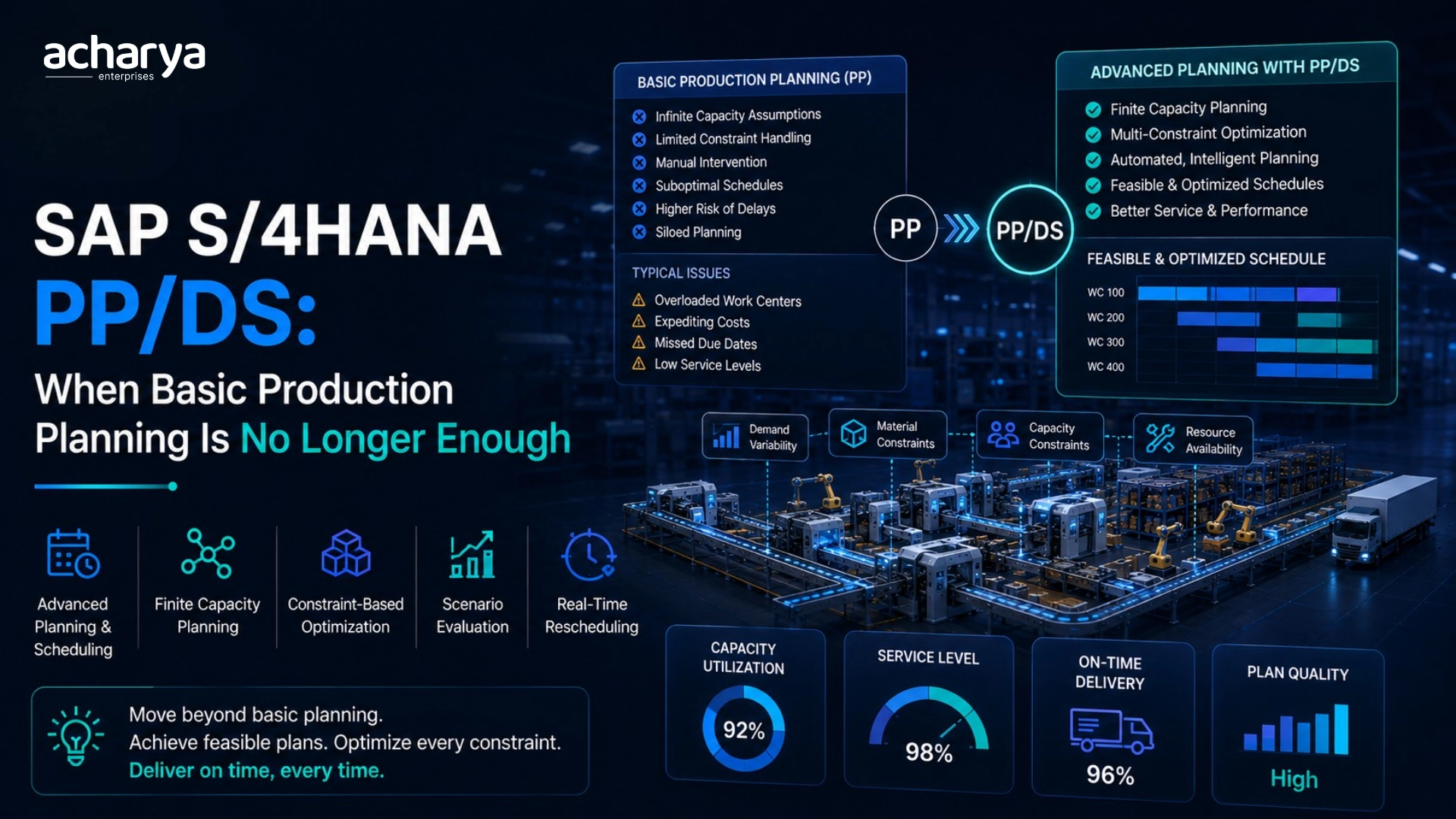
For advanced scheduling needs, advanced production planning and scheduling capabilities can support deeper planning conversations around constrained resources, sequencing, and detailed production plans.
How does S/4HANA Production Planning connect the shop floor with business planning?
S/4HANA Production Planning connects the shop floor with business planning by linking production orders, confirmations, material movements, capacity updates, and operational progress.
Shop floor data matters because plans lose value when actual production updates arrive late.
A machine breakdown, quality hold, material overuse, or delayed operation can change the production plan immediately. If planning teams do not see that update, procurement, inventory, sales, and finance may continue working from outdated assumptions.
For UAE multi-plant manufacturers, this connection improves collaboration between plant managers, production planners, procurement teams, warehouse users, and finance controllers.
It also supports better operational control because production status becomes visible before month-end reporting.
What are the key S/4HANA Production Planning features for manufacturers?
Key S/4HANA Production Planning features include MRP, production orders, capacity planning, demand management, production monitoring, and real-time analytics.
These SAP S/4HANA PP module features for manufacturers are useful because they connect planning decisions with execution data.
Core features include:
- Material Requirements Planning
- Production orders
- Capacity planning
- Demand management
- Production monitoring
- Real-time analytics
- Work-center planning
- BOM and routing usage
- Production confirmations
The SAP PP module is most useful when these features are configured around how the factory actually works, not copied from a generic template.
For example, a food manufacturer, packaging factory, automotive component supplier, and process manufacturer may all need different planning rules.
How does S/4HANA Production Planning reduce manufacturing costs?
S/4HANA Production Planning reduces manufacturing costs by lowering inventory waste, reducing delays, improving resource use, and cutting manual planning effort.
Manufacturing cost is affected by more than raw material price.
Poor planning can increase overtime, machine idle time, urgent procurement, excess stock, rework, missed delivery penalties, and manual coordination effort.
The cost impact usually appears in five areas:
| Cost area | How planning improves it |
| Inventory holding | Better material planning |
| Production delay | Earlier shortage detection |
| Resource utilization | Better work-center planning |
| Manual effort | Fewer spreadsheet checks |
| Delivery performance | Better schedule control |
SAP S/4HANA pMRP demand and capacity simulations can help leadership test planning options before committing capacity or procurement decisions. SAP S/4HANA pMRP demand and capacity simulations
What benefits do UAE manufacturers achieve with S/4HANA Production Planning?
UAE manufacturers can achieve better production visibility, faster planning cycles, reduced downtime, stronger inventory control, higher productivity, and improved on-time delivery.
The benefits of SAP S/4HANA PP depend on clean data, correct configuration, user adoption, and disciplined planning processes.
The strongest outcomes usually come when production, procurement, warehouse, finance, and shop floor teams work from the same planning truth.
For UAE CIOs, IT Directors, and SAP PMOs, the larger question is not only How SAP S/4HANA improves production planning. It is whether the business is ready to modernize planning data, user roles, approval flows, and master data governance.
Acharya’s Full Implementation + License + Support + Training package fits this need because a reliable SAP S/4HANA PP implementation guide should cover assessment, license planning, implementation, data migration, go-live, hypercare, and user training.
Key Takeaways
S/4HANA Production Planning gives UAE manufacturers a stronger way to connect demand, materials, capacity, production execution, and business control.
- S/4HANA Production Planning improves production visibility and planning accuracy.
- UAE manufacturers need it when demand, materials, and schedules change quickly.
- MRP helps ensure required materials are available on time.
- Production scheduling improves when machine, labor, and capacity constraints are visible.
- Shop floor integration helps planners respond faster to disruptions.
- Better planning can reduce excess inventory, delays, and manual coordination.
- Clean master data is essential before implementation.
- Acharya can support implementation, training, data migration, and post-go-live optimization.