SAP S/4HANA pMRP: How Manufacturers Test Demand and Capacity Scenarios Before Production
SAP S/4HANA pMRP helps UAE manufacturers test demand, capacity, material, and bottleneck scenarios before production plans are executed.
For factories in Dubai, Abu Dhabi, Sharjah, Ras Al Khaimah, and UAE free zones, planning errors can quickly turn into AED cost leakage, urgent procurement, missed delivery dates, overtime, or excess inventory.
The value of pMRP is simple: it helps planning teams ask “what if?” before they commit materials, capacity, machines, and people.
When the biggest risk is capacity pressure before execution, identify capacity bottlenecks before production gives useful context for UAE manufacturers reviewing planning control.
How does SAP S/4HANA pMRP help manufacturers test demand and capacity scenarios before production?
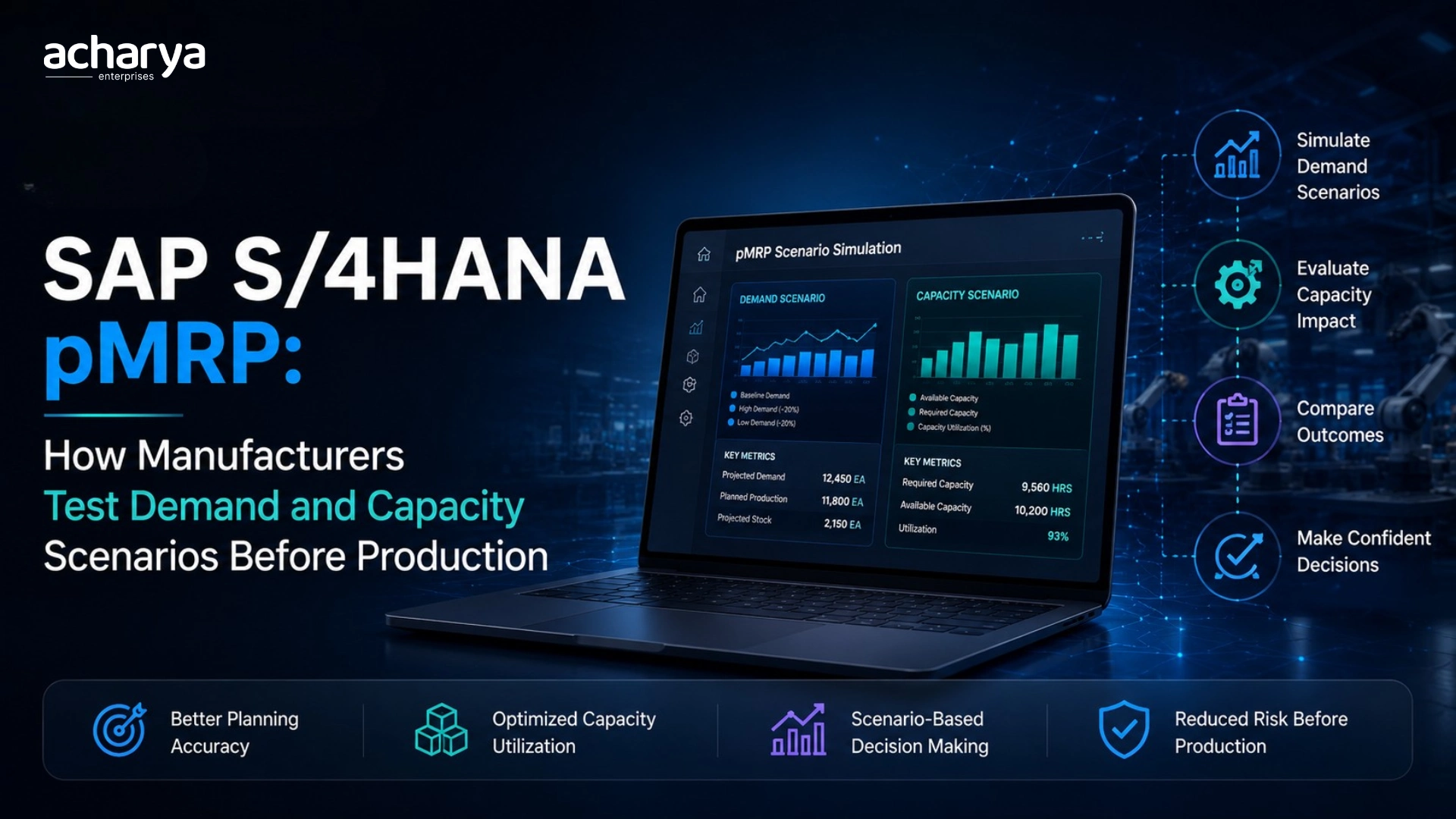
SAP S/4HANA pMRP allows manufacturers to simulate production scenarios before execution. It helps teams evaluate material requirements, capacity constraints, and potential bottlenecks to make better planning decisions.
SAP pMRP stands for predictive material and resource planning.
It helps production planners test possible planning situations before they affect the shop floor.
Instead of waiting for a full production plan to fail, teams can review demand changes, capacity limits, material shortages, and overloaded resources earlier.
For UAE manufacturers managing seasonal demand, export orders, customer-specific batches, and multi-plant operations, this creates better planning confidence.
Why do manufacturers need to simulate production scenarios before planning?
Manufacturers need simulation because demand, capacity, materials, and operational constraints often change before production begins.
A plan may look workable when it is created. Then a customer increases order quantity, a supplier shipment is delayed, a work center reaches capacity, or a production line becomes unavailable.
Without simulation, planners often discover these issues too late.
Common triggers include:
- Changing customer demand
- Limited production capacity
- Material availability risks
- Unexpected operational constraints
- Need for faster decisions
- Supplier delays
- Rush orders from key customers
- Seasonal production peaks
For UAE manufacturers, this matters because local, GCC, and export commitments can overlap across the same plants and warehouse network.
What is SAP S/4HANA pMRP and how does it work?
SAP S/4HANA pMRP is a predictive planning simulation capability that uses planning data to test alternative production, material, and resource scenarios before execution.
SAP S/4HANA pMRP explained simply means planners can create simulated planning scenarios without immediately changing the live production plan.
SAP Help describes pMRP as a way to identify capacity issues and evaluate possible solutions early using a simplified requirements plan.
How does SAP pMRP work? It uses reference data from material resource planning, then allows planners to test changes and review the impact.
This helps teams compare options before deciding whether to adjust demand plans, resource plans, preproduction, or make-or-buy decisions.
How does SAP S/4HANA pMRP help test demand scenarios?
SAP S/4HANA pMRP helps test demand scenarios by simulating demand increases, demand reductions, and changed production requirements before plans are finalized.
SAP demand planning becomes stronger when planners can test what happens if demand changes.
For example, a UAE FMCG manufacturer may need to test a Ramadan demand spike. A packaging company may need to check whether a new retail contract will overload production. An industrial manufacturer may need to evaluate a large export order before committing delivery.
pMRP helps planners compare demand options before production starts.
Useful demand checks include:
- What if demand increases by product family?
- What if a customer delays an order?
- What if forecast demand becomes confirmed demand?
- What if export demand conflicts with local supply?
- What if one plant cannot handle the full volume?
This supports better demand-driven production planning strategies. demand-driven production planning strategies
How does SAP S/4HANA pMRP evaluate capacity constraints?
SAP S/4HANA pMRP evaluates capacity constraints by checking whether planned demand can be supported by available resources, work centers, and production capacity.
SAP capacity planning is where many production problems become visible.
A demand plan may be accepted by sales, but the factory may not have enough machine time, labor availability, packaging capacity, or critical work-center capacity to execute it.
SAP Help confirms pMRP helps identify capacity issues early in the planning process.
For UAE manufacturers, this is useful when production capacity is shared across product lines, shifts, plants, or customer contracts.
A simple capacity review should ask:
| Capacity question | Why it matters |
| Which work center is overloaded? | Shows bottleneck risk |
| Which product consumes most capacity? | Supports prioritization |
| Which period is constrained? | Helps adjust timing |
| Which demand scenario is realistic? | Improves plan confidence |
| Which alternative resource can help? | Supports faster action |
How does SAP S/4HANA pMRP help manufacturers identify bottlenecks early?
SAP S/4HANA pMRP helps identify bottlenecks early by highlighting capacity limits, material shortages, and planning risks before production execution begins.
Bottlenecks are not always visible in a spreadsheet.
They may appear when multiple products need the same work center, when one material is short, when a supplier cannot meet the required date, or when a quality process slows release.
SAP S/4HANA capacity simulation helps planners test these risks before the shop floor is committed.
This is especially useful for UAE manufacturers managing fast-moving orders, limited production windows, or imported materials with long lead times.
Early bottleneck visibility allows planners to shift production, adjust capacity, change sourcing decisions, or revise customer promises before disruption becomes expensive.
How does SAP S/4HANA pMRP improve production planning decisions?
SAP S/4HANA pMRP improves production planning decisions by helping teams compare different scenarios before choosing a final production plan.
How SAP pMRP improves production planning comes down to better decision timing.
Instead of reacting after a production plan fails, planners can compare options while changes are still manageable.
The biggest improvement is cross-functional clarity.
Production sees capacity risk. Procurement sees material impact. Finance sees inventory and working capital exposure. Sales sees whether delivery commitments are realistic.
For UAE CIOs, IT Directors, and SAP PMOs, this makes planning less dependent on guesswork and more dependent on tested scenarios.
How is SAP S/4HANA pMRP different from traditional production planning?
SAP S/4HANA pMRP is different because it supports simulation before execution, while traditional planning often focuses on fixed planning runs and operational follow-up.
Traditional production planning often answers, “What does the current plan require?”
pMRP adds another question: “What happens if demand, capacity, or material conditions change?”
SAP MRP vs pMRP difference is important for manufacturers that face frequent planning changes.
SAP MRP helps calculate material requirements. SAP predictive MRP helps test future planning scenarios before planners decide which changes to make.
This does not replace disciplined planning. It gives planners another layer of decision support before operational execution begins.
What benefits can manufacturers achieve with SAP S/4HANA pMRP?
Manufacturers can achieve better capacity utilization, fewer production delays, improved material planning, faster response to demand changes, and more reliable production schedules.
SAP predictive MRP for manufacturing is most valuable when planning risk is high.
The benefits are strongest when manufacturers have clean master data, accurate demand inputs, reliable capacity data, and trained planners.
Key benefits include:
- Better capacity utilization
- Reduced production delays
- Improved material planning
- Faster response to demand changes
- More reliable production schedules
- Better collaboration between teams
- Earlier visibility into planning risk
- Stronger confidence before production commitment
For complex planning environments, advanced planning scenarios with SAP PP/DS can support deeper discussions around detailed scheduling and constrained planning.
Acharya’s Full Implementation + License + Support + Training package fits this need because pMRP success depends on assessment, license planning, implementation, clean data migration, go-live, hypercare, and user training.
Key Takeaways
SAP S/4HANA pMRP helps UAE manufacturers test demand, capacity, and production risks before committing resources to execution.
- SAP pMRP supports predictive material and resource planning.
- pMRP helps planners create scenarios before production execution.
- Demand simulations help manufacturers test increases, reductions, and changing customer requirements.
- Capacity simulations help identify overloaded work centers and resource limits.
- Bottleneck visibility helps reduce last-minute production disruptions.
- SAP MRP simulation before production improves planning confidence.
- pMRP supports better collaboration between production, procurement, finance, and sales.
- Clean master data, accurate demand inputs, and trained planners are essential.
Improve Production Planning with SAP S/4HANA pMRP
Test production scenarios, identify risks early, and make confident planning decisions with SAP S/4HANA predictive planning capabilities.
If your UAE manufacturing team still finds capacity problems, material shortages, or schedule conflicts too late, the next step is a SAP S/4HANA pMRP readiness review.